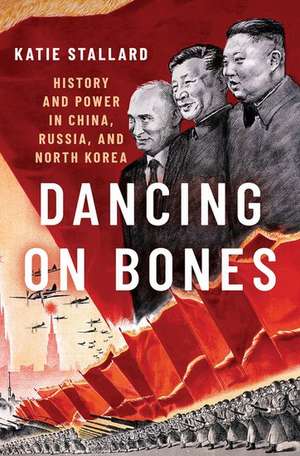
Dancing on Bones: History and Power in China, Russia and North Korea
Autor Katie Stallarden Limba Engleză Hardback – 29 sep 2022
Preț: 174.51 lei
Preț vechi: 229.55 lei
-24%
Puncte Express: 262
Carte disponibilă
Livrare economică 13-24 noiembrie
Livrare express 30 octombrie-05 noiembrie pentru 92.18 lei
Livrare prin curier în România Termenul estimat este afișat lângă disponibilitate.
Transport gratuit de la 400.00 lei Plată online sau ramburs, în funcție de opțiunile comenzii.
Retur gratuit în 14 zile Comandă securizată și suport în română.
Specificații
ISBN-13: 9780197575352
ISBN-10: 0197575358
Pagini: 304
Dimensiuni: 159 x 241 x 27 mm
Greutate: 0.54 kg
Editura: Oxford University Press
Colecția OUP USA
Locul publicării:New York, United States
ISBN-10: 0197575358
Pagini: 304
Dimensiuni: 159 x 241 x 27 mm
Greutate: 0.54 kg
Editura: Oxford University Press
Colecția OUP USA
Locul publicării:New York, United States
Recenzii
Dancing on Bones is a compelling testament to the power of history and myth in global politics. Fast-paced and insightful, Stallard's book skillfully unfolds the narratives that legitimize and drive the leaders of China, Russia, and North Korea. A must-read for anyone who wants to understand how America's competitors think.
When I first arrived in England some thirty years ago, I was surprised to find that the history of the People's Republic of China, as taught at Oxford, was quite different from what we were taught at school. This book helped me to better understand why and how authoritarian leaders want to control the history of their nations. Interweaving interviews and personal stories of those challenging the official narrative and fighting for the right to preserve individual memory, this book delivers a powerful antidote to the stereotypes and caricatures that so often dominate coverage of these countries. Deeply reported and drawing on extensive research, the result is a nuanced and compelling account that sheds light on these consequential global powers.
Through impeccable research and exhaustive reporting, Katie Stallard details how three modern-day autocrats have co-opted and corrupted-and often outright fabricated-history in their efforts to stay in power and try to gain the upper geopolitical hand. To understand how Putin, Xi, and Kim operate in the present, Stallard expertly shows how they are weaponizing the past. Essential reading.
A beguiling and disturbing journey into how a new generation of authoritarian leaders distort the past to dominate the present. A powerful mix of reportage and analysis.
An engaging account of how leaders in China, Russia and North Korea and remolded, re-tooled and retrofitted postwar history to turn it into an unforgiving bulwark of support for today's regimes. Its value lies not just in illuminating how this happened, but why it matters for the rest of the world, as the powerful and aggrieved nationalism constructed on this new historical foundation spills out into the rest of the world.
The book is based on the author's first-hand experience as a journalist in Russia, China and North Korea, combining journalistic curiosity and scholarship to produce an interesting and readable account that avoids complex theories and jargon. Stallard's book, while offering much to specialists, is also accessible to non-specialist readers who wish to understand the popular support for the leadership of Putin, Xi and Kim.
Dancing on Bones is a book about how three authoritarian states have shaped their respective historical narratives, but it also contains elements of reportage and time spent in Russia, China, and North Korea. This in-country experience lends Dancing on Bones a certain immediacy, a conversational fluency, that enlivens the text. Thus, while it operates along the same argumentative lines taken by other commercially successful or Timothy Snyder-esque texts written for the US market-chronicling authoritarian similarities or sinews of alignment, accusing the authoritarian states of harnessing academia and repressing civil society, and sounding the alarm of a rising colossus of misinformation in the East-Katie Stallard's book has unique aspects that make it worth reading.
In Dancing on Bones, Katie Stallard has produced a work of remarkable insight and relevance. Through meticulous analysis and evocative storytelling, she illuminates the ways in which history is co-opted to serve the interests of those in power. At once a study of authoritarian regimes and a broader meditation on the nature of historical memory, this book is essential reading for anyone seeking to understand the intersection of history, politics, and power in the modern world.
When I first arrived in England some thirty years ago, I was surprised to find that the history of the People's Republic of China, as taught at Oxford, was quite different from what we were taught at school. This book helped me to better understand why and how authoritarian leaders want to control the history of their nations. Interweaving interviews and personal stories of those challenging the official narrative and fighting for the right to preserve individual memory, this book delivers a powerful antidote to the stereotypes and caricatures that so often dominate coverage of these countries. Deeply reported and drawing on extensive research, the result is a nuanced and compelling account that sheds light on these consequential global powers.
Through impeccable research and exhaustive reporting, Katie Stallard details how three modern-day autocrats have co-opted and corrupted-and often outright fabricated-history in their efforts to stay in power and try to gain the upper geopolitical hand. To understand how Putin, Xi, and Kim operate in the present, Stallard expertly shows how they are weaponizing the past. Essential reading.
A beguiling and disturbing journey into how a new generation of authoritarian leaders distort the past to dominate the present. A powerful mix of reportage and analysis.
An engaging account of how leaders in China, Russia and North Korea and remolded, re-tooled and retrofitted postwar history to turn it into an unforgiving bulwark of support for today's regimes. Its value lies not just in illuminating how this happened, but why it matters for the rest of the world, as the powerful and aggrieved nationalism constructed on this new historical foundation spills out into the rest of the world.
The book is based on the author's first-hand experience as a journalist in Russia, China and North Korea, combining journalistic curiosity and scholarship to produce an interesting and readable account that avoids complex theories and jargon. Stallard's book, while offering much to specialists, is also accessible to non-specialist readers who wish to understand the popular support for the leadership of Putin, Xi and Kim.
Dancing on Bones is a book about how three authoritarian states have shaped their respective historical narratives, but it also contains elements of reportage and time spent in Russia, China, and North Korea. This in-country experience lends Dancing on Bones a certain immediacy, a conversational fluency, that enlivens the text. Thus, while it operates along the same argumentative lines taken by other commercially successful or Timothy Snyder-esque texts written for the US market-chronicling authoritarian similarities or sinews of alignment, accusing the authoritarian states of harnessing academia and repressing civil society, and sounding the alarm of a rising colossus of misinformation in the East-Katie Stallard's book has unique aspects that make it worth reading.
In Dancing on Bones, Katie Stallard has produced a work of remarkable insight and relevance. Through meticulous analysis and evocative storytelling, she illuminates the ways in which history is co-opted to serve the interests of those in power. At once a study of authoritarian regimes and a broader meditation on the nature of historical memory, this book is essential reading for anyone seeking to understand the intersection of history, politics, and power in the modern world.
Notă biografică
Katie Stallardis Senior Editor, China and Global Affairs, at the New Statesman magazine and a non-resident Global Fellow at the Wilson Center in Washington, DC. She was previously based in Russia and China as a foreign correspondent for Sky News, where she reported extensively from across both countries, as well as North Korea, South Korea, Myanmar, Japan, Georgia, and Ukraine, and covered conflicts and natural disasters around the world. She broadcast under sniper fire from ISIS-linked militants in the Philippines, from Crimea as Russian forces annexed the peninsula, and from the front lines of the subsequent war in eastern Ukraine. As well as the New Statesman and Sky News, her writing has been published in outlets including Foreign Policy,The National Interest,The Diplomat, and the East Asia Forum.
Cuprins
- Introduction
- Chapter 1: Myth
- Chapter 2: Victory
- Chapter 3: Enemies
- Chapter 4: Memory
- Chapter 5: Victims
- Chapter 6: Truth
- Chapter 7: Lies
- Chapter 8: Control
- Chapter 9: Heroes
- Chapter 10: Patriots
- Conclusion: Power
- Notes
- Bibliography