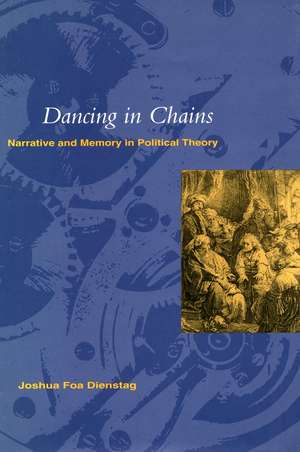
Dancing in Chains: Narrative and Memory in Political Theory
Autor Joshua Dienstagen Limba Engleză Paperback – apr 1997
Observăm în mediul academic o tendință de a separa riguros filosofia politică de domeniul literaturii sau al mitului, considerând-o o disciplină bazată strict pe rațiune abstractă. Volumul Dancing in Chains de Joshua Dienstag, publicat de Stanford University Press, contestă această premisă, demonstrând că aplicabilitatea practică a marilor teorii politice rezidă în capacitatea lor de a construi o narațiune în care publicul să se recunoască. Subliniem faptul că autorul nu tratează istoria ca pe un simplu adaos la teorie, ci ca pe nucleul central al naturii umane; scopul filosofiei politice nu este doar reforma morală, ci reconfigurarea memoriei colective.
Remarcăm structura analitică a cărții, care investighează modul în care Locke înlocuiește autoritatea patriarhală cu o istorie a consimțământului sau cum Hegel transformă epocile istorice în imagini estetice „înghețate”. Analiza culminează cu Nietzsche, a cărui viziune despre violență și mântuire este prezentată ca fiind esențială pentru o înțelegere robustă a libertății umane. Cititorii familiarizați cu Committing the Future to Memory de Sarah Clift vor aprecia modul în care Joshua Dienstag extinde dezbaterea despre temporalitate, trecând de la trauma istorică la o analiză aplicată a modului în care rescrierea trecutului este utilizată pentru a direcționa viitorul politic. Spre deosebire de Identity, Narrative and Politics de Maureen Whitebrook, care caută înțelegerea politică în romane, acest volum demonstrează că textele filosofice fundamentale sunt, în sine, construcții narative sofisticate care persuadează prin invitarea cititorului să locuiască într-un nou rol istoric.
Preț: 209.26 lei
Carte disponibilă
Livrare economică 02-16 noiembrie
Specificații
ISBN-10: 0804729247
Pagini: 284
Dimensiuni: 127 x 203 x 20 mm
Greutate: 0.41 kg
Ediția:1
Editura: Stanford University Press
Colecția Stanford University Press
V-ar putea interesa
-
 Armies Of GodDominic GreenPreț: 116.95 lei
 -
 UtopiaThomas More-20%Preț: 45.54 lei56.80 lei
 -
 -16%Preț: 230.14 lei272.56 lei
 -
 Arab Spring DreamsNasser WeddadyPreț: 111.50 lei
 -
 The Big ShortMichael LewisPreț: 94.01 lei
 -
 The Cuban Revolution in the 21st CenturyGeorge LambiePreț: 257.95 lei
 -
 Devolution in the United KingdomRussell Deacon-17%Preț: 175.70 lei211.47 lei
 -
 Zizek and Communist StrategyChris Mcmillan-25%Preț: 597.80 lei794.21 lei
 -
 National Disaster Housing Strategy & Implementation PlanHunter F Emond-27%Preț: 889.72 lei1211.13 lei
 -
 -26%Preț: 395.39 lei531.78 lei
 -
 Every Secret Thing: My Family, My CountryGillian Slovo-26%Preț: 69.25 lei93.66 lei
 -
 Valences of the DialecticFredric JamesonPreț: 230.97 lei
De ce să citești această carte
Această lucrare este esențială pentru studenții și cercetătorii în științe politice care doresc să înțeleagă mecanismele psihologice ale puterii dincolo de argumentele logice. Cititorul câștigă o perspectivă nouă asupra modului în care memoria și percepția timpului sunt utilizate ca instrumente politice. Este un volum care transformă lectura clasicilor filosofiei într-o explorare a modului în care identitatea noastră este modelată de poveștile despre trecut.
Descriere scurtă
The book maintains that philosophical texts frequently persuade through the creation of a role that they invite their audience to inhabit. Political theory is most powerful not when it erects timeless principles, but when it alters readers' understanding of their own past and future. By this the author means that a theorist's account of history or of time itself is in many instances the center of (and not merely an addendum to) an account of human nature and politics; political theory seeks not so much to reform our morals as to reshape our memories.
This book investigates the place of narrative in politics in two ways. It offers a hypothesis of a broad connection between political identity and narrative, and it analyzes three major figures in the history of political thought—Locke, Hegel, and Nietzsche—to demonstrate that their work is best understood through the hypothesis. The author argues that each of these philosophers rewrites the past in an attempt to direct the future.
For Locke, this involves replacing the patriarchal history of kingly authority with a more naturalistic past grounded in episodes of consent—an act that he believes will replace a tyrannical future with a free one. In contrast, Hegel's approach to the past is aesthetic, and each epoch of history is understood as a work of art. Despite the romantic overtones of this view, the frozenness of these images results, for Hegel, in a weakly imagined future. Nietzsche's narrative is at once the most open and the most gruesome, emphasizing the centrality of violence in human history but also holding out hope for a redemption of that history in a particular future. This redemptive approach to the past, the author argues, is superior to the alternatives in that it supports the strongest account of human freedom.