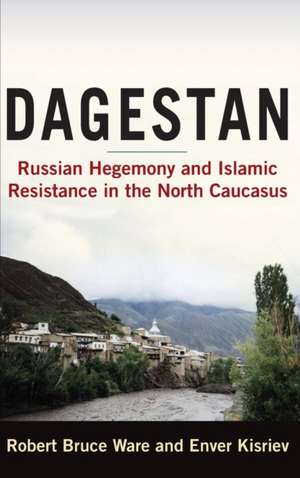
Dagestan: Russian Hegemony and Islamic Resistance in the North Caucasus
Autor Robert Ware, Enver Kisrieven Limba Engleză Hardback – 15 mar 2009
Preț: 1251.35 lei
Preț vechi: 1526.04 lei
-18%
Puncte Express: 1877
Carte tipărită la comandă
Livrare economică 18 noiembrie-02 decembrie
Livrare prin curier în România Termenul estimat este afișat lângă disponibilitate.
Transport gratuit pentru acest produs Plată online sau ramburs, în funcție de opțiunile comenzii.
Retur gratuit în 14 zile Comandă securizată și suport în română.
Specificații
ISBN-13: 9780765620286
ISBN-10: 0765620286
Pagini: 367
Dimensiuni: 152 x 229 x 20 mm
Greutate: 0.52 kg
Ediția:New.
Editura: Taylor & Francis
Colecția Routledge
Locul publicării:Oxford, United Kingdom
ISBN-10: 0765620286
Pagini: 367
Dimensiuni: 152 x 229 x 20 mm
Greutate: 0.52 kg
Ediția:New.
Editura: Taylor & Francis
Colecția Routledge
Locul publicării:Oxford, United Kingdom
V-ar putea interesa
-
 Religion and the Global Politics of Human RightsThomas Banchoff-13%Preț: 303.90 lei347.54 lei
 -
 -31%Preț: 872.53 lei1264.86 lei
 -
 -19%Preț: 341.37 lei419.56 lei
 -
 -21%Preț: 366.98 lei465.47 lei
 -
 -31%Preț: 578.25 lei836.62 lei
 -
 -16%Preț: 193.18 lei231.34 lei
 -
 -12%Preț: 306.44 lei348.87 lei
 -
 Peaceful Islamist Mobilization in the Muslim WorldKenneth A LoparoPreț: 376.13 lei
 -
 After SecularismE. Wilson-15%Preț: 661.58 lei778.33 lei
 -
 Religion and International Relations TheoryJack SnyderPreț: 265.11 lei
 -
 The Enlightenment: A Sourcebook and ReaderOlga GomezPreț: 451.24 lei
 -
 Preț: 474.19 lei
 -
 The Balkan Wars 1912-1913: Prelude to the First World WarRichard C. HallPreț: 407.04 lei
 -
 The Occult Philosophy in the Elizabethan AgeFrances YatesPreț: 155.44 lei
 -
 Preț: 369.93 lei
 -
 Russia and the USSR, 1855–1991: Autocracy and DictatorshipStephen J. LeePreț: 370.97 lei
 -
 From Jeremiad to JihadJohn D. CarlsonPreț: 278.68 lei
 -
 The Contemporary Arab Reader on Political IslamIbrahim M. Abu-Rabi'Preț: 262.79 lei
 -
 Hitler, Mussolini and the VaticanEmma FattoriniPreț: 117.29 lei
 -
 Can America Survive? Updated EditionJohn HageePreț: 125.22 lei
 -
 The World Turned Upside DownMelanie PhillipsPreț: 120.82 lei
Cuprins
Chapter 1 Introduction; Chapter 2 Murids and Tsars; Chapter 3 Soviet Rule in the North Caucasus; Chapter 4 Democratic Dagestan; Chapter 5 The Islamic Factor; Chapter 6 Conflict and Catharsis; Chapter 7 Russian Recentralization and Islamic Resistance; Chapter 8 Conclusion;
Notă biografică
Robert Bruce Ware Since completing his doctorate at Oxford University, Robert Bruce Ware has conducted field research in the North Caucasus, and has authored numerous articles on the region in scholarly and popular publications. He is a professor of philosophy at Southern Illinois University, Edwardsville., Enver Kisriev Enver Kisriev, a Dagestani sociologist, is studying the impact made by traditional institutions of Caucasian communities on the nature of modern political processes. With roots in the Lezgin town of Akhty, he was born in 1947 in Makhachkala, where he graduated from the Dagestan State University majoring in history. In 1972–75 he was a postgraduate in sociology at the Russian Academy of Sciences. After graduation he continued his research work in the Department of Sociology of the Dagestan branch of the Russian Academy of Sciences. In 1979 he defended his thesis titled “National and International in Ethnic and Cultural Processes in Dagestan.” In 1988 he became director of the department. In 1994–98, he was an adviser to the chairperson of the Dagestani Parliament while simultaneously continuing his research at the Dagestani Academy of Sciences. In 2001, he moved to Moscow to work at the Moscow branch of the Russian Academy of Sciences and in 2003 he became head of the Sector for Caucasian Studies at the Center for Civilizational and Regional Studies of the Russian Academy of Sciences. He is the author of more than 200 publications.
Descriere
Like other majority Muslim regions of the former Soviet Union, the republic of Dagestan, on Russia's southern frontier, has become contested territory in a hegemonic competition between Moscow and resurgent Islam. This book presents a path breaking study of this volatile state far from the world's gaze.