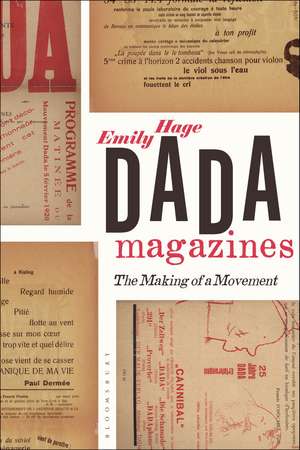
Dada Magazines: The Making of a Movement
Autor Dr. Emily Hageen Limba Engleză Paperback – dec 2022
Ne-a atras atenția modul în care Dada Magazines reușește să recupereze spiritul anarhic al avangardei prin explorarea colecției de periodice care au definit mișcarea. Observăm o abordare ce depășește simpla analiză estetică, punând accent pe revistă ca obiect material, ca „readymade” și ca spațiu de expoziție alternativ. Suntem de părere că autoarea Dr. Emily Hage oferă o perspectivă inedită asupra rețelelor transnaționale Dada, incluzând în discursul academic orașe mai puțin explorate în acest context, precum București sau Zagreb.
Experiența de lectură este una vizuală și tactilă, susținută de cele 68 de ilustrații care redau explozia grafică a publicațiilor originale. Structura cărții este riguros organizată cronologic, de la primele denunțuri spirituale din 1916, până la capitolul final care trasează punți către fenomenul „Dadazines” din America anilor '70. Complementar volumului Dadaism de Dietmar Elger, care oferă o privire de ansamblu asupra stilului și filosofiei anti-sistem, lucrarea de față se diferențiază prin focalizarea strictă pe mediul tipărit ca motor principal al propagării ideilor Dada. Dacă Dada and Beyond, Volume 1 explorează formele creative diverse ale mișcării, Dada Magazines izolează periodicul ca agent activ al schimbării artistice, demonstrând cum paginile de revistă au devenit primele galerii de artă portabile ale modernismului. Publicat sub egida Bloomsbury Visual Arts, acest titlu reprezintă o resursă academică esențială pentru înțelegerea modului în care designul grafic și literatura s-au contopit în contextul Primului Război Mondial.
Preț: 184.73 lei
Preț vechi: 242.96 lei
-24%
Carte disponibilă
Livrare economică 29 octombrie-12 noiembrie
Livrare express 14-20 octombrie pentru 97.70 lei
Specificații
ISBN-10: 1350213837
Pagini: 224
Ilustrații: 10 colour and 58 bw illus
Dimensiuni: 156 x 234 x 16 mm
Greutate: 0.6 kg
Editura: Bloomsbury Publishing
Colecția Bloomsbury Visual Arts
Locul publicării:London, United Kingdom
V-ar putea interesa
-
 100 Artists' ManifestosAlex Danchev-18%Preț: 77.28 lei94.45 lei
 -
 -28%Preț: 568.96 lei787.56 lei
 -
 DadaHans Richter-13%Preț: 85.16 lei98.24 lei
 -
 Seven Dada Manifestos and LampisteriesTristan TzaraPreț: 63.50 lei
 -
 Dazed: 30 Years ConfusedKatie Grand-19%Preț: 544.08 lei671.71 lei
 -
 Dreamworld: Surrealism at 100Matthew AffronPreț: 349.35 lei
 -
 Preț: 384.83 leiRecomandat
 -
 Man Ray: When Objects DreamStephanie D'AlessandroPreț: 431.37 lei
 -
 Copy Machine ManifestosBranden W. JosephPreț: 331.36 lei
 -
 The Century Of Artists' BooksJohanna DruckerPreț: 176.85 lei
 -
 -28%Preț: 91.49 lei126.72 lei
 -
 Maintenant 17: A Journal of Contemporary Dada Writing and ArtPeter CarlaftesPreț: 139.42 lei
 -
 Maintenant 18: A Journal of Contemporary Dada Writing and ArtPeter CarlaftesPreț: 168.95 lei
 -
 Maintenant 19: A Journal of Contemporary Dada Writing and ArtPeter CarlaftesPreț: 170.78 lei
 -
 Network Paris: Abstraction-Création 1931–1937Astrid von Asten-21%Preț: 202.66 lei256.17 lei
 -
 DadaismDietmar ElgerPreț: 113.96 lei
 -
 Preț: 427.97 lei
 -
 Street ArtMagda DanyszPreț: 162.26 lei
 -
 Surrealism through its journalsFranca Franchi-19%Preț: 182.06 lei225.79 lei
 -
 Print MattersMaria Antonella Pelizzari-8%Preț: 441.79 lei480.21 lei
De ce să citești această carte
Această carte se adresează cercetătorilor și pasionaților de istoria artei care doresc să înțeleagă mecanismele din spatele avangardei. Cititorul câștigă o perspectivă documentată asupra modului în care revistele au funcționat ca rețele sociale timpurii, facilitând schimbul de idei între artiști precum Tristan Tzara sau Marcel Duchamp. Este un motiv concret de a explora cum un obiect efemer poate schimba cursul istoriei culturale.
Descriere
Including magazines from the well-known Dada cities of New York and Paris, as well as the lesser-known cities of Zagreb and Bucharest, the book reveals that Dada continued to inspire art journals well into the 1920s. Anchored in close material analysis within a historical and theoretical framework, Dada Magazines models a novel, multifaceted methodology for assessing many kinds of periodicals. The book traces how the Dadaists-Marcel Duchamp, Tristan Tzara, Dragan Aleksic, Hannah Höch, and many others-compiled, printed, distributed, and exchanged these publications. At the same time, it recognizes the journals as active agents that engendered the Dada network, and its thematic, chronological structure captures the constant exchanges that took place in this network. With in-depth scrutiny of these magazines-and 1970s "Dadazines" inspired by them-Dada Magazines is a vital source in the histories of art and design, periodical studies, and modernist studies.
Cuprins
List of Figures
Acknowledgements
Introduction
1. An Extraordinary Opportunity to be Denounced as a Wit: How Magazines Launched 'Dada,' 1916-1917
2. 'Every page must explode': Dada Magazines as Exhibition Venues, 1918-1919
3. Printing Artworks, Exhibiting Ephemera: Dada Journals and Exhibitions, 1920-1921
4. 'Be on your guard, Madam': New York Dada and the Magazine as Readymade, 1921
5. Contingency and Continuity: Dada Magazines and the Expanding Network, 1922-1926
Epilogue: Magazines to Zines: Echoes of Dada in 1970s America
Bibliography
Index
Recenzii
Magazines were the lifeblood of Dada, a movement that still resists neat pigeonholing in the history of the avant-gardes. Emily Hage's Dada Magazines brings a fresh eye to these publications and presents new arguments and evidence for their importance, not just as the print conduits for the manifestos, art, poems, polemics, gossip, and diverse writings of the small, widely separated groups of activists who produced them, under a non-name that spread like a virus, but as active in their own right-creating networks and influencing Dada exhibitions, for example. Hage expertly lays out the ways the juxtapositions, collages, jokes, and confrontations in the magazines influenced radical methods of display in Dada exhibitions and installations. Hage's lucid presentation, focusing on the material production, presence, and impact of the magazines, is especially valuable for the breadth of her research, bringing out the later strands of Dada in unexpected places like Zagreb and Bucharest. This excellent study of the magazines is a timely reminder of the way Dada has remained a cultural, artistic, political, and even moral irritant, whose tactics have been repeated in so many contexts over the last century: from appropriation to performance, parody to the readymade, and are still not quite laid to rest in history, as Hage's fascinating epilogue, looking at the 'Dadazines' of the sixties and seventies, explains.
If we thought that we knew everything there was to know about Dada periodicals, Emily Hage's Dada Magazines sets us right. This engaging and elegantly crafted study provides fresh approaches to the 'active agents' of Dada's formation and spread.
The international dissemination of its creative energy, its anarchic humor and its response to the contradictions of modernity made Dada possibly the most vital of the early twentieth-century avant-gardes. Emily Hage's lively, meticulously researched volume tackles the issue of Dada's geographical expansion head-on, offering the most complete study of Dada magazines, in all their inventiveness and diversity, currently available to scholars.