
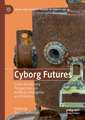
Cyborg Futures: Social and Cultural Studies of Robots and AI
Editat de Teresa Heffernanen Limba Engleză Hardback – 6 dec 2019



Preț: 920.78 lei
Preț vechi: 1122.90 lei
-18%
Puncte Express: 1381
Carte tipărită la comandă
Livrare economică 04-18 decembrie
Livrare prin curier în România Termenul estimat este afișat lângă disponibilitate.
Transport gratuit pentru acest produs Plată online sau ramburs, în funcție de opțiunile comenzii.
Retur gratuit în 14 zile Comandă securizată și suport în română.
Specificații
ISBN-13: 9783030218355
ISBN-10: 303021835X
Pagini: 208
Ilustrații: XVII, 187 p. 11 illus. in color.
Dimensiuni: 153 x 216 x 16 mm
Greutate: 0.35 kg
Ediția:1st ed. 2019
Editura: Springer
Colecția Social and Cultural Studies of Robots and AI
Seria Social and Cultural Studies of Robots and AI
Locul publicării:Cham, Switzerland
ISBN-10: 303021835X
Pagini: 208
Ilustrații: XVII, 187 p. 11 illus. in color.
Dimensiuni: 153 x 216 x 16 mm
Greutate: 0.35 kg
Ediția:1st ed. 2019
Editura: Springer
Colecția Social and Cultural Studies of Robots and AI
Seria Social and Cultural Studies of Robots and AI
Locul publicării:Cham, Switzerland
V-ar putea interesa
-
 Religion and Family LinksDonald SwensonPreț: 384.69 lei
 -
 Contemporary Sociological TheoryDoyle Paul Johnson-15%Preț: 630.39 lei741.64 lei
 -
 Racism in the 21st CenturyRonald E. Hall-20%Preț: 647.55 lei809.43 lei
 -
 TWO EGGS AND A LEMONJoanna MacLeanPreț: 84.62 lei
 -
 Diary of a Rad HousewifeShannon DruryPreț: 71.91 lei
 -
 Handbook of European SocietiesStefan Immerfall-18%Preț: 1217.73 lei1485.04 lei
 -
 Post-Apocalyptic CultureTeresa HeffernanPreț: 324.22 lei
 -
 Veiled FiguresTeresa HeffernanPreț: 374.58 lei
 -
 Gangs and Adolescent SubculturesLa Tanya Skiffer-23%Preț: 1085.77 lei1410.09 lei
 -
 Haying With HorsesLynn R MillerPreț: 307.01 lei
 -
 Audio System for Technical ReadingsT. V. RamanPreț: 366.02 lei
 -
 Globalization and UnemploymentHelmut M. Wagner-15%Preț: 672.55 lei791.23 lei
 -
 -8%Preț: 581.38 lei631.93 lei
 -
 Uprooting and After...Charles ZwingmannPreț: 381.05 lei
 -
 Growing up in the KibbutzAlbert Í. Rábí¿Preț: 370.57 lei
 -
 Preț: 81.11 lei
 -
 Preț: 231.09 lei
 -
 Preț: 80.64 lei
 -
 Preț: 87.65 lei
 -
 Preț: 87.65 lei
 -
 Preț: 80.64 lei
 -
 Preț: 421.64 lei
 -
 Der Islam in EuropaGordon Wagner-19%Preț: 386.02 lei476.58 lei
 -
 Preț: 157.98 lei
 -
 La voluntad de serAntonio Pacheco FuentesPreț: 136.82 lei
 -
 eReaders ed eBooks nelle universitàNicola CavalliPreț: 200.38 lei
Cuprins
Chapter 1: Introduction.- Chapter 2: Evolution Ain't Engineering: Animals, Robots, and the Messy Struggle for Existence.- Chapter 3: Demystifying the Intelligent Machine.- Chapter 4: Autonomy of Artificial Intelligence, Ecology and Existential Risk: A Critique.- Chapter 5: Visions of Swarming Robots: Artificial Intelligence and Stupidity in the Military-Industrial Projection of the Future of Warfare.- Chapter 6: The Business of Ethics, Robotics and Artificial Intelligence.- Chapter 7: Fiction Meets Science: Ex Machina, Artificial Intelligence and the Robotics Industry.- Chapter 8: Rossum's Mimesis.- Chapter 9: Race and Robotics.
Notă biografică
Teresa Heffernan is Professor of English at Saint Mary's University, Halifax, NS. Her current research is on the science and fiction of robotics and AI. Her previous books include Veiled Figures: Women, Modernity, and the Spectres of Orientalism (2016) and Post-Apocalyptic Culture: Modernism, Postmodernism, and the Twentieth-Century Novel (2008).
Textul de pe ultima copertă
This volume brings together academics from evolutionary biology, literary theory, robotics, digital culture, anthropology, sociology, and environmental studies to consider the impact of robotics and AI on society. By bringing these perspectives together in one book, readers gain a sense of the complex scientific, social, and ideological contexts within which AI and robotics research is unfolding, as well as the illusory suppositions and distorted claims being mobilized by the industry in the name of bettering humanity’s future. Discussions about AI and robotics have been shaped by computer science and engineering, steered by corporate and military interests, forged by transhumanist philosophy and libertarian politics, animated by fiction, and hyped by the media. From fiction passing as science to the illusion of AI autonomy to the business of ethics to the automation of war, this collection recognizes the inevitable entanglement of humanity and technology, while exposing the problematic assumptions and myths driving the field in order to better assess its risks and potential.
Caracteristici
Utilizes perspectives from a variety of disciplines to provide an analysis of AI and robotics Considers the broad social impact of these technologies Critiques some of the myths driving the field of robotics and AI