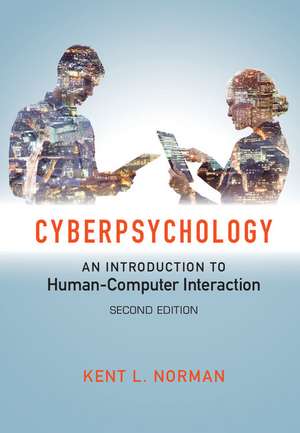
Cyberpsychology
Autor Kent Normanen Limba Engleză Hardback – 10 mai 2018
Preț: 695.88 lei
Preț vechi: 903.74 lei
-23%
Puncte Express: 1044
Carte tipărită la comandă
Livrare economică 03-17 decembrie
Livrare prin curier în România Termenul estimat este afișat lângă disponibilitate.
Transport gratuit pentru acest produs Plată online sau ramburs, în funcție de opțiunile comenzii.
Retur gratuit în 14 zile Comandă securizată și suport în română.
Specificații
ISBN-13: 9781107102545
ISBN-10: 1107102545
Pagini: 558
Ilustrații: 161 b/w illus. 50 tables 83 exercises
Dimensiuni: 183 x 260 x 34 mm
Greutate: 1.23 kg
Ediția:2Revizuită
Editura: Cambridge University Press
Locul publicării:New York, United States
ISBN-10: 1107102545
Pagini: 558
Ilustrații: 161 b/w illus. 50 tables 83 exercises
Dimensiuni: 183 x 260 x 34 mm
Greutate: 1.23 kg
Ediția:2Revizuită
Editura: Cambridge University Press
Locul publicării:New York, United States
V-ar putea interesa
-
 Dream & Underwor PBJames HillmanPreț: 88.29 lei
 -
 A Blue FireJames HillmanPreț: 116.34 lei
 -
 Depression And How To Survive ItAnthony ClarePreț: 114.39 lei
 -
 Self-Hypnosis For DummiesMike BryantPreț: 135.78 lei
 -
 Social EntrepreneurshipRyszard PraszkierPreț: 316.59 lei
 -
 Taking CareNeil D. WeinsteinPreț: 344.99 lei
 -
 Language from the BodySarah F. TaubPreț: 301.49 lei
 -
 PicoeconomicsGeorge AinsliePreț: 383.54 lei
 -
 Grounding CognitionDiane PecherPreț: 466.81 lei
 -
 Shyness and EmbarrassmentW. Ray CrozierPreț: 369.76 lei
 -
 Life And How To Survive ItRobin Skynner-35%Preț: 91.00 lei140.19 lei
 -
 Scripts People LiveClaude SteinerPreț: 117.03 lei
 -
 Gender and Culture in PsychologyEva MagnussonPreț: 254.88 lei
Cuprins
Part I. Fundamentals: 1. Introduction: importance, implications, and historical perspectives; 2. Fundamentals: biological and technological bases; 3. Theoretical approaches: models and metaphors; 4. Research: modes and methods; Part II. Systems: 5. Sensory-motor interfaces: input and output; 6. Virtual environments; 7. Learning and memory, transfer and interference; 8. Thinking and problem solving; 9. Language and programming; Part III. Relationships: 10. Individual differences: people, performance, and personality; 11. Motivation, emotion, and affective computing; 12. Social media and interpersonal relations; 13. Cyberpathologies and cybertherapies; Part IV. Applications: 14. Automation and artificial intelligence; 15. Assistive technologies; 16. Video games and entertainment; 17. Technology and education; 18. Cybersecurity; 19. The future: the ultimate human-computer interface.
Descriere
This accessible textbook gives students in psychology and computer science a comprehensive understanding of the human-computer interface.