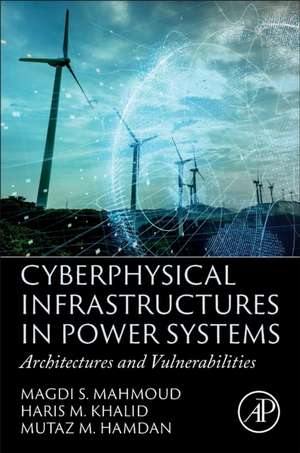
Cyberphysical Infrastructures in Power Systems: Architectures and Vulnerabilities
Autor Magdi S. Mahmoud, Haris M. Khalid, Mutaz M. Hamdanen Limba Engleză Paperback – 28 oct 2021
Ne-a atras atenția în mod deosebit capitolul dedicat controlului prin declanșare la eveniment (event-triggering), un exercițiu de optimizare a resurselor de comunicație care demonstrează aplicabilitatea practică a acestui volum. Cyberphysical Infrastructures in Power Systems abordează o problemă critică a ingineriei energetice moderne: insuficiența modelelor fizice simplificate în fața incertitudinilor și nelinearităților sistemelor de mare scară. Notăm cu interes tranziția pe care autorii o propun de la computațiile tradiționale către algoritmi adaptivi și de deep-learning, esențiali pentru schemele de control contemporane.
Putem afirma că lucrarea reprezintă o evoluție firească în opera lui Magdi S. Mahmoud. Dacă în Advanced Distributed Consensus for Multiagent Systems sau Multiagent Systems accentul era pus pe coordonarea entităților autonome, în volumul de față autorul aplică aceste principii de consens și control distribuit strict asupra infrastructurilor critice de energie. Structura cărții urmărește o progresie logică, pornind de la fundamentele CPS în Partea I, trecând prin metode de detecție a defectelor în Partea a II-a și culminând cu viziuni asupra arhitecturilor viitoare ale rețelelor smart în Partea a III-a.
Complementar volumului Power Systems Cybersecurity, care se concentrează masiv pe scheme de protecție împotriva atacurilor, lucrarea de față acoperă zona de arhitectură a controlului și filtrare securizată, oferind instrumente matematice specifice pentru reziliența sistemului. De asemenea, spre deosebire de Resilient Control Architectures and Power Systems, care pune accent pe simulări de eșec, textul de față prioritizează metodologiile de comunicație și strategiile de control activ pentru a preveni instabilitatea sub atac.
Preț: 691.29 lei
Preț vechi: 759.65 lei
-9%
Carte tipărită la comandă
Livrare economică 08-22 iunie
Specificații
ISBN-10: 0323852610
Pagini: 424
Dimensiuni: 152 x 229 x 28 mm
Greutate: 0.57 kg
Editura: ELSEVIER SCIENCE
V-ar putea interesa
-
 Power Electronics HandbookMuhammad H. Rashid-31%Preț: 1225.36 lei1767.65 lei
 -
 Power System Stability and Control, Second EditionPrabha S. Kundur-33%Preț: 741.65 lei1112.49 lei
 -
 -23%Preț: 1189.60 lei1544.93 lei
 -
 -30%Preț: 2114.19 lei3026.97 lei
 -
 Critical Infrastructure Security and ResilienceDimitris Gritzalis-20%Preț: 961.70 lei1202.13 lei
 -
 Security and Resilience of Control SystemsHideaki Ishii-18%Preț: 1067.19 lei1301.45 lei
 -
 Power Systems CybersecurityHassan Haes Alhelou-24%Preț: 1055.91 lei1389.35 lei
 -
 Power System Dynamic Modelling and Analysis in Evolving NetworksBabak Badrzadeh-18%Preț: 2048.84 lei2498.58 lei
 -
 -18%Preț: 853.60 lei1040.98 lei
 -
 -18%Preț: 1069.54 lei1304.32 lei
 -
 Resilience of Cyber-Physical SystemsFrancesco Flammini-20%Preț: 902.67 lei1128.34 lei
 -
 Innovations in Cyber Physical SystemsJawar Singh-24%Preț: 1292.22 lei1700.29 lei
 -
 Control Applications in Modern Power SystemsJitendra Kumar-24%Preț: 1288.42 lei1695.29 lei
 -
 Application of Advance Techniques in Power and Energy SystemsPartha Sarathee Bhowmik-18%Preț: 1189.33 lei1450.40 lei
 -
 Data-Driven Cyber Physical SystemsFangyu Li-18%Preț: 969.72 lei1182.58 lei
 -
 Intelligent Methods in Electrical Power SystemsChetan B. Khadse-20%Preț: 1119.52 lei1399.41 lei
 -
 Microgrids and Virtual Power PlantsFarhad Shahnia-18%Preț: 982.68 lei1198.40 lei
 -
 -24%Preț: 735.90 lei968.29 lei
 -
 -18%Preț: 973.96 lei1187.76 lei
 -
 Control Applications in Modern Power SystemsShailendra Kumar-18%Preț: 1064.06 lei1297.63 lei
Public țintă
Primary market/audience: Senior undergraduates and graduates in power, energy, and systems engineering or computer science departments, and college researchers. Secondary market/audience: Process engineers, designers, power system operators, R&D engineers.De ce să citești această carte
Această resursă tehnică este esențială pentru inginerii de sistem și cercetătorii care doresc să integreze securitatea cibernetică direct în arhitectura de control a rețelelor electrice. Cititorul câștigă o înțelegere profundă a modului în care algoritmii de învățare automată pot securiza infrastructurile critice, transformând vulnerabilitățile teoretice în strategii de apărare practică și reziliență operațională.
Descriere scurtă
Cyberphysical Infrastructures in Power Systems: Architectures and Vulnerabilities provides an extensive overview of CPS concepts and infrastructures in power systems with a focus on the current state-of-the-art research in this field. Detailed classifications are pursued highlighting existing solutions, problems, and developments in this area.
- Gathers the theoretical preliminaries and fundamental issues related to CPS architectures.
- Provides coherent results in adopting control and communication methodologies to critically examine problems in various units within smart power systems and microgrid systems.
- Presents advanced analysis under cyberphysical attacks and develops resilient control strategies to guarantee safe operation at various power levels.
Cuprins
1. Overview
2. Smart grids: control and cybersecurity
Part II. Control, estimation, and fault detection
3. Safe control methods
4. Event-triggering control of cyberphysical power systems
5. Wide-area monitoring and estimation systems
Part III. Power systems' architectures
6. Future grid architectures
7. Mature industrial functions
8. Secure filtering in power systems
9. Basic mathematical tools