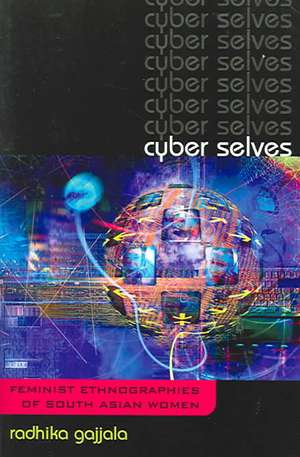
Cyber Selves: Feminist Ethnographies of South Asian Women
Autor Radhika Gajjala Contribuţii de Annapurna Mamidipudien Limba Engleză Paperback – 21 oct 2004
Preț: 273.55 lei
Preț vechi: 361.39 lei
-24%
Puncte Express: 410
Carte tipărită la comandă
Livrare economică 04-18 decembrie
Livrare prin curier în România Termenul estimat este afișat lângă disponibilitate.
Transport gratuit de la 400.00 lei Plată online sau ramburs, în funcție de opțiunile comenzii.
Retur gratuit în 14 zile Comandă securizată și suport în română.
Specificații
ISBN-13: 9780759106925
ISBN-10: 0759106924
Pagini: 172
Dimensiuni: 148 x 226 x 12 mm
Greutate: 0.26 kg
Ediția:New.
Editura: Bloomsbury Publishing
Colecția AltaMira Press
Locul publicării:New York, United States
ISBN-10: 0759106924
Pagini: 172
Dimensiuni: 148 x 226 x 12 mm
Greutate: 0.26 kg
Ediția:New.
Editura: Bloomsbury Publishing
Colecția AltaMira Press
Locul publicării:New York, United States
V-ar putea interesa
-
 How To Be A HeroineSamantha Ellis-31%Preț: 64.10 lei92.84 lei
 -
 What Women WantDeborah L. RhodePreț: 304.95 lei
 -
 Contradictory Lives: Baul Women in India and BangladeshLisa I. Knight-19%Preț: 304.48 lei377.38 lei
 -
 Imagining Women's CareersLaurie Cohen-34%Preț: 645.82 lei976.19 lei
 -
 -23%Preț: 247.02 lei320.56 lei
 -
 Women in My Rose GardenAnn Chapman-9%Preț: 97.95 lei107.78 lei
 -
 Why Marketing to Women Doesn't WorkJ. DarrochPreț: 323.73 lei
 -
 Behind Every Great ManMarlene Wagman-GellerPreț: 102.30 lei
 -
 The Tattooed LadyAmelia Klem OsterudPreț: 128.56 lei
 -
 Skirting Traditions: Arizona Women Writers and Journalists 1912-2012Arizona Press WomenPreț: 124.59 lei
 -
 Cries for HelpJoanna KozubskaPreț: 184.78 lei
 -
 Educating Black GirlsJawanza KunjufuPreț: 90.18 lei
 -
 Smart Girls in the 21st CenturyBarbara A KerrPreț: 159.70 lei
Cuprins
Part 1 ACKNOWLEDGMENTS
Part 2 PROLOGUE: I REFUSE TO BE READ
Part 3 INTRODUCTION
Part 4 PART I: Cyborg-Diaspora to the SAWnet Refusal
Chapter 5 Chapter One: Imagining Virtual Community and Dialogic Encounters
Chapter 6 Chapter Two: The SAWnet Refusal
Chapter 7 Chapter Three: Feminist Ethnography, Feminist Media Studies, and Internet Research
Part 8 PART II: Building (South Asian) Cyberfeminist Webs?
Chapter 9 Chapter Four: Interrogating Identities: Composing Other Cyberspaces
Chapter 10 Chapter Five: Building Cyberfeminist Webs
Part 11 PART III: Cyberfeminism and the "third-world"-Dialogues
Chapter 12 Chapter Six: Cyberfeminism, technology, and international "development"
Chapter 13 Chapter Seven: Carving dis-appearing analogue/digital "selves"
Part 14 EPILOGUE: I WANT TO CURL UP AND DENY YOU
Part 15 REFERENCES
Part 16 ABOUT THE AUTHOR
Part 2 PROLOGUE: I REFUSE TO BE READ
Part 3 INTRODUCTION
Part 4 PART I: Cyborg-Diaspora to the SAWnet Refusal
Chapter 5 Chapter One: Imagining Virtual Community and Dialogic Encounters
Chapter 6 Chapter Two: The SAWnet Refusal
Chapter 7 Chapter Three: Feminist Ethnography, Feminist Media Studies, and Internet Research
Part 8 PART II: Building (South Asian) Cyberfeminist Webs?
Chapter 9 Chapter Four: Interrogating Identities: Composing Other Cyberspaces
Chapter 10 Chapter Five: Building Cyberfeminist Webs
Part 11 PART III: Cyberfeminism and the "third-world"-Dialogues
Chapter 12 Chapter Six: Cyberfeminism, technology, and international "development"
Chapter 13 Chapter Seven: Carving dis-appearing analogue/digital "selves"
Part 14 EPILOGUE: I WANT TO CURL UP AND DENY YOU
Part 15 REFERENCES
Part 16 ABOUT THE AUTHOR
Recenzii
Radhika Gajjala's Cyberselves asks all the essential questions about technology, diaspora, nationality, and gender in the age of the Internet. Her lyrical interventions into the form of the academic book disrupt expectations about what ethnography ought to look like, and her unusual perspective as a member and leader of early online community gives the book a welcome grounding in lived experience. Her earnest, passionate, and deeply felt intervention into cyberculture studies is grounded in an excellent knowledge of the most relevant theoretical debates regarding postcolonialism, gender, and technology. This book also includes an exciting dialogue with a South Asian women's labor activist, and is committed throughout to collaborative thinking and knowledge-creation. This is a very personal and intimate book, and a welcome addition to the existing body of literature on online ethnography.
This probing and thoughtful work begins by addressing the politics of enunciation within diasporic cyberspaces, illustrating the kinds of complicities and resistances that get articulated through the struggle for control over meaning-making in such spaces. The book concludes by challenging us to think about how internet technologies could be redesigned to enable a truly dialogic exchange across gender, race, class and geographic location.
Using cyber-ethnographic methodology and feminist theoretical framwork, [Gajjala] has studies the structure and content of exchanges among paricipants (netizens) in these virtual communities to answer fundamental questions about virtual communities...Theauthor's critical and reflective analysis challenges students of feminist studies and of online communication studies to reconsider the assumption that internet communication in the globalized world is a power equalizerrrr
...an intriguing study...
...insightful. It highlights several important issues, not only online practices that lead to an 'insider' becoming an 'outsider', but more importantly women only spaces on the Web.
Gajjala's book is uniquely personal, uniquely insightful, and uniquely provocative. It adds new and important dimensions to the study of identity, race, and communication, on the internet as well as in the world offline.
This probing and thoughtful work begins by addressing the politics of enunciation within diasporic cyberspaces, illustrating the kinds of complicities and resistances that get articulated through the struggle for control over meaning-making in such spaces. The book concludes by challenging us to think about how internet technologies could be redesigned to enable a truly dialogic exchange across gender, race, class and geographic location.
Using cyber-ethnographic methodology and feminist theoretical framwork, [Gajjala] has studies the structure and content of exchanges among paricipants (netizens) in these virtual communities to answer fundamental questions about virtual communities...Theauthor's critical and reflective analysis challenges students of feminist studies and of online communication studies to reconsider the assumption that internet communication in the globalized world is a power equalizerrrr
...an intriguing study...
...insightful. It highlights several important issues, not only online practices that lead to an 'insider' becoming an 'outsider', but more importantly women only spaces on the Web.
Gajjala's book is uniquely personal, uniquely insightful, and uniquely provocative. It adds new and important dimensions to the study of identity, race, and communication, on the internet as well as in the world offline.