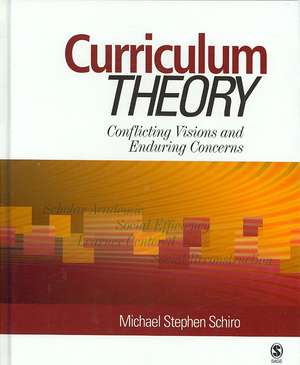
Curriculum Theory: Conflicting Visions and Enduring Concerns
Autor Michael Stephen Schiroen Limba Engleză Hardback – 11 noi 2007
| Toate formatele și edițiile | Preț | Express |
|---|---|---|
| Paperback (1) | 643.11 lei 22-36 zile | +23.10 lei 5-11 zile |
| SAGE Publications – 12 iun 2012 | 643.11 lei 22-36 zile | +23.10 lei 5-11 zile |
| Hardback (1) | 1391.65 lei 43-57 zile | |
| SAGE Publications – 11 noi 2007 | 1391.65 lei 43-57 zile |
Preț: 1391.65 lei
Preț vechi: 1697.13 lei
-18%
Puncte Express: 2087
Preț estimativ în valută:
246.09€ • 282.19$ • 212.68£
246.09€ • 282.19$ • 212.68£
Carte tipărită la comandă
Livrare economică 27 aprilie-11 mai
Specificații
ISBN-13: 9781412953153
ISBN-10: 1412953154
Pagini: 256
Dimensiuni: 187 x 232 x 20 mm
Greutate: 0.59 kg
Ediția:First Edition
Editura: SAGE Publications
Colecția Sage Publications, Inc
Locul publicării:Thousand Oaks, United States
ISBN-10: 1412953154
Pagini: 256
Dimensiuni: 187 x 232 x 20 mm
Greutate: 0.59 kg
Ediția:First Edition
Editura: SAGE Publications
Colecția Sage Publications, Inc
Locul publicării:Thousand Oaks, United States
V-ar putea interesa
-
 EDUCATION REFORMStephen Ball-30%Preț: 200.63 lei285.49 lei
 -
 Changing School SubjectsCarrie F PaechterPreț: 338.57 lei
 -
 Teachers Matter: Connecting Work, Lives and EffectivenessChristopher Day-29%Preț: 165.63 lei233.79 lei
 -
 Urban Youth and SchoolingLouise Archer-30%Preț: 173.19 lei248.07 lei
 -
 Media EducationDavid BuckinghamPreț: 151.77 lei
 -
 Curriculum Studies in the Lifelong Learning SectorJonathan TummonsPreț: 301.99 lei
 -
 -33%Preț: 247.20 lei367.88 lei
 -
 The Power of PedagogyJenny LeachPreț: 467.91 lei
 -
 Enriching Curriculum for All StudentsJoseph S. RenzulliPreț: 295.00 lei
 -
 Closing the Teaching Gap: Coaching for Instructional LeadersDonald B. BartaloPreț: 303.53 lei
 -
 Preț: 272.65 lei
 -
 Preț: 401.80 lei
 -
 Preț: 399.60 lei
 -
 Cross-curricular Approaches to Teaching and LearningChris RowleyPreț: 377.63 lei
 -
 Preț: 354.71 lei
 -
 Cognition and Curriculum ReconsideredElliot W. EisnerPreț: 195.78 lei
Recenzii
"Provides readers with a clear, sympathetic and unbiased understanding of the four conflicting visions of curriculum that will enable them to more productively interact with educators who might hold different beliefs. The book stimulates readers to better understand their own beliefs and also to provide them with an understanding of alternate ways of thinking about the fundamental goals of education" —SIRREADALOT.ORG
"Schiro (Boston College) has written a text that examines curriculum theory for experience and pre-service educators with the purpose of understanding educational philosohpies or ideologies that they are likely to encounter in their teaching."
"Not only are the chapters extremely comprehensive, the organization of the book is extremely thoughtful and provides a variety of activities for the neophyte and experienced teacher."
“This is the perfect book for both undergraduate and 'graduate' students of education and curriculum studies (yes, graduate students!). In fact, it is one of the best books I have read detailing the four main `ideologies' of curricula, namely, the Essentialist, the Social Efficiency, the Progressive, and the Social Reconstruction models of curriculum.
The back of the book contains the following quotation: "A clear, unbiased, and rigorous description of the major curriculum philosophies that have influenced educators and schooling over the last century..." It is all of this, and more!
(1) It is written to appeal to theorists (academics) and practitioners. Although it is a thorough and in-depth study of the ideologies, it is devoid of dense, academic jargon; the idiom is clear, direct, and accessible (all technical terminology is thoroughly explained). E.g., students and practitioners having difficulty with the convoluted writings of contemporary scholars of curriculum, will find this book a welcome change!
(2) It adopts a `historicist' approach to the presentation of its subject-matter, which means that the author defines and analyzes the various `ideologies' in light of their contextual emergence and importance. This book is not simply presenting `facts' for memorization; the positions `live,' as it were, as historical realities!
(3) It provides the rigorous foundational knowledge needed in order for students to truly grasp the writings of contemporary philosophers of education and curriculum studies, e.g., when juxtaposing these `ideologies' a student sees more clearly `why' it is that proponents of the `scholar academic ideology' are opposed to the `child-centered ideology.' This allows the student to situate the views of Adler and Dewey within a legitimate historical context, which emerge as a product of a particular ideological world-view, of which education and curriculum are inextricably a part.
If you're a curriculum planner, evaluator, advocate, developer, or burgeoning theorist, you must have this book! “
"Schiro (Boston College) has written a text that examines curriculum theory for experience and pre-service educators with the purpose of understanding educational philosohpies or ideologies that they are likely to encounter in their teaching."
"Not only are the chapters extremely comprehensive, the organization of the book is extremely thoughtful and provides a variety of activities for the neophyte and experienced teacher."
“This is the perfect book for both undergraduate and 'graduate' students of education and curriculum studies (yes, graduate students!). In fact, it is one of the best books I have read detailing the four main `ideologies' of curricula, namely, the Essentialist, the Social Efficiency, the Progressive, and the Social Reconstruction models of curriculum.
The back of the book contains the following quotation: "A clear, unbiased, and rigorous description of the major curriculum philosophies that have influenced educators and schooling over the last century..." It is all of this, and more!
(1) It is written to appeal to theorists (academics) and practitioners. Although it is a thorough and in-depth study of the ideologies, it is devoid of dense, academic jargon; the idiom is clear, direct, and accessible (all technical terminology is thoroughly explained). E.g., students and practitioners having difficulty with the convoluted writings of contemporary scholars of curriculum, will find this book a welcome change!
(2) It adopts a `historicist' approach to the presentation of its subject-matter, which means that the author defines and analyzes the various `ideologies' in light of their contextual emergence and importance. This book is not simply presenting `facts' for memorization; the positions `live,' as it were, as historical realities!
(3) It provides the rigorous foundational knowledge needed in order for students to truly grasp the writings of contemporary philosophers of education and curriculum studies, e.g., when juxtaposing these `ideologies' a student sees more clearly `why' it is that proponents of the `scholar academic ideology' are opposed to the `child-centered ideology.' This allows the student to situate the views of Adler and Dewey within a legitimate historical context, which emerge as a product of a particular ideological world-view, of which education and curriculum are inextricably a part.
If you're a curriculum planner, evaluator, advocate, developer, or burgeoning theorist, you must have this book! “
Cuprins
Preface
1. Introduction to Curriculum Ideologies
Your Beliefs About Curriculum
The Curriculum Ideologies
Curriculum Workers
The Nature of the Curriculum Ideologies
2. Scholar Academic Ideology
Scholar Academic Curricula
Curriculum and the Disciplines
The Academic Disciplines
Curriculum Issues
Historical Context
Aims
Knowledge
The Child
Learning
Teaching
Evaluation
Concluding Perspective
3. Social Efficiency Ideology
A Scientific Technique of Curriculum Making
Programmed Curriculum and the Behavioral Engineer
The Analogy
Social Orientation
Objectives
Historical Context
Aims
Knowledge
Learning
The Child
Teaching
Evaluation
Concluding Perspective
4. Learner Centered Ideology
The Ideal School
Learners
The Growing Individual
The Learning Person
The Curriculum: Unit of Work Versus School Subject
Historical Context
Aims
The Child
Learning
Teaching
Knowledge
Evaluation
Concluding Perspective
5. Social Reconstruction Ideology
Highlander
Sixth-Grade Social Reconstruction Mathematics
Society and Reconstruction
Reconstruction Through Education
Historical Context
Aims
The Child
Learning
Teaching
Knowledge
Evaluation
Concluding Perspective
6. A Comparative Overview of Curriculum Ideologies
Comparative Summary
Other Parameters
Concluding Perspective
7. Individual Perspectives on Curriculum Ideologies
Curriculum Life Histories
Can People Believe in More Than One Ideology?
Why Do Educators Change Ideologies?
Concluding Perspective
Appendix: Curriculum Ideologies Inventory
References
Index
About the Author
1. Introduction to Curriculum Ideologies
Your Beliefs About Curriculum
The Curriculum Ideologies
Curriculum Workers
The Nature of the Curriculum Ideologies
2. Scholar Academic Ideology
Scholar Academic Curricula
Curriculum and the Disciplines
The Academic Disciplines
Curriculum Issues
Historical Context
Aims
Knowledge
The Child
Learning
Teaching
Evaluation
Concluding Perspective
3. Social Efficiency Ideology
A Scientific Technique of Curriculum Making
Programmed Curriculum and the Behavioral Engineer
The Analogy
Social Orientation
Objectives
Historical Context
Aims
Knowledge
Learning
The Child
Teaching
Evaluation
Concluding Perspective
4. Learner Centered Ideology
The Ideal School
Learners
The Growing Individual
The Learning Person
The Curriculum: Unit of Work Versus School Subject
Historical Context
Aims
The Child
Learning
Teaching
Knowledge
Evaluation
Concluding Perspective
5. Social Reconstruction Ideology
Highlander
Sixth-Grade Social Reconstruction Mathematics
Society and Reconstruction
Reconstruction Through Education
Historical Context
Aims
The Child
Learning
Teaching
Knowledge
Evaluation
Concluding Perspective
6. A Comparative Overview of Curriculum Ideologies
Comparative Summary
Other Parameters
Concluding Perspective
7. Individual Perspectives on Curriculum Ideologies
Curriculum Life Histories
Can People Believe in More Than One Ideology?
Why Do Educators Change Ideologies?
Concluding Perspective
Appendix: Curriculum Ideologies Inventory
References
Index
About the Author
Notă biografică
Michael Stephen Schiro has taught at the elementary, middle, and high school levels. He received his bachelorate from Tufts University and his doctorate from Harvard University. In the 1960¿s he worked for school desegregation n North Carolina. In the 1970¿s he worked to improve urban education in Lowell, Massachusetts. He was chair of the Department of Teacher Education and School Administration at Boston College in the 1980¿s. He specializes in mathematics education and curriculum theory, and taught courses in mathematics education, curriculum theory, computer education, literacy, and multicultural education at Boston College from 1974 to 2009, when he retired. He published eleven books with such diverse titles as Integrating Children¿s Literature and Mathematics in the Classroom, Oral Story Telling and Teaching Mathematics, Mega-Fun Math Games, Curriculum for Better Schools: The Great Ideological Debate, and Tan and the Shape Changer.
Descriere
Descriere de la o altă ediție sau format:
A clear, unbiased, and rigorous description of the major curriculum philosophies that have influenced educators and schooling over the last century.
A clear, unbiased, and rigorous description of the major curriculum philosophies that have influenced educators and schooling over the last century.