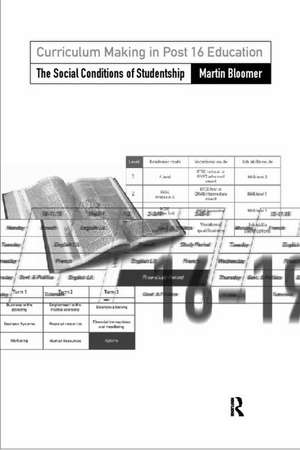
Curriculum Making in Post-16 Education: The Social Conditions of Studentship
Autor Martin Bloomeren Limba Engleză Paperback – 9 oct 1997
YTS was a reaction to problems of youth unemployment, CPVE and BTEC embraced a 'broad' concept of vocationalism, and even with the introduction of NVQ and GNVQ the A-level retains its gold-standard in the eyes of many. The post-16 curriculum that has emerged is hardly coherent. So how can teachers translate an externally imposed curriculum into a meaningful learning experience for students?
Drawing on solid research in post-16 education, this book makes explicit the nature of flaws in policy, and provides an account of how teachers and students construct their roles. It puts forward the case for a radical reappraisal and identifies appropriate aims and organising principles for a post-16 curriculum for the future.
Martin Bloomer is currently Dean of the Faculty of Education at Exeter University.
Preț: 465.98 lei
Puncte Express: 699
Carte tipărită la comandă
Livrare economică 08-22 iunie
Specificații
ISBN-13: 9780415120234
ISBN-10: 0415120233
Pagini: 234
Dimensiuni: 156 x 234 x 13 mm
Greutate: 0.45 kg
Ediția:1
Editura: Taylor & Francis
Colecția Routledge
Locul publicării:Oxford, United Kingdom
ISBN-10: 0415120233
Pagini: 234
Dimensiuni: 156 x 234 x 13 mm
Greutate: 0.45 kg
Ediția:1
Editura: Taylor & Francis
Colecția Routledge
Locul publicării:Oxford, United Kingdom
V-ar putea interesa
-
 Teaching and Learning History 11-18: Understanding the PastChris Husbands-28%Preț: 185.31 lei256.61 lei
 -
 Cross-Curricular Teaching and Learning in the Secondary SchoolJonathan SavagePreț: 328.49 lei
 -
 Preț: 357.94 lei
 -
 Preț: 327.34 lei
 -
 Debates in Citizenship EducationJames Arthur-15%Preț: 404.61 lei476.00 lei
 -
 Preț: 127.01 lei
 -
 Discipline Survival Guide for the Secondary TeacherJulia G ThompsonPreț: 177.80 lei
 -
 -23%Preț: 483.93 lei628.47 lei
 -
 Developing Professional Practice 14-19Andrew ArmitagePreț: 306.56 lei
 -
 Der Sandmann. Das öde HausErnst Theodor Amadeus HoffmannPreț: 20.88 lei
Public țintă
ProfessionalCuprins
Acknowledgements Chapter 1. Introduction Chapter 2. The Context of Educational Practice Chapter 3. Knowledge and the Prescription of Learning Opportunities Chapter 4. Knowledge and Learning in Practice: Vocational Courses Chapter 5. Knowledge and Learning in Practice: A-level Chemistry Courses Chapter 6. Knowledge and Learning in Practice: A-level History Courses Chapter 7. Studentship and Learning Careers Chapter 8. Towards s Reconstruction of the Post-16 Curriculum Chapter 9. Towards a Curriculum for the Future Notes Bibliography Index
Descriere
The post-16 curriculum is not a coherent one. This book identifies the flaws and provides an account of how teachers and students can construct their roles.