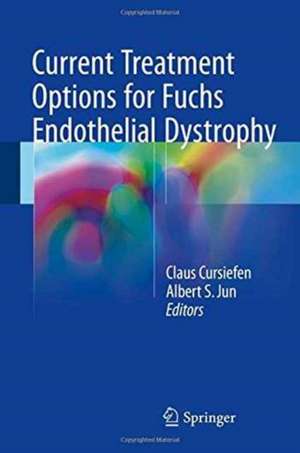
Current Treatment Options for Fuchs Endothelial Dystrophy
Editat de Claus Cursiefen, Albert S. Junen Limba Engleză Hardback – 11 noi 2016
Adresat în mod direct medicilor rezidenți în oftalmologie, specialiștilor în cornee și chirurgilor care doresc să își rafineze tehnicile de transplant, Current Treatment Options for Fuchs Endothelial Dystrophy reprezintă o sinteză clinică riguroasă a standardelor actuale de îngrijire. Remarcăm o structură logică ce ghidează cititorul de la fundamentele fiziopatologice și genetice ale distrofiei Fuchs către complexitatea intervențiilor chirurgicale de ultimă generație. Autorii, sub îndrumarea editorilor Claus Cursiefen și Albert S. Jun, detaliază tranziția istorică și tehnologică de la keratoplastia penetrantă (PK) la variantele moderne de keratoplastie lamelară posterioară, oferind protocoale pas cu pas pentru procedurile DSAEK și DMEK. Considerăm că valoarea practică a acestui volum rezidă în abordarea integrată a managementului de caz: de la pregătirea țesutului în banca de ochi și riscurile de eșec ale grefonului, până la soluționarea complicațiilor specifice. Ca alternativă la Mastering Endothelial Keratoplasty de Soosan Jacob, care oferă o perspectivă extinsă asupra diverselor variante de keratoplastie, volumul de față are avantajul unei focalizări stricte pe distrofia Fuchs, explorând inclusiv potențialul terapeutic al micro-ARN și al terapiilor celulare. De asemenea, spre deosebire de Modern Keratoplasty, care acoperă spectrul larg al chirurgiei corneene, această lucrare de la Springer oferă o profunzime sporită în ceea ce privește fenotipurile clinice și diagnosticul diferențial al FED, fiind un instrument de precizie pentru practica clinică cotidiană.
Preț: 1105.45 lei
Preț vechi: 1163.64 lei
-5%
Carte disponibilă
Livrare economică 02-16 noiembrie
Specificații
ISBN-10: 331943019X
Pagini: 264
Ilustrații: VIII, 255 p. 71 illus., 59 illus. in color.
Dimensiuni: 160 x 241 x 19 mm
Greutate: 0.61 kg
Ediția:1st ed. 2017
Editura: Springer
Locul publicării:Cham, Switzerland
V-ar putea interesa
-
 Research methods in palliative careJulia M Addington-Hall-22%Preț: 523.80 lei675.25 lei
 -
 The Frailty ModelLuc Duchateau-15%Preț: 671.62 lei790.14 lei
 -
 Bioconductor Case StudiesFlorian Hahne-15%Preț: 702.45 lei826.42 lei
 -
 -5%Preț: 464.15 lei488.58 lei
 -
 Research Methods for Health Care PracticeFrances Griffiths-11%Preț: 373.38 lei419.54 lei
 -
 Bone-Implant Interface in Orthopedic SurgeryTheofilos Karachalios-5%Preț: 1151.17 lei1211.75 lei
 -
 Preț: 361.70 lei
 -
 Mental Illness: A Handbook for CarersGeoffrey Wolff-29%Preț: 186.25 lei261.80 lei
 -
 -5%Preț: 441.81 lei465.07 lei
 -
 Pharmacological Basis of Acute CareYoo Kuen Chan-5%Preț: 813.09 lei855.88 lei
 -
 -5%Preț: 848.73 lei893.39 lei
 -
 -5%Preț: 1146.56 lei1206.90 lei
De ce să citești această carte
Această resursă este esențială pentru oftalmologii care doresc să treacă de la tehnicile clasice de transplant la proceduri minim invazive. Cititorul câștigă o înțelegere profundă a tehnicilor DMEK și DSAEK, beneficiind de ghiduri procedurale ce reduc curba de învățare și îmbunătățesc managementul complicațiilor postoperatorii în cazul distrofiei Fuchs.
Despre autor
Claus Cursiefen este un renumit specialist în oftalmologie, recunoscut pentru expertiza sa în chirurgia corneei și imunologia oculară, ocupând funcții academice și clinice de prestigiu în Germania. Albert S. Jun este profesor de oftalmologie la Johns Hopkins University, cu o activitate vastă de cercetare axată pe genetica și biologia moleculară a bolilor endoteliale corneene. Împreună, acești editori reunesc rigoarea academică americană și europeană, oferind o perspectivă globală asupra tratamentului distrofiei Fuchs.
Descriere scurtă
Cuprins
Recenzii
Notă biografică
Albert S. Jun, MD, PhD, is a board-certified opththalmologist who works at The Johns Hopkins Hospital, Baltimore, MD, USA, and is Associate Professor of Ophthalmology at The Johns Hopkins University School of Medicine. He is also Associate Professor of Ophthalmology and Vice Chair for Education at the Wilmer Eye Institute. After gaining his PhD from Emory University Graduate School of Arts and Sciences, focusing on Genetics and Molecular Biology, Dr. Jun completed an Ophthalmology Residency at The Johns Hopkins Medical Institutions (1998–2001), a Cornea and External Disease Fellowship at Moorfields Eye Hospital (London, UK) (2001–2), and a Corneal Gene Therapy Research Fellowship at Imperial College School of Medicine (London, UK) (2002). He became a Diplomate of the American Board of Ophthalmology in 2003. In 2013 he received an Achievement Award from the American Academy of Ophthalmology and was International Visiting Professor on the occasion of the 150th Anniversary of the Department of Ophthalmology, Medical University of Graz, Austria. More recently he was International Visiting Professor at the Bowman Corneal Club, Liverpool (UK). Dr. Jun is a member of the editorial board of Cornea: The Journal of Cornea and External Disease. He is lead or co-author of approximately 60 peer-reviewed publications.