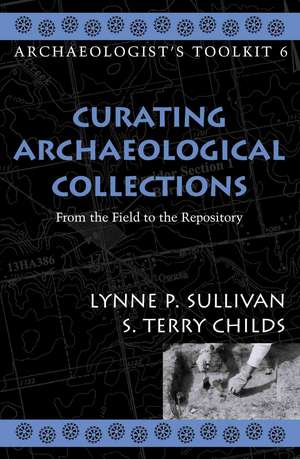
Curating Archaeological Collections: From the Field to the Repository: Archaeologist's Toolkit
Autor Lynne P. Sullivan, Terry S. Childsen Limba Engleză Paperback – 12 mar 2003
![Archaeologist's Toolkit: [7 volumes]](https://i2.books-express.ro/bs/9780759100176/archaeologist-s-toolkit.jpg)
Preț: 252.57 lei
Preț vechi: 334.38 lei
-24%
Puncte Express: 379
Carte tipărită la comandă
Livrare economică 27 noiembrie-11 decembrie
Livrare prin curier în România Termenul estimat este afișat lângă disponibilitate.
Transport gratuit de la 400.00 lei Plată online sau ramburs, în funcție de opțiunile comenzii.
Retur gratuit în 14 zile Comandă securizată și suport în română.
Specificații
ISBN-13: 9780759100244
ISBN-10: 0759100241
Pagini: 162
Dimensiuni: 149 x 227 x 11 mm
Greutate: 0.27 kg
Editura: Bloomsbury Publishing
Colecția AltaMira Press
Seria Archaeologist's Toolkit
Locul publicării:New York, United States
ISBN-10: 0759100241
Pagini: 162
Dimensiuni: 149 x 227 x 11 mm
Greutate: 0.27 kg
Editura: Bloomsbury Publishing
Colecția AltaMira Press
Seria Archaeologist's Toolkit
Locul publicării:New York, United States
Cuprins
Part 1 Series Editors' Foreword
Part 2 Acknowledgments
Part 3 1 Introduction
Part 4 2 A Brief History of Archaeological Curation in the United States
Chapter 5 The Museum Era of Archaeology: Nineteenth Century to the 1930s / Early Federal Archaeology Programs: 1930s and 1940s / The Postwar Construction Boom and the "New Archaeology": 1945 to 1970 / Making versus Caring for Collections: The 1970s and Beyond /
Part 6 3 The Current Status of Archaeological Collections
Chapter 7 Federal Legislation and Policy / Key Elements of the Curation Crisis / The Bright Side
Part 8 4 Repositories: What Are They, and What Do They Do?
Chapter 9 Kinds of Repositories / What a Repository Does and Why / Responsibilities and Training of Repository Staff / Conclusion
Part 10 5 Managing Curated Collections: The Basics
Chapter 11 Acquistions Policies and Practices / Accessioning / Cataloging / Collections Preparation: Labeling and Conservation / Storage / Inventory Control and Data Management / Deaccessioning / Public Access and Use / Conclusion
Part 12 6 Making a Collection: Fieldwork Practices and Curation Considerations
Chapter 13 Before the Field: Project Design / In the Field: Sampling and Conservation / In the Laboratory: Applying the Sampling Strategy and More Conservation / In Your Office after the Field Project: Records Management / Conclusion
Part 14 7 Working with a Repository
Chapter 15 Arranging for Long-term Curation / Using Curated Collections / ConclusionPart 16 8 The Future of Archaeological Collections Curation
Chapter 17 Access: Collections in the Computer Age / Use of Curated Collections / The "Big Picture": Curated Collections as Samples of the Archaeological Record / Encouraging Repositories to Curate Representative Samples of the Archaeological Record / Coordinated
Part 18 Appendix: Useful Internet Sites Relating to Curating Archaeological Collections
Part 19 References
Part 20 Index
Part 21 About the Authors
Part 2 Acknowledgments
Part 3 1 Introduction
Part 4 2 A Brief History of Archaeological Curation in the United States
Chapter 5 The Museum Era of Archaeology: Nineteenth Century to the 1930s / Early Federal Archaeology Programs: 1930s and 1940s / The Postwar Construction Boom and the "New Archaeology": 1945 to 1970 / Making versus Caring for Collections: The 1970s and Beyond /
Part 6 3 The Current Status of Archaeological Collections
Chapter 7 Federal Legislation and Policy / Key Elements of the Curation Crisis / The Bright Side
Part 8 4 Repositories: What Are They, and What Do They Do?
Chapter 9 Kinds of Repositories / What a Repository Does and Why / Responsibilities and Training of Repository Staff / Conclusion
Part 10 5 Managing Curated Collections: The Basics
Chapter 11 Acquistions Policies and Practices / Accessioning / Cataloging / Collections Preparation: Labeling and Conservation / Storage / Inventory Control and Data Management / Deaccessioning / Public Access and Use / Conclusion
Part 12 6 Making a Collection: Fieldwork Practices and Curation Considerations
Chapter 13 Before the Field: Project Design / In the Field: Sampling and Conservation / In the Laboratory: Applying the Sampling Strategy and More Conservation / In Your Office after the Field Project: Records Management / Conclusion
Part 14 7 Working with a Repository
Chapter 15 Arranging for Long-term Curation / Using Curated Collections / ConclusionPart 16 8 The Future of Archaeological Collections Curation
Chapter 17 Access: Collections in the Computer Age / Use of Curated Collections / The "Big Picture": Curated Collections as Samples of the Archaeological Record / Encouraging Repositories to Curate Representative Samples of the Archaeological Record / Coordinated
Part 18 Appendix: Useful Internet Sites Relating to Curating Archaeological Collections
Part 19 References
Part 20 Index
Part 21 About the Authors
Recenzii
Curating Archaeological Collections is not a comprehensive handbook for conservation of Attic vases or Andean textiles, but it is a timely and useful summary of "best practices" for repositories. And that's what we need. Curating Archaeological Collections also offers a reasoned, but forceful call for resolution of the curation crisis. This book belongs on the shelves of every U.S. museum with archaeological collections, and on the reading list of every curator and collection manager who deal with those collections. And the reading lists of Federal and State agencies which oversee the care of old collections and production of new collections.
Curating Archaeological Collections, by Lynne P. Sullivan and S. Terry Childs, fills a conspicuous gap in training for students, archeologists, and agencies that manage collections.
This volume, part of a new series designed to provide practical information to students and people studying archaeology, highlights the importance of considering curatorial issues early on in the design of archaeological projects.
Curating Archaeological Collections, by Lynne P. Sullivan and S. Terry Childs, fills a conspicuous gap in training for students, archeologists, and agencies that manage collections.
This volume, part of a new series designed to provide practical information to students and people studying archaeology, highlights the importance of considering curatorial issues early on in the design of archaeological projects.