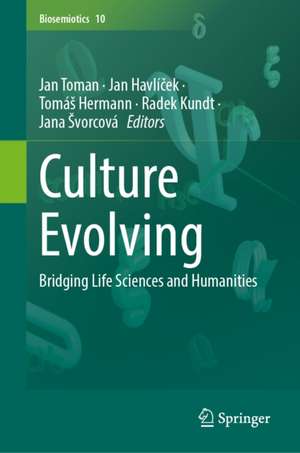
Culture Evolving: Biosemiotics, cartea 10
Editat de Jan Toman, Jan Havlí¿ek, Tomá¿ Hermann, Radek Kundt, Jana ¿Vorcováen Limba Engleză Hardback – 5 aug 2026
Din seria Biosemiotics
- 15%
 Preț: 661.90 lei
 - 18%
 Preț: 810.23 lei
 - 15%
 Preț: 667.41 lei
 - 15%
 Preț: 605.19 lei
 - 18%
 Preț: 1614.82 lei
 - 18%
 Preț: 983.18 lei
 - 15%
 Preț: 670.03 lei
 - 24%
 Preț: 888.19 lei
 - 24%
 Preț: 874.94 lei
 - 18%
 Preț: 1658.66 lei
 - 18%
 Preț: 1108.12 lei
 - 15%
 Preț: 658.43 lei
 - 18%
 Preț: 725.47 lei
 - 18%
 Preț: 1153.67 lei
 - 18%
 Preț: 784.37 lei
 - 18%
 Preț: 735.23 lei
 - 24%
 Preț: 692.18 lei
 - 18%
 Preț: 763.32 lei
 - 18%
 Preț: 817.70 lei
 - 24%
 Preț: 773.10 lei
 - 18%
 Preț: 2126.06 lei
 - 24%
 Preț: 785.95 lei
 - 18%
 Preț: 945.12 lei
 - 18%
 Preț: 952.24 lei
 - 18%
 Preț: 1223.02 lei
 - 18%
 Preț: 1722.08 lei
 - 18%
 Preț: 1223.13 lei
 - 18%
 Preț: 926.71 lei
Preț: 916.06 lei
Preț vechi: 1117.15 lei
-18% Nou
Puncte Express: 1374
Carte disponibilă
Livrare economică 06-20 noiembrie
Livrare prin curier în România Termenul estimat este afișat lângă disponibilitate.
Transport gratuit pentru acest produs Plată online sau ramburs, în funcție de opțiunile comenzii.
Retur gratuit în 14 zile Comandă securizată și suport în română.
Specificații
ISBN-13: 9783032161239
ISBN-10: 3032161231
Pagini: 520
Dimensiuni: 160 x 241 x 34 mm
Greutate: 0.89 kg
Editura: Springer
Colecția Biosemiotics
Seria Biosemiotics
ISBN-10: 3032161231
Pagini: 520
Dimensiuni: 160 x 241 x 34 mm
Greutate: 0.89 kg
Editura: Springer
Colecția Biosemiotics
Seria Biosemiotics
Notă biografică
Jan Toman is a postdoctoral researcher at the Department of Philosophy and History of Sciences, Faculty of Science, Charles University. His research focuses on macroevolutionary and theoretical biological topics, encompassing the evolution of evolvability, stability-based sorting and its role in evolving systems, as well as cultural evolution and biosemiotics. He is also interested in the history of biological concepts and science outreach.
Jan Havlí¿ek is a Full Professor at the Department of Zoology, Faculty of Science, Charles University. His main research interests concern the evolutionary aspects of human social perception, particularly within the theoretical frameworks of signalling theory, sexual selection, and dual inheritance theory. He has published over 170 papers and co-edited a textbook on animal behaviour.
Tomáš Hermann is a researcher at the Department of Philosophy and History of Sciences, Faculty of Science, Charles University. His research focuses on intellectual history and the history of sciences in the 19th and 20th centuries in the Czech and Central European context, with particular emphasis on the life sciences, philosophy, and historiography. He is a long-standing member of the Society for the History of Sciences and Technology of the Czech Republic and serves as Editor-in-Chief of its scientific journal D¿jiny v¿d a techniky – History of Sciences and Technology.
Radek Kundt is a researcher at LEVYNA – Laboratory for the Experimental Research of Religion, Department for the Study of Religions, Masaryk University. Interested in the origins of ritual, he argues that collective ritual evolved as a complex signalling system facilitating mutualistic cooperation. Combining methods from experimental anthropology and experimental psychology, he researched the effects of religious priming on prosocial and moral behaviour, drawing on several years of laboratory and field experience in the Czech Republic and Mauritius.
Jana Švorcová is an Assistant Professor at the Department of Philosophy and History of Sciences, Faculty of Science, Charles University. She teaches theoretical and evolutionary biology, and her research focuses on non-mechanistic approaches to living systems within biophilosophy. Her interests also include non-genetic evolutionary variation and inheritance, organismal agency, and various levels of memory in living systems.
Jan Havlí¿ek is a Full Professor at the Department of Zoology, Faculty of Science, Charles University. His main research interests concern the evolutionary aspects of human social perception, particularly within the theoretical frameworks of signalling theory, sexual selection, and dual inheritance theory. He has published over 170 papers and co-edited a textbook on animal behaviour.
Tomáš Hermann is a researcher at the Department of Philosophy and History of Sciences, Faculty of Science, Charles University. His research focuses on intellectual history and the history of sciences in the 19th and 20th centuries in the Czech and Central European context, with particular emphasis on the life sciences, philosophy, and historiography. He is a long-standing member of the Society for the History of Sciences and Technology of the Czech Republic and serves as Editor-in-Chief of its scientific journal D¿jiny v¿d a techniky – History of Sciences and Technology.
Radek Kundt is a researcher at LEVYNA – Laboratory for the Experimental Research of Religion, Department for the Study of Religions, Masaryk University. Interested in the origins of ritual, he argues that collective ritual evolved as a complex signalling system facilitating mutualistic cooperation. Combining methods from experimental anthropology and experimental psychology, he researched the effects of religious priming on prosocial and moral behaviour, drawing on several years of laboratory and field experience in the Czech Republic and Mauritius.
Jana Švorcová is an Assistant Professor at the Department of Philosophy and History of Sciences, Faculty of Science, Charles University. She teaches theoretical and evolutionary biology, and her research focuses on non-mechanistic approaches to living systems within biophilosophy. Her interests also include non-genetic evolutionary variation and inheritance, organismal agency, and various levels of memory in living systems.
Cuprins
Introduction (Jan Havlí¿ek & Jan Toman).- Part 1:The Human Condition and Evolutionary Thought in the History of Ideas (Tomáš Hermann).- .1. Progress or Decline? The Evolution of Culture According to Some Ancient Thinkers (Vojt¿ch Hladký & Eliška Fulínová).- 2: Breaking Through the Boundaries of Time: Changing Modern Notions About the Age of Nature and Culture (Tomáš Hermann, Vojt¿ch Hladký & Lucie Strnadová).- 3: The Evolutionary Utopia and a Confusion of Discourses: Projecting Eugenic Para-Religious Visions onto Human Future (Tomáš Hermann, Michal V. Šim¿nek & Jan Musil).- 4: On the Monistic and Dualistic Origins and the Development of Nature and Culture: Haeckel and Ehrenfels (Lenka Ov¿á¿ková).- Part 2:Cultural Evolution and the Human Sciences: Archaeological and Anthropological Perspectives (Radek Kundt).- 5: Genes, Identity, and Material Culture: In Search of a Unifying Theory (Petr Kv¿tina & Václav Hrn¿í¿).- 6: Shifting Perceptions of the Greek Bronze Age: From Simple Valuative Judgements Like ‘Civilised’ or ‘Barbaric’ to a Comprehensive Implementation of the Archaeological Science (Tomáš Alušík).- 7: The Evolutionary and Cognitive Perspectives in Research of Cultural and Social Phenomena (Danijela Jerotijevi¿ & Radek Kundt).- 8: Appreciating Culture in Human Mating and Parenting Research: The Reproductive Functions of Religious Systems (Terezie Dvöá¿ková, Eva Kundtová Klocová & Radek Kundt).- Part 3: Culture from the Perspective of Evolutionary Behavioural Science (Jan Havlí¿ek).- 9: Culture: Uniquely Human? (Jitka Lindová).- 10: Memetics: Rise, Fall, and Reconsideration (Jaroslav Flegr & Jan Toman).- 11: Cultural Attraction as One of the Pillars of Cultural Evolution (Pavlína Hillerová & Petr Ture¿ek).- 12: Cultures as Species: Tree Thinking and the Phylogenetic Approach in Linguistics, Archaeology, and Anthropology (Pavel Duda).- 13: Human Cumulative Culture: Bridging Cognition and Population Dynamics (Jan Havlí¿ek).- Part 4: Biosemiotic Reflections upon the Relationships Between Nature and Culture (Jana Švorcová).- 14: The Role of Sociomorphic Modelling in the Perception of Nature (Petr Hampl: Mirroring Nature).- 15: Stability-Based Sorting in Cultural Evolution: Macroevolutionary Phenomena as a Model for Explaining Cultural Dynamics (Jan Toman).- 16: The Past Lives on With Us: Epigenetics as a Link Between Cultural and Biological Evolution (Jana Švorcová & Karel Kleisner).- 17: Abiosphere and Biosphere: An Individual, a Community, a Culture (Anton Markoš).- 18: Reflections on Analogies Between Cultural and Biological Evolution: Contribution to the Discussion from the Perspective of Historical Sciences (Jan Horský).