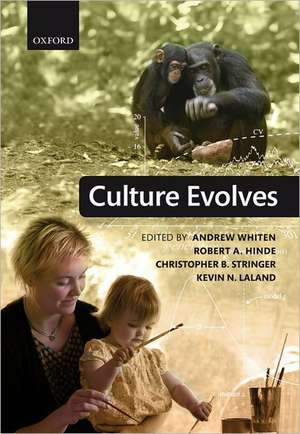
Culture Evolves
Editat de Andrew Whiten, Robert A. Hinde, Christopher B. Stringer, Kevin N. Lalanden Limba Engleză Hardback – 22 dec 2011
Bazându-ne pe datele furnizate de Royal Society și British Academy, descoperim în Culture Evolves o sinteză academică de anvergură care reevaluează locul culturii în biologia evoluționistă. Remarcăm faptul că volumul, editat de Andrew Whiten și colegii săi, nu se limitează la perspectiva antropocentrică, ci investighează continuitatea dintre regnul animal și civilizația umană. Structura lucrării reflectă caracterul interdisciplinar al reuniunii din care a rezultat, reunind experți din domenii precum primatologia, ecologia comportamentală și arheologia.
Putem afirma că acest volum reprezintă o evoluție firească în opera lui Andrew Whiten. Dacă în Machiavellian Intelligence autorul se concentra pe manipularea socială ca motor al intelectului, în Culture Evolves perspectiva se extinde asupra modului în care învățarea socială și tradițiile generează sisteme care pot opera independent de selecția naturală genetică, deși interacționează constant cu aceasta. Tonul este unul riguros, axat pe dovezi care împing originile culturii mult mai departe în timp decât se credea anterior.
Ca alternativă la The Origin and Evolution of Cultures pentru cursurile de psihologie colectivă sau antropologie evoluționistă, acest titlu oferă avantajul unei perspective integrate, care include descoperiri recente despre predispoziția copiilor de a achiziționa cultura. Spre deosebire de lucrările lui Robert Boyd, care se concentrează pe modele teoretice ale evoluției culturale, Culture Evolves pune un accent mai mare pe datele empirice din etologie și arheologie, oferind o bază factuală vastă pentru înțelegerea proceselor darwiniene aplicate culturii umane și animale.
Preț: 834.61 lei
Preț vechi: 1254.97 lei
-33%
Carte tipărită la comandă
Livrare economică 11-17 iunie
Specificații
ISBN-10: 0199608962
Pagini: 472
Dimensiuni: 176 x 248 x 33 mm
Greutate: 1 kg
Editura: OUP OXFORD
Colecția OUP Oxford
Locul publicării:Oxford, United Kingdom
V-ar putea interesa
-
 -35%Preț: 767.72 lei1174.22 lei
 -
 Animal InnovationSimon M. Reader-31%Preț: 423.32 lei609.18 lei
 -
 Intangible Cultural Heritage in International LawLucas Lixinski-28%Preț: 616.84 lei853.52 lei
 -
 The Mormon Quest for Glory: The Religious World of the Latter-Day SaintsMelvyn HammarbergPreț: 348.11 lei
 -
 -8%Preț: 328.28 lei356.27 lei
 -
 Preț: 249.84 lei
 -
 Born to RunChristopher McDougallPreț: 100.78 lei
 -
 Don't Sleep, There Are SnakesDaniel L. EverettPreț: 104.87 lei
 -
 Preț: 186.78 lei
 -
 A General Theory of Emotions and Social LifeWarren D. TenHoutenPreț: 446.00 lei
 -
 Preț: 451.37 lei
 -
 -11%Preț: 71.94 lei81.15 lei
De ce să citești această carte
Această lucrare este esențială pentru studenții și cercetătorii din științele sociale și biologice care doresc să înțeleagă mecanismele transmiterii tradițiilor. Cititorul câștigă o viziune unitară asupra modului în care cultura a modelat specia umană, beneficiind de expertiza unor lideri mondiali în domeniu. Este un argument solid pentru continuitatea evolutivă, demonstrând că procesele culturale nu sunt un accident istoric, ci o componentă fundamentală a biologiei noastre.
Despre autor
Andrew Whiten este un reputat profesor de psihologie evoluționistă și comparată, cunoscut pentru cercetările sale de pionierat asupra inteligenței primatelor. Alături de co-editori precum Robert A. Hinde și Christopher B. Stringer, el a coordonat proiecte care au redefinit înțelegerea comportamentului social. Opera sa, incluzând volumele de referință Machiavellian Intelligence, explorează modul în care presiunile sociale au modelat evoluția creierului uman. În Culture Evolves, Whiten își continuă misiunea de a integra datele din observația animală cu studiul culturii umane, consolidând puntea dintre biologie și științele sociale.
Descriere
Recenzii
This collection is an excellent introduction to the vibrant and increasingly diverse field of cultural evolution. It is especially valuable in treating human and non-human culture in a comparative framework Prof Pete Richerson, University of California, USA
Perhaps the most impressive aspect of the volume lies in bringing such a diverse range of topics together in one place, for which the editors should be commended. Rarely does one find oneself considering the social transmission of stickleback foraging behaviour, followed a few chapters later by historical analysis of socio-political organisation in small-scale Pacific island societies. This breadth necessarily encompasses multiple disciplines, from biology to anthropology, psychology, archaeology, linguistics, and sociology. Whereas traditionally such disciplines have had little to do with one another, the evolutionary framework adopted here provides a common language within which to understand these diverse phenomena, from fish foraging to Fijian fiefdoms.