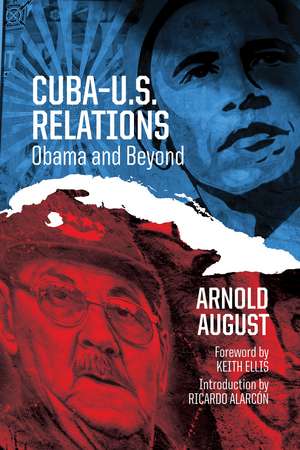
Cuba–U.S. Relations: Obama and Beyond
Autor Arnold Augusten Limba Engleză Paperback – mai 2017
Featuring interviews with Cuban-based experts Jesús Arboleya Cervera, Esteban Morales Domínguez, Elier Ramírez Cañedo, Iroel Sánchez Espinosa and Luis Toledo Sande.
Preț: 106.30 lei
Preț vechi: 128.89 lei
-18%
Puncte Express: 159
Carte disponibilă
Livrare economică 07-21 noiembrie
Livrare express 27-31 octombrie pentru 49.07 lei
Livrare prin curier în România Termenul estimat este afișat lângă disponibilitate.
Transport gratuit de la 400.00 lei Plată online sau ramburs, în funcție de opțiunile comenzii.
Retur gratuit în 14 zile Comandă securizată și suport în română.
Specificații
ISBN-13: 9781552669655
ISBN-10: 1552669653
Pagini: 224
Dimensiuni: 152 x 229 x 13 mm
Greutate: 0.36 kg
Editura: Fernwood Publishing
Colecția Fernwood Publishing
Locul publicării:Canada
ISBN-10: 1552669653
Pagini: 224
Dimensiuni: 152 x 229 x 13 mm
Greutate: 0.36 kg
Editura: Fernwood Publishing
Colecția Fernwood Publishing
Locul publicării:Canada
V-ar putea interesa
-
 International Security: A Very Short IntroductionChristopher S. Browning-20%Preț: 56.65 lei70.82 lei
 -
 -18%Preț: 201.23 lei246.78 lei
 -
 China Dreams: 20 Visions of the FutureWilliam Callahan-11%Preț: 360.54 lei406.32 lei
 -
 -28%Preț: 371.06 lei513.34 lei
 -
 The Future of ViolenceBenjamin WittesPreț: 291.84 lei
 -
 Preț: 79.62 lei
 -
 Preț: 209.73 lei
 -
 Preț: 376.67 lei
 -
 -25%Preț: 49.49 lei65.73 lei
 -
 -41%Preț: 77.32 lei132.12 lei
 -
 The European Union: An IntroductionMark Corner-14%Preț: 166.24 lei194.11 lei
 -
 Strike for AmericaMicah UetrichtPreț: 109.20 lei
 -
 The Enemy WithinSeumas MilnePreț: 308.25 lei
 -
 International RelationsManan DwivediPreț: 312.89 lei
 -
 -27%Preț: 760.37 lei1041.60 lei
Cuprins
- : Foreword — Too Interconnected to Be Unravelled by Keith Ellis
- : Preface — This Book Comes into Being
- : Introduction — Not One Iota, by Ricardo Alarcón de Quesada
- : Historical/Political Context: From the Thirteen Colonies to the Obama Era
- : Debate in Cuba Following Re-establishment of Diplomatic Relations, 2014-16
- : Interviews with Five of Cuba’s Leading Experts on Cuba–U.S. Relations
- : Challenges for Cuba in 2017 and Beyond
- : The Blockade: From Obama to Trump
- : Fidel and the U.S.-Led Cultural Blitzkrieg on “Dictatorship”
- : References
- : Index
Recenzii
An expert on Cuba, Arnold August offers a revealing view of the conflict between Washington and Havana and the foreign policy of the United States vis-à-vis the island.
Any open-minded discussion about the obviously asymmetrical relations between Cuba and the United States should start with this highly readable informative book. Based on deep research, including use of historical U.S. government documents and extensive field work inside Cuba, it should be acquired by libraries, students, and people about to travel to Cuba, journalists, government employees, and academics working in international affairs.
This book could not have been more timely. With Fidel Castro’s death focusing outside attention on Cuba’s future and with Trump’s election throwing U.S.–Cuban “normalization” into question, Arnold August contests the common assumptions and public rhetoric about Cuban politics and about that “normalization.”
August provides the reader with a bridge across time and nations to understand the changes that have led to the “normalization” of Cuba–U.S. relations and serves as a guide to the Trump future.
For those who want a fresh and reasoned perspective on Cuba and U.S. relations — and with it a perspective very different from that which we get from the mainstream Western media — this book is a must-read.
August’s deft analysis, firmly grounded in a prolonged exposure to Cuban history and debates while mapping out the possible future developments, makes for an enlightening book.
Arnold August’s new book on Cuba dispels the propaganda and myths perpetuated by both the U.S. corporate media and the Obama administration and provides valuable insights into what we might expect from a Trump government in the post-Fidel era.
Arnold August’s bristling collection of interventions vigorously debunks U.S.-centric misrepresentations of Cuban society and of Obama’s new ‘regime change’ strategy. It also engages critically with Cuban intellectuals and bloggers fighting in the ‘Cultural War,’ challenging the Revolution’s cohesion since the 2014 ‘normalization’ process began.
A timely and valuable source of clear analysis of Cuba–U.S. relations at the dawn of the Trump era, and an indispensable tome for activists and others interested in furthering normalized relations between Cuba and the U.S. and asserting Cuba’s right to self-determination and sovereignty over all its territory.
Here at last for English-speaking readers is a full overview of U.S. relations with Cuba from Cuban points of view. The book is essential background for understanding whatever President Trump has in store.
Any open-minded discussion about the obviously asymmetrical relations between Cuba and the United States should start with this highly readable informative book. Based on deep research, including use of historical U.S. government documents and extensive field work inside Cuba, it should be acquired by libraries, students, and people about to travel to Cuba, journalists, government employees, and academics working in international affairs.
This book could not have been more timely. With Fidel Castro’s death focusing outside attention on Cuba’s future and with Trump’s election throwing U.S.–Cuban “normalization” into question, Arnold August contests the common assumptions and public rhetoric about Cuban politics and about that “normalization.”
August provides the reader with a bridge across time and nations to understand the changes that have led to the “normalization” of Cuba–U.S. relations and serves as a guide to the Trump future.
For those who want a fresh and reasoned perspective on Cuba and U.S. relations — and with it a perspective very different from that which we get from the mainstream Western media — this book is a must-read.
August’s deft analysis, firmly grounded in a prolonged exposure to Cuban history and debates while mapping out the possible future developments, makes for an enlightening book.
Arnold August’s new book on Cuba dispels the propaganda and myths perpetuated by both the U.S. corporate media and the Obama administration and provides valuable insights into what we might expect from a Trump government in the post-Fidel era.
Arnold August’s bristling collection of interventions vigorously debunks U.S.-centric misrepresentations of Cuban society and of Obama’s new ‘regime change’ strategy. It also engages critically with Cuban intellectuals and bloggers fighting in the ‘Cultural War,’ challenging the Revolution’s cohesion since the 2014 ‘normalization’ process began.
A timely and valuable source of clear analysis of Cuba–U.S. relations at the dawn of the Trump era, and an indispensable tome for activists and others interested in furthering normalized relations between Cuba and the U.S. and asserting Cuba’s right to self-determination and sovereignty over all its territory.
Here at last for English-speaking readers is a full overview of U.S. relations with Cuba from Cuban points of view. The book is essential background for understanding whatever President Trump has in store.