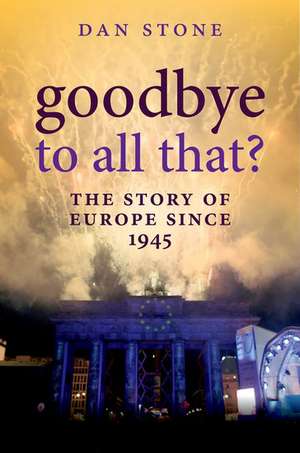
Goodbye to All That?: The Story of Europe Since 1945
Autor Dan Stoneen Limba Engleză Hardback – 23 ian 2014
Preț: 201.23 lei
Preț vechi: 246.78 lei
-18%
Puncte Express: 302
Carte tipărită la comandă
Livrare economică 04-09 decembrie
Livrare prin curier în România Termenul estimat este afișat lângă disponibilitate.
Transport gratuit de la 400.00 lei Plată online sau ramburs, în funcție de opțiunile comenzii.
Retur gratuit în 14 zile Comandă securizată și suport în română.
Specificații
ISBN-13: 9780199697717
ISBN-10: 019969771X
Pagini: 408
Ilustrații: 15 black and white halftones, 3 maps
Dimensiuni: 161 x 240 x 37 mm
Greutate: 0.75 kg
Editura: Oxford University Press
Colecția OUP Oxford
Locul publicării:Oxford, United Kingdom
ISBN-10: 019969771X
Pagini: 408
Ilustrații: 15 black and white halftones, 3 maps
Dimensiuni: 161 x 240 x 37 mm
Greutate: 0.75 kg
Editura: Oxford University Press
Colecția OUP Oxford
Locul publicării:Oxford, United Kingdom
V-ar putea interesa
-
 Representative Government in Modern EuropeMichael Gallagher-19%Preț: 462.54 lei571.03 lei
 -
 The Brussels I Regulation RecastAndrew Dickinson-33%Preț: 2041.19 lei3031.49 lei
 -
 -19%Preț: 315.48 lei391.57 lei
 -
 Concentration Camps: A Short HistoryDan StonePreț: 110.76 lei
 -
 Economics of the European UnionMichael Artis-24%Preț: 559.12 lei733.06 lei
 -
 -34%Preț: 710.51 lei1077.17 lei
 -
 The European Commission of the Twenty-First CenturyHussein Kassim-31%Preț: 745.54 lei1079.26 lei
 -
 EU Law after LisbonAndrea Biondi-31%Preț: 1000.07 lei1450.84 lei
 -
 -18%Preț: 1253.07 lei1528.14 lei
 -
 -18%Preț: 1305.94 lei1592.61 lei
 -
 European Security Governance: The European Union in a Westphalian WorldCharlotte WagnssonPreț: 292.98 lei
 -
 Preț: 362.94 lei
 -
 -16%Preț: 224.82 lei269.19 lei
 -
 Europe 2030Daniel Benjamin-21%Preț: 135.72 lei172.03 lei
 -
 -24%Preț: 225.31 lei295.87 lei
 -
 -18%Preț: 1260.08 lei1536.68 lei
 -
 Political Communication in European Parliamentary ElectionsMichaela Maier-18%Preț: 1248.98 lei1523.15 lei
 -
 The Rest of Our LivesDan StonePreț: 85.80 lei
 -
 Ice on FireDan StonePreț: 152.95 lei
 -
 European Union: Background & IssuesMorgan D Coelata-27%Preț: 1273.94 lei1736.18 lei
 -
 The Directory of EU Information Sources 2010Sheila Garrard-18%Preț: 3091.55 lei3770.18 lei
 -
 The Rest of the GospelDan StonePreț: 191.01 lei
Recenzii
A valuable contribution to the historiography of the post-war period.
... the book's innovative take on the postwar period ... is thus a worthy companion to Tony Judt's magisterial Postwar (2005). Stone's emphasis on the centrality of memory politics presents a new way of thinking about the connections between disparate phenomena, along with a new set of tools for explaining Europe's troubled present
Dan Stone has written the first serious history since Tony Judt of the continent after 1945
Dan Stone,[is] one of the finest historians of Europe working in Britain today
...have no fear. Dan Stone is far too fine a historian to see the past as unlinear and neatly packaged.
... a good historian must, on the basis of detailed knowledge and sound judgement, define and present the important issues, leaving "a lot of things" aside. The past six decades of Europe's history, full of complexities and transformations, imperatively need this sort of treatment, and they get it in Dan Stone's illuminating and stimulating book ... One of the book's admirable features is Stone's ability to devote serious attention, decade by decade, to both Eastern and Western Europe.
A well-researched and academic volume.
Compellingly written.
absorbing and provocative
this is a provocative, well-argued, and very readable synthesis that surely will inspire more debate on how to make sense of the second half of Europes twentieth century.
... the book's innovative take on the postwar period ... is thus a worthy companion to Tony Judt's magisterial Postwar (2005). Stone's emphasis on the centrality of memory politics presents a new way of thinking about the connections between disparate phenomena, along with a new set of tools for explaining Europe's troubled present
Dan Stone has written the first serious history since Tony Judt of the continent after 1945
Dan Stone,[is] one of the finest historians of Europe working in Britain today
...have no fear. Dan Stone is far too fine a historian to see the past as unlinear and neatly packaged.
... a good historian must, on the basis of detailed knowledge and sound judgement, define and present the important issues, leaving "a lot of things" aside. The past six decades of Europe's history, full of complexities and transformations, imperatively need this sort of treatment, and they get it in Dan Stone's illuminating and stimulating book ... One of the book's admirable features is Stone's ability to devote serious attention, decade by decade, to both Eastern and Western Europe.
A well-researched and academic volume.
Compellingly written.
absorbing and provocative
this is a provocative, well-argued, and very readable synthesis that surely will inspire more debate on how to make sense of the second half of Europes twentieth century.
Notă biografică
Dan Stone is Professor of Modern History at Royal Holloway, University of London. He is a historian of ideas who has written or edited fourteen books on subjects including the Holocaust, genocide, fascism and eugenics, including (as editor) the The Oxford Handbook of Postwar European History (2012).
Cuprins
- Preface
- Part I: The Rise of the Postwar Consensus
- 1: Consensus Enforced: Eastern Europe, 1944-1953
- 2: Consensus of Silence: Western Europe, 1944-1953
- Part II: Boom to Bust
- 3: Golden Years: Western Europe, 1953-1975
- 4: Catching Up? Eastern Europe, 1953-1975
- Part III: Shock Treatment
- 5: Neo-Liberalism: Western Europe, 1975-1989
- 6: Gerontocracy: Eastern Europe, 1975-1989
- Part IV: The Fall of the Postwar Consensus
- 7: Consensus Shattered
- 8: Memory Wars
- Conclusion
- Notes
- Index