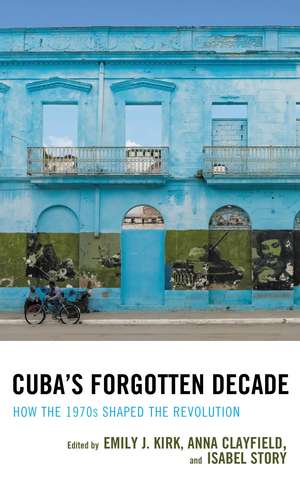
Cuba's Forgotten Decade: How the 1970s Shaped the Revolution: Bloomsbury Studies on Cuba
Editat de Emily J. Kirk, Anna Clayfield, Dr Isabel Story Contribuţii de Mervyn J. Bain, Guy Baron, H. Michael Erisman, Robert Huish, Antoni Kapcia, Dr. or Prof. John M. Kirk, Par Kumaraswami, Anne Luke, Hope Bastian, Raquel Ribeiro, Isaac Saney, Rosi Smithen Limba Engleză Paperback – 15 iul 2020
Din seria Bloomsbury Studies on Cuba
- 33%
 Preț: 550.36 lei
 - 33%
 Preț: 545.71 lei
 - 27%
 Preț: 255.41 lei
 - 33%
 Preț: 579.06 lei
 - 27%
 Preț: 284.39 lei
 - 32%
 Preț: 585.34 lei
 - 27%
 Preț: 257.00 lei
 - 34%
 Preț: 598.87 lei
 - 32%
 Preț: 583.50 lei
 - 24%
 Preț: 260.00 lei
 - 35%
 Preț: 529.09 lei
 - 33%
 Preț: 610.01 lei
 - 24%
 Preț: 597.00 lei
 - 33%
 Preț: 582.17 lei
 - 33%
 Preț: 616.72 lei
 - 33%
 Preț: 592.02 lei
Preț: 271.93 lei
Preț vechi: 370.05 lei
-27%
Puncte Express: 408
Carte tipărită la comandă
Livrare economică 05-19 decembrie
Livrare prin curier în România Termenul estimat este afișat lângă disponibilitate.
Transport gratuit de la 400.00 lei Plată online sau ramburs, în funcție de opțiunile comenzii.
Retur gratuit în 14 zile Comandă securizată și suport în română.
Specificații
ISBN-13: 9781498568753
ISBN-10: 1498568750
Pagini: 268
Dimensiuni: 152 x 229 x 18 mm
Greutate: 0.4 kg
Editura: Bloomsbury Publishing
Colecția Lexington Books
Seria Bloomsbury Studies on Cuba
Locul publicării:New York, United States
ISBN-10: 1498568750
Pagini: 268
Dimensiuni: 152 x 229 x 18 mm
Greutate: 0.4 kg
Editura: Bloomsbury Publishing
Colecția Lexington Books
Seria Bloomsbury Studies on Cuba
Locul publicării:New York, United States
Descriere
The 1970s have largely been overlooked in scholarly studies of the Cuban Revolution, or, at the very least, dismissed simply as a period of "Sovietization" characterized by widespread bureaucratization, institutionalization, and adherence to Soviet orthodoxy. Consequently, scant research exists that examines the major changes that took place across the decade and their role in determining the course of the Revolution. This book provides, for the first time, a comprehensive assessment of the 1970s which challenges prevailing interpretations. Drawing from multidisciplinary perspectives and exploring a range of areas-including politics, international relations, culture, education, and healthcare-its contributing authors demonstrate that the decade was a time of intense transformation which proved pivotal to the development of the Revolution. Indeed, many of the ideas, approaches, policies, and legislation developed and tested during the 1970s maintain a very visible legacy in contemporary Cuba. In highlighting the complexity of the 1970s, this volume ultimately aims to contribute to a greater understanding of the Cuban Revolution and how it chooses to face the challenges of the twenty-first century.
Cuprins
List of Acronyms
Introduction: Cuba's Forgotten Decade
Section One: Politics and International Relations
Chapter 1: Raúl's Decade? Or the First Swing of the Pendulum?
Antoni Kapcia
Chapter 2: Havana and Moscow in the 1970s: "Sovietization" in an Era of Détente
Mervyn Bain
Chapter 3: David Rising: Cuba and its Northern Goliath in the 1970s
H. Michael Erisman
Chapter 4: Canada-Cuba Relations in the 1970s
John M. Kirk
Chapter 5: Militarized by Moscow? Re-examining Soviet Influence on Cuba in the 1970s
Anna Clayfield
Section Two: Healthcare and Education
Chapter 6: No Secret Cure: Why the 1970s Hold the Mystery to Cuba's Health Paradox
Robert Huish
Chapter 7: Sexual Education in the 1970s: A Health-Based Approach
Emily J. Kirk
Chapter 8: Cuban Women and the State: Women's Lives in the 1970s and the New Reproductive Bargain
Hope Bastian Martínez
Chapter 9: The "Three Ps" (Perfecting, Professionalization, and Pragmatism) and their Limitations for Understanding Cuban Education in the 1970s
Rosi Smith
Chapter 10: Is Class Race, and Race Class? Blacks, the Cuban Revolution, and the 1970s
Isaac Saney
Section Three: Culture
Chapter 11: Black Skin, Red Masks? Decolonization and Literature in 1970s Cuba
Par Kumaraswami
Chapter 12: Utopian Cultural Construction: Cuban Cultural Organization in the 1970s
Isabel Story
Chapter 13: Cinema and Culture in the 1970s: The Art of Autonomy
Guy Baron
Chapter 14: "Seremos (otra vez) como el Che"? Angola as an "alternative narrative" to Cuba in the 1970s
Raquel Ribeiro
Chapter 15: Within the Revolution, Everyone: Cuba, Youth, and Interrogating the 1970s Paradigm
Anne Luke
Conclusion
Index
About the Contributors
Introduction: Cuba's Forgotten Decade
Section One: Politics and International Relations
Chapter 1: Raúl's Decade? Or the First Swing of the Pendulum?
Antoni Kapcia
Chapter 2: Havana and Moscow in the 1970s: "Sovietization" in an Era of Détente
Mervyn Bain
Chapter 3: David Rising: Cuba and its Northern Goliath in the 1970s
H. Michael Erisman
Chapter 4: Canada-Cuba Relations in the 1970s
John M. Kirk
Chapter 5: Militarized by Moscow? Re-examining Soviet Influence on Cuba in the 1970s
Anna Clayfield
Section Two: Healthcare and Education
Chapter 6: No Secret Cure: Why the 1970s Hold the Mystery to Cuba's Health Paradox
Robert Huish
Chapter 7: Sexual Education in the 1970s: A Health-Based Approach
Emily J. Kirk
Chapter 8: Cuban Women and the State: Women's Lives in the 1970s and the New Reproductive Bargain
Hope Bastian Martínez
Chapter 9: The "Three Ps" (Perfecting, Professionalization, and Pragmatism) and their Limitations for Understanding Cuban Education in the 1970s
Rosi Smith
Chapter 10: Is Class Race, and Race Class? Blacks, the Cuban Revolution, and the 1970s
Isaac Saney
Section Three: Culture
Chapter 11: Black Skin, Red Masks? Decolonization and Literature in 1970s Cuba
Par Kumaraswami
Chapter 12: Utopian Cultural Construction: Cuban Cultural Organization in the 1970s
Isabel Story
Chapter 13: Cinema and Culture in the 1970s: The Art of Autonomy
Guy Baron
Chapter 14: "Seremos (otra vez) como el Che"? Angola as an "alternative narrative" to Cuba in the 1970s
Raquel Ribeiro
Chapter 15: Within the Revolution, Everyone: Cuba, Youth, and Interrogating the 1970s Paradigm
Anne Luke
Conclusion
Index
About the Contributors
Recenzii
This collection offers a sound challenge to received historical wisdom about Cuba. Most fundamentally, it is a great example of what happens to historical truths when cultural, social, and political life are examined with one lens. This is as true for Cuba in the 1970s as it is anywhere, anytime.
A wide ranging look at all aspects of Cuba in the 1970s, a crucial inflexion point between the freewheeling revolution 'por la libre' of the 1960s and the institutionalized system that followed. Anyone interested in understanding the origins of contemporary Cuba should not miss this thoughtful assessment of an important yet often neglected decade.
A wide ranging look at all aspects of Cuba in the 1970s, a crucial inflexion point between the freewheeling revolution 'por la libre' of the 1960s and the institutionalized system that followed. Anyone interested in understanding the origins of contemporary Cuba should not miss this thoughtful assessment of an important yet often neglected decade.