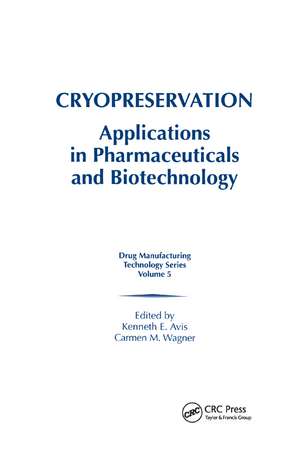
Cryopreservation: Applications in Pharmaceuticals and Biotechnology
Editat de Kenneth E. Avis, Carmen M. Wagneren Limba Engleză Paperback – 25 sep 2019
Preț: 340.84 lei
Puncte Express: 511
Carte tipărită la comandă
Livrare economică 21 noiembrie-05 decembrie
Livrare prin curier în România Termenul estimat este afișat lângă disponibilitate.
Transport gratuit de la 400.00 lei Plată online sau ramburs, în funcție de opțiunile comenzii.
Retur gratuit în 14 zile Comandă securizată și suport în română.
Specificații
ISBN-13: 9780367399399
ISBN-10: 0367399393
Pagini: 504
Dimensiuni: 156 x 234 x 25 mm
Greutate: 0.84 kg
Ediția:1
Editura: CRC Press
Colecția CRC Press
ISBN-10: 0367399393
Pagini: 504
Dimensiuni: 156 x 234 x 25 mm
Greutate: 0.84 kg
Ediția:1
Editura: CRC Press
Colecția CRC Press
V-ar putea interesa
-
 Drugs in PsychiatryBasant K. Puri-17%Preț: 430.48 lei521.13 lei
 -
 Pharmaceutical ChemistryDavid G. Watson-29%Preț: 299.90 lei421.09 lei
 -
 Principles and Practice of BioanalysisRichard F. Venn-18%Preț: 974.85 lei1188.84 lei
 -
 Polymers for Controlled Drug DeliveryPeter J. Tarcha-18%Preț: 5190.98 lei6330.46 lei
 -
 -18%Preț: 2494.97 lei3042.64 lei
 -
 Textbook of Receptor PharmacologyJohn C. Foreman-18%Preț: 1125.34 lei1372.37 lei
 -
 Principles of Pharmacology: The Pathophysiologic Basis of Drug TherapyDavid E. Golan MD, PhD-5%Preț: 676.19 lei711.78 lei
 -
 -18%Preț: 2653.82 lei3236.37 lei
 -
 Pharmaceutical Unit Operations: CoatingKenneth E. Avis-18%Preț: 1426.31 lei1739.40 lei
 -
 Botanical Dietary Supplements:Gail B. Mahady-18%Preț: 1009.27 lei1230.81 lei
Public țintă
Academic and Professional Practice & DevelopmentCuprins
Contents include: Principles & Scale-up: Cryopreservation for Cells, Microorganisms, Protein Solutions, Biopharmaceutical Formulations, & Biological Products. Large-Scale Cryopreservation: Process Development for Freezing & Thawing of Large Volumes of Cell Suspensions, Protein Solutions & Biological Products. Methods: Long-Term Preservation of Mammalian Cells & Microorganisms. Cryopreservation of Mammalian Cell Culture Materials. Freeze-Drying of Human Live Virus Vaccines. The Design & Use of Thermal Transport Containers.
Descriere
This book covers the principles of cryopreservation as they relate the preservation of viable cells and cell materials being developed for biopharmaceutical applications. Topics include: the principles of freezing and thawing cells, physiochemical phenomena, process and system design options, method selection considerations, preservation procedures, cryoprotectant additives, freeze-drying human live virus vaccines, and transport system selection criteria. Contributions from well-known experts such as Steven S. Lee, Thomas C. Pringle, William H. Siegel, Richard Wisniewski, and Fangdong Yin make this the single most important study available.