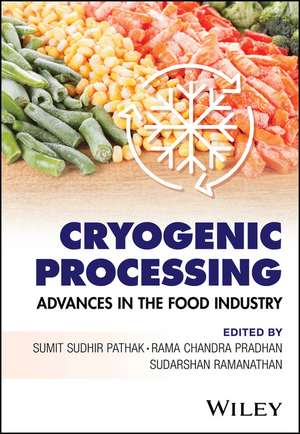
Cryogenic Processing
Editat de Sumit Sudhir Pathak, Rama Chandra Pradhan, Sudarshan Ramanathanen Limba Engleză Hardback – 27 apr 2026
Preț: 1126.41 lei
Preț vechi: 1237.81 lei
-9%
Puncte Express: 1690
Carte tipărită la comandă
Livrare economică 19 decembrie 26 - 02 ianuarie 27
Livrare prin curier în România Termenul estimat este afișat lângă disponibilitate.
Transport gratuit pentru acest produs Plată online sau ramburs, în funcție de opțiunile comenzii.
Retur gratuit în 14 zile Comandă securizată și suport în română.
Specificații
ISBN-13: 9781394280087
ISBN-10: 1394280084
Pagini: 320
Dimensiuni: 170 x 244 x 19 mm
Greutate: 0.71 kg
Editura: Wiley
Locul publicării:Chichester, United Kingdom
ISBN-10: 1394280084
Pagini: 320
Dimensiuni: 170 x 244 x 19 mm
Greutate: 0.71 kg
Editura: Wiley
Locul publicării:Chichester, United Kingdom
Notă biografică
SUMIT SUDHIR PATHAK is an Assistant Professor in the Division of Food Processing Technology at Karunya Institute of Technology and Sciences, Coimbatore, India. His research focuses on cryogenic applications in post-harvest operations of spices, herbs, and minor forest produce, with an emphasis on value addition and preservation. He has handled ANRF, DST funded project based on cryogenic processing of herbs.
RAMA CHANDRA PRADHAN is a Professor in the Department of Food Process Engineering at the National Institute of Technology, Rourkela, India. With over 16 years of teaching and research experience, his expertise spans food process engineering, post-harvest technology, value-added products, and equipment design for agricultural and food systems.
SUDARSHAN RAMANATHAN is a Junior Research fellow-ANRF, DST in the Division of Food Processing Technology at Karunya Institute of Technology and Sciences, Coimbatore, India. His research interests include cryogenic processing, non-thermal processing of medicinal herbs, novel extraction techniques, food preservation, and valorisation of fruit and vegetable by-products.
Cuprins
List of Contributors xix
Preface xxiii
1 Cryogenics: An Overview and Introduction 1
Sudarshan Ramanathan, Teena Bijo, and Sumit Sudhir Pathak
1.1 Introduction 1
1.2 Historical Developments of Cryogenics 2
1.3 Fundamental Concepts of Cryogenics 3
1.4 Cryogenic Equipment and Systems 10
1.5 Impacts and Application of Cryogenics 13
1.6 Influence of Cryogenics in Food 15
1.7 Safety in Cryogenics 16
1.8 Limitations and Challenges in Cryogenics 18
1.9 Summary and Structure of the Book 19
1.10 Conclusion 20
References 21
2 Molecular Foundations of Cryogenic Processes: A Chemical Perspective 25
Sakkaravarthy Abishek and Parameswaran Gurumoorthi
2.1 Introduction 25
2.2 Thermodynamic Principles of Cryogenic Systems 27
2.3 Kinetic and Molecular Motion in Cryogenic Conditions 30
2.4 Intermolecular Forces and Structural Stabilization 33
2.5 Cryogenic Effects on Biomolecules 34
2.6 Water Behaviour and Ice Crystallization in Cryogenic Processing in the Food Industry 37
2.7 Role of Cryogens: Liquid Nitrogen and Carbon Dioxide 38
2.8 Implications for Food Structure and Quality 40
2.9 Molecular Basis of Bioactive Stabilization 42
2.10 Emerging Trends and Future Directions 44
2.11 Conclusion and Summary 46
References 46
3 Cryogenic Impact on Food Material Properties: Structural and Functional Transformations 51
Bhupendra M. Ghodki, Krishna Bahadur Chhetri, and Naveen Kumar Mahanti
3.1 Introduction 51
3.2 Fundamentals of Cryogenic Processing in Food Industry 53
3.3 Structural Alterations in Cryogenically Treated Food Materials 56
3.4 Functional Enhancements and Impacts on Food Quality 63
3.5 Applications of Cryogenic Processing 65
3.6 Future Directions and Challenges 67
3.7 Conclusion 69
References 70
4 Industrial Design and Engineering Aspects in Cryogenic Applications 73
Awani Shrivastav and Tridib Kumar Goswami
4.1 Introduction 73
4.2 Fundamental Principles of Cryogenics 74
4.3 Industrial Role of Cryogenics in the Food Processing 76
4.4 Industrial Design and Engineering Considerations in Food Processing Applications 78
4.5 Role of LN 2 and LCO 2 in Food Processing Applications 82
4.6 Key Design Elements of Cryogenic Equipment for Food Processing Applications 83
4.7 Challenges and Future Trends 86
4.8 Conclusion and Summary 88
References 88
5 Cryogenic Freezing Process for the Preservation of Fruits and Vegetables 95
Prateek Gururani, Abhirup Mitra, Jesni Manjula Sivaprasad, and Mahipal Singh Tomar
5.1 Introduction 95
5.2 Overview of Cryogenics in Food Processing 96
5.3 Conventional Freezing Methods for Fruits and Vegetables 97
5.4 Cryogenic Freezing Techniques 98
5.5 Case Studies on Cryogenic Freezing of Fruits and Vegetables 101
5.6 Advantages and Limitations of Cryogenic Freezing 103
5.7 Conclusion 104
References 104
6 Cold Revolution: Cryogenic Innovations in Dairy Production and Preservation 107
Revathi P. and Sudarshan Ramanathan
6.1 Introduction 107
6.2 Cryogenics in Dairy Production and Preservation 108
6.3 Cryogenic Processing of Dairy Products 112
6.4 Cryogenic Drying: A Revolution in Milk Powder Production 114
6.5 Ice Cream and Frozen Desserts 116
6.6 Cryogenic Technology in Fermented Milk Processing 118
6.7 Cryogenic Preservation of Cultures and Enzymes 120
6.8 Cryogenic Technology in Value- Added Dairy Products 122
6.9 Technological Evolution of Cryogenic Systems 125
6.10 Challenges and Future Prospects 125
6.11 Conclusion 126
References 126
7 Advanced Cryogenic Applications in Plant- Based Food Preservation 129
Mahipal Singh Tomar, Rahul Kumar Sharma, and Abhirup Mitra
7.1 Introduction 129
7.2 Emerging Trend for Plant- Based Foods 130
7.3 Basic Principles and Cryogenic Techniques for Plant- Based Product Development 133
7.4 Engineering Challenges in Cryogenic Plant- Based Food Processing 136
7.5 Conclusion and Future Perspective 138
References 138
8 Frosty Enhancements: Cryogenic Approaches in Meat, Poultry, and Marine Product Processing 141
Sourav Misra, Sanchita Biswas Murmu, Sivashankari Manickam, Rahul Kumar Rout, Ankit Kumar, Sitesh Kumar, and Ritu Bharat Kukde
8.1 Introduction 141
8.2 Cryobiology: Principles and Methods 141
8.3 Cryogenic Freezers for Meat, Poultry, and Marine Products 144
8.4 Effect of Cryogenic Processing on Quality Changes of Meats 146
8.5 Effect of Cryogenic Processing on Quality Changes of Marine/Aquatic Products 149
8.6 Cryogenic Freezing of Shrimp 154
8.7 Major Considerations for Design and Safety 156
8.8 Safety Measures in Cryogenics 156
8.9 Conclusion 156
References 158
9 Spice Chills: Cryogenic Technologies in Spice Processing 163
Gintu Sara George, Akshay D. Sonawane, and Shivanand S. Shirkole
9.1 Introduction 163
9.2 Overview of Conventional Spice Processing Techniques 164
9.3 Cryogenic Grinding Technology 168
9.4 Design and Engineering of Cryogenic Grinding Equipment 171
9.5 Impact on Spice Quality and Preservation 173
9.6 Challenges and Limitations of Cryogenic Grinding 175
9.7 Conclusion 175
References 175
10 Preserving Nature's Remedies: Cryogenic Applications in Herbal Medicine Processing 181
K. U. Pavitra Krishna
10.1 Introduction 181
10.2 Herbal Medicine Processing 183
10.3 Quality Control for Phytomedicines 184
10.4 Importance of Cryogenic Applications in Herbal Medicine Processing 193
10.5 Conclusion 194
References 195
11 Vegan Chills: Cryogenic Technologies for Vegan- Based Products 205
Dhiraj Kumar Yadav, Khalid Bashir, Pintu Choudhary, and Shweta Suri
11.1 Introduction 205
11.2 Concept of Vegan Chills 206
11.3 Concept of Cryogenic Techniques 207
11.4 Cryogenic Principle and Mechanism 208
11.5 Cryogenic Techniques for Vegan Products 210
11.6 Effect of Cryogenic Processing on Quality Characteristics of Vegan Products 216
11.7 Applications of Cryogenically Treated Vegan Products 220
11.8 Consumer Attitudes Towards Frozen Vegan Products and Cryogenic Processing 221
11.9 Future Perspectives and Challenges Associated with Production of Vegan Products 222
11.10 Conclusion 223
References 224
12 Impact of Cryogenics on Microbial Populations and Food Safety 227
Pratiksha Wankhede, Jessica Hannah, Sumit Sudhir Pathak, Surendra Babu, and Bhushan Chaudhari
12.1 Introduction 227
12.2 Overview of Cryogenics in Food Microbiology 229
12.3 Role of Temperature in Microbial Survival and Proliferation 231
12.4 Mechanisms of Microbial Inactivation Through Cryogenic Freezing 232
12.5 Comparison of Cryogenic Freezing with Conventional Freezing Methods 233
12.6 Safety Considerations in Cryogenic Processing 234
12.7 Case Studies on Cryogenic Processing and Microbial Safety 235
12.8 Challenges, Limitations, and Future Direction 237
12.9 Conclusion 240
References 241
13 Environmental Impact and Sustainability of Cryogenic Processing in Food Industries 243
Abhishek Kumar
13.1 Introduction 243
13.2 Technologies and Mechanisms 245
13.3 Environmental Impact Analysis 247
13.4 Challenges in Cryogenic Processing 248
13.5 Benefits of Cryogenic Processing 251
13.6 Sustainability Considerations 253
13.7 Case Studies and Applications 256
13.8 Future Directions in Cryogenic Processing 257
13.9 Conclusion 260
References 260
14 Advancements and Future Avenues in Cryo- Processing Technologies in Food 267
Keerthivasan Ragupathi, Sankar Manokaran, and Krishnakumar Panneerselvam
14.1 Introduction 267
14.2 Cryogens 268
14.3 Advanced Cryogenic Processing in the Food Sector 269
14.4 Cryogenic Grinding 272
14.5 Advantages of Cryogenic Technology 274
14.6 Challenges of Cryogenic Processing 275
14.7 Integration of Artificial Intelligence in Cryogenic Processing 275
14.8 Hybrid Cryogenic Systems 276
14.9 Quantum Cryogenics in Food: A Theoretical Approach 276
14.10 Precision Cryogenic Processing 277
14.11 Advances in Cryogenic Equipment and Material Science 277
14.12 Start- ups, Collaborations, and Commercial Innovations 279
14.13 Future Goals of Cryogenics 280
14.14 Technological Gap 281
14.15 Vision 2030: Strategic Roadmap for Cryogenic Food Processing 281
14.16 Conclusion 282
References 282
Index 287