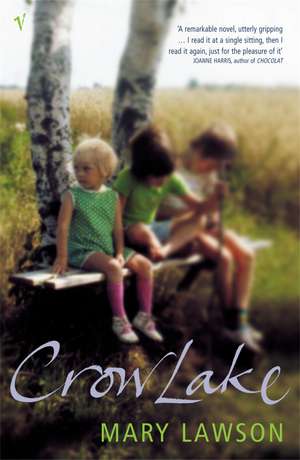
Crow Lake
Autor Mary Lawsonen Limba Engleză Paperback – 6 feb 2003
Ce rămâne dintr-o familie atunci când tragedia lovește brusc, lăsând patru copii să navigheze singuri într-un peisaj la fel de necruțător precum propria lor durere? În Crow Lake, Mary Lawson construiește o miza psihologică profundă în jurul lui Kate Morrison, o femeie care a reușit să evadeze din izolarea nordului Canadei pentru o carieră academică, dar care rămâne prizoniera unui trecut pe care nu îl poate procesa. Suntem de părere că forța acestui roman rezidă în contrastul dintre precizia rece a microscopului prin care Kate privește lumea și haosul emoțional mocnit care îi definește relația cu frații săi. Atmosfera este una de tip „slow-burn”, unde tensiunea nu provine din evenimente explozive, ci din resentimentele îngropate adânc și din tăcerile încărcate dintre Luke, Matt și Kate. În tradiția scriitoarei Donna Morrissey din Kit's Law, acest roman reimaginează viața în comunitățile rurale izolate nu ca pe o idilă, ci ca pe un spațiu al supraviețuirii, unde asprimea decorului natural oglindește dificultățile interioare ale personajelor. Totuși, spre deosebire de alte cronici de familie, Lawson introduce un umor fin, sfâșietor, care îndulcește tragismul situației. Privind retrospectiv, Crow Lake stabilește temele fundamentale pe care autoarea le va explora și în lucrări ulterioare precum The Other Side of the Bridge sau A Town Called Solace: legătura indisolubilă cu pământul natal și modul în care deciziile luate în tinerețe ne modelează iremediabil maturitatea. Este o lectură despre datoria morală și despre momentul dureros în care realizăm că cei pe care îi idolatrizam în copilărie sunt, în final, doar oameni supuși greșelii.
Preț: 59.03 lei
Preț vechi: 72.07 lei
-18%
Carte disponibilă
Livrare economică 29 octombrie-04 noiembrie
Livrare express 10-16 octombrie pentru 36.36 lei
Specificații
ISBN-10: 0099429322
Pagini: 352
Dimensiuni: 130 x 198 x 27 mm
Greutate: 0.29 kg
Editura: Vintage Publishing
Locul publicării:United Kingdom
V-ar putea interesa
-
 PASTURES NEW EXAIIE PBClare BaldingPreț: 105.67 lei
 -
 The Other Side of the BridgeMary Lawson-18%Preț: 64.40 lei78.68 lei
 -
 Road EndsMary Lawson-18%Preț: 58.64 lei71.84 lei
 -
 A Beautiful FamilyJennifer Trevelyan-33%Preț: 72.25 lei108.51 lei
 -
 -17%Preț: 59.81 lei72.27 lei
 -
 Preț: 71.08 lei
 -
 -26%Preț: 57.72 lei78.45 lei
 -
 Groundwater: ‘Complex, chilling, masterful' Financial TimesThomas McMullan-26%Preț: 99.21 lei134.96 lei
 -
 The ForrestsEmily Perkins-26%Preț: 53.04 lei71.38 lei
 -
 BroodJackie Polzin-34%Preț: 46.36 lei70.57 lei
 -
 Birdlane Island: A NovelV.C. Andrews-19%Preț: 113.93 lei141.19 leiRecomandat
 -
 The Bright YearsSarah DamoffPreț: 157.05 leiRecomandat
 -
 Big Kiss, Bye-ByeClaire-Louise BennettPreț: 91.80 lei
 -
 Like FamilyErin White-19%Preț: 87.96 lei108.25 lei
 -
 One Summer in ProvenceCarol DrinkwaterPreț: 72.58 lei
 -
 Wild Dark ShoreCharlotte McConaghyPreț: 71.25 lei
 -
 Carried AwayAlice Munro-32%Preț: 93.25 lei137.82 lei
 -
 The Long Delirious Burning BlueSharon BlackiePreț: 79.29 lei
 -
 Saturday Night at the Lakeside Supper ClubJ. Ryan StradalPreț: 108.72 lei
De ce să citești această carte
Recomandăm Crow Lake cititorilor care apreciază proza contemplativă și studiile de personaj minuțioase. Veți descoperi o poveste despre sacrificiu și mândrie, plasată într-un decor canadian captivant. Este o carte care nu oferă răspunsuri facile, ci invită la o reflecție profundă asupra modului în care ne purtăm traumele timpurii în viața adultă, fiind ideală pentru fanii realismului psihologic și ai sagăi de familie.
Despre autor
Mary Lawson s-a născut și a crescut într-o comunitate agricolă din sud-vestul Ontario, fiind rudă îndepărtată a celebrei L. M. Montgomery. Deși s-a mutat în Anglia în 1968, proza sa rămâne profund ancorată în peisajul canadian, în special în regiunea Scutului Canadian, ale cărei stânci rotunjite îi servesc drept punct de reper emoțional. Lawson explorează recurent influența formativă a copilăriei asupra destinului adult, temă ce a devenit semnătura sa literară. Succesul debutului său a fost confirmat ulterior prin selecția pe lista lungă a premiului Booker pentru romanele sale ulterioare.
Notă biografică
www.marylawson.ca
Descriere scurtă
Kate Morrison has spent years away from Crow Lake, the small northern Ontario farming community where her childhood changed in an instant. After her parents died in an accident, she and her siblings clung to one another while trying to remain a family.
Her brilliant brother Matt once seemed destined for a life far beyond the farm. Kate escaped through education and the natural world, but she could not escape the story she had built around Matt's sacrifice or the neighbouring Pye family's violence and secrets. Returning home as an adult, she must look again at what she believed she knew.
Crow Lake is a restrained and deeply affecting novel about siblings, rural life, grief, ambition and the cost of survival.
'I've been trying to tell everyone I know about Mary Lawson . . . Each one of her novels is just a marvel' Anne Tyler
'A remarkable novel, utterly gripping...I read it at a single sitting, then I read it again, just for the pleasure of it' Joanne Harris
'Full of blossoming insights and emotional acuity...a compelling and serious page-turner' Observer
Descriere
Extras
My great-grandmother Morrison fixed a book rest to her spinning wheel so that she could read while she was spinning, or so the story goes. And one Saturday evening she became so absorbed in her book that when she looked up, she found that it was half past midnight and she had spun for half an hour on the Sabbath day. Back then, that counted as a major sin.
I’m not recounting that little bit of family lore just for the sake of it. I’ve come to the conclusion recently that Great-Grandmother and her book rest have a lot to answer for. She’d been dead for decades by the time the events occurred that devastated our family and put an end to our dreams, but that doesn’t mean she had no influence over the final outcome. What took place between Matt and me can’t be explained without reference to Great-Grandmother. It’s only fair that some of the blame should be laid at her door.
There was a picture of her in my parents’ room while I was growing up. I used to stand in front of it, as a very small child, daring myself to meet her eyes. She was small, tight-lipped, and straight, dressed in black with a white lace collar (scrubbed ruthlessly, no doubt, every single evening and ironed before dawn each day). She looked severe, disapproving, and entirely without humor. And well she might; she had fourteen children in thirteen years and five hundred acres of barren farmland on the Gaspe Peninsula. How she found time to spin, let alone read, I’ll never know.
Of the four of us, Luke, Matt, Bo, and I, Matt was the only one who resembled her at all. He was far from grim, but he had the same straight mouth and steady gray eyes. If I fidgeted in church and got a sharp glance from my mother, I would peer sideways up at Matt to see if he had noticed. And he always had, and looked severe, and then at the last possible moment, just as I was beginning to despair, he would wink.
Matt was ten years older than I, tall and serious and clever. His great passion was the ponds, a mile or two away across the railroad tracks. They were old gravel pits, abandoned years ago after the road was built, and filled by nature with all manner of marvelous wriggling creatures. When Matt first started taking me back to the ponds I was so small he had to carry me on his shoulders through the woods with their luxuriant growth of poison ivy, along the tracks, past the dusty boxcars lined up to receive their loads of sugar beets, down the steep sandy path to the ponds themselves. There we would lie on our bellies while the sun beat down on our backs, gazing into the dark water, waiting to see what we would see.
There is no image of my childhood that I carry with me more clearly than that; a boy of perhaps fifteen or sixteen, fair-haired and lanky; beside him a little girl, fairer still, her hair drawn back in braids, her thin legs burning brown in the sun. They are both lying perfectly still, chins resting on the backs of their hands. He is showing her things. Or rather, things are drifting out from under rocks and shadows and showing themselves, and he is telling her about them.
“Just move your finger, Kate. Waggle it in the water. He’ll come over. He can’t resist.”
Cautiously the little girl waggles her finger; cautiously a small snapping turtle slides over to investigate.
“See? They’re very curious when they’re young. When he gets older, though, he’ll be suspicious and bad-tempered.”
“Why?”
The old snapper they had trapped out on land once had looked sleepy rather than suspicious. He’d had a wrinkled, rubbery head, and she had wanted to pat it. Matt held out a branch as thick as his thumb and the snapper chopped it in two.
“Their shells are small for the size of their bodies, smaller than most turtles, so a lot of their skin is exposed. It makes them nervous.”
The little girl nods, and the ends of her braids bob up and down in the water, making tiny ripples which tremble out across the surface of the pond. She is completely absorbed.
Hundreds of hours, we must have spent that way over the years. I came to know the tadpoles of the leopard frogs, the fat gray tadpoles of the bullfrogs, the tiny black wriggling ones of toads. I knew the turtles and the catfish, the water striders and the newts, the whirligigs spinning hysterically over the surface of the water. Hundreds of hours, while the seasons changed and the pond life died and renewed itself many times, and I grew too big to ride on Matt’s shoulders and instead picked my way through the woods behind him. I was unaware of these changes of course, they happened so gradually, and children have very little concept of time. Tomorrow is forever, and years pass in no time at all.
Chapter One
When the end came, it seemed to do so completely out of the blue, and it wasn’t until long afterward that I was able to see that there was a chain of events leading up to it. Some of those events had nothing to do with us, the Morrisons, but were solely the concern of the Pyes, who lived on a farm about a mile away and were our nearest neighbors. The Pyes were what you’d call a problem family, always had been, always would be, but that year, within the privacy of their big old gray-painted farmhouse, offstage as far as the rest of the community was concerned, their problems were developing into a full-scale nightmare. The other thing we didn’t know was that the Pye nightmare was destined to become entangled with the Morrison dream. Nobody could have predicted that.
There’s no end to how far back you can go, of course, when you’re trying to figure out where something started. The search can take you back to Adam and beyond. But for our family there was an event that summer catastrophic enough to be the start of practically anything. It took place on a hot, still Saturday in July when I was seven years old, and brought normal family life to an end; even now, almost twenty years later, I find it hard to get any sort of perspective on it.
The only positive thing you can say about it is that at least everything ended on a high note, because the previous day, our last day together as a family, my parents had learned that Luke, my “other” brother, other than Matt, had passed his senior matriculation and won a place at teachers college. Luke’s success was something of a surprise because, to put it mildly, he was not a scholar. I remember reading somewhere a theory to the effect that each member of a family has a role, ”the clever one,” “the pretty one,” “the selfish one.” Once you’ve been established in the role for a while, you’re stuck with it, no matter what you do, people will still see you as whatever-it-was, but in the early stages, according to the theory, you have some choice as to what your role will be. If that’s the case, then early on in life Luke must have decided that what he really wanted to be was “the problem one.” I don’t know what influenced his choice, but it’s possible that he’d heard the story of Great-Grandmother and her famous book rest once too often. That story must have been the bane of Luke’s life. Or one of the banes, the other would have been having Matt as a brother. Matt was so obviously Great-Grandmother’s true intellectual heir that there was no point in Luke even trying. Better, then, to find what he was naturally good at, raising our parents’ blood pressure, say, and practice, practice, practice.
But somehow, in spite of himself, here he was at the age of nineteen having passed his exams. After three generations of striving, a member of the Morrison family was about to go on to higher education.
Recenzii
— Joanne Harris, author of Chocolat
“I didn’t read Crow Lake so much as I fell in love with it. This is one beautiful book.”
— David Macfarlane, author of Summer Gone
"A finely crafted debut ... conveys an astonishing intensity of emotion, almost Proustian in its sense of loss and regret."
— Kirkus Reviews (starred review)
“Beautifully written, carefully balanced, Mary Lawson constructs a history of sacrifice, emotional isolation and family love without sounding a false note.” -- Daily Mail (London)
“A lot of readers are going to surrender themselves to the magic of Crow Lake.”
— The Globe and Mail
“The best [first novel for 2002] that I have read so far…compulsively readable.”
— Sandra Martin, The Globe and Mail (Dec. 27, 2001)
“Crow Lake…is a spellbinding story…a marvelous story….The bitter land and climate of Northern Ontario are like characters in this story of four orphaned children struggling to stay together as a family….The language is subtle but beautiful. The reader is drawn into the lives of the characters…. The prospects for success are endless.”
—W.P. Kinsella, First Novels
“Crow Lake mesmerizes. … Crow Lake may be one of the loveliest novels you almost ever read.”
— The Telegram
“Crow Lake [is] superb, elegant…. Lawson is a brilliant storyteller; she takes her time in laying the foundation of her tale and layering on the complexities. She’s also an elegant stylist; her prose is lyrically thoughtful…. The depth, honesty and feeling throughout are superbly wrought. Crow Lake is a wondrous thing -- it’s a new Canadian classic.”
— The Hamilton Spectator
“The assurance with which Mary Lawson handles both reflection and violence makes her a writer to read and watch….. Peripheral portraits are skillfully drawn. Pot-banging Bo, with her minimal vocabulary of mostly shouted words, speaks to the heart without a scrap of sentimentality. The combative Cranes, unusual among fictional academics, are funny without being ridiculous and square off over the tablecloth with intelligence intact…. Most impressive are the nuanced and un-self-conscious zoological metaphors that thread through the text.”
— The New York Times
“Lawson delivers a potent combination of powerful character writing and gorgeous description of the land. Her sense of pace and timing is impeccable throughout, and she uses dangerous winter weather brilliantly to increase the tension as the family battles to survive. This is a vibrant, resonant novel by a talented writer whose lyrical evocative writing invites comparisons to Rick Bass and Richard Ford.”
— Publishers Weekly (starred review)
"Beautifully written, carefully balanced, Mary Lawson constructs a history of sacrifice, emotional isolation and family love without sounding a false note or a showy sentence."
— Elizabeth Buchan, Daily Mail (UK)
“Crow Lake: deep, clear and teeming with life. A lot of readers are going to surrender themselves to the magic of Crow Lake...So have I. Within days, you'll see people reading Crow Lake in odd places as they take quick breaks from the business of their lives. You'll also hear people say, ‘I stayed up all night reading this book by Mary Lawson.’ Mary Lawson, Mary Lawson. Remember the name…. Kate Morrison’s voice overturns convention and makes everything fresher, larger, livelier than it first appears…. She is very special. So is Crow Lake…. This is the real thing.”
—Terry Rigelhof, The Globe and Mail
"Every detail in this beautifully written novel rings true, the characters so solid we almost feel their flesh. Bo must be one of the most vividly realized infants in recent literature. Lawson creates a community without ever giving in to the Leacockian impulse to poke fun at small-town ways, instead showing respect to lives shaped by hard work and starved for physical comfort. The adult Kate’s alienation from Crow Lake is initially difficult to accept, for everything in Kate’s life, including her career in science, reflects the values of her formative years on the farm. Soon, though, her crippling guilt becomes the mystery that draws the reader on."
— Maureen Garvie, Quill & Quire starred review
“Lawson's narrative flows effortlessly in ever-increasing circles, swirling impressions in the reader's mind until form takes shape and the reader is left to reflect on the whole. Crow Lake is a wonderful achievement that will ripple in and out the reader's consciousness long after the last page is turned.”
— Amazon.co.uk
“Critics are raving about…Crow Lake, a tightly plotted page-turner about sibling love, murder, and invertebrate zoology in rural Ontario, set in the 1950s and ‘60s."
— Judy Stoffman, The Toronto Star
"Lawson achieves a breathless anticipatory quality in her surprisingly adept first novel, in which a child tells the story, but tells it very well indeed.”
— Danise Hoover, Booklist