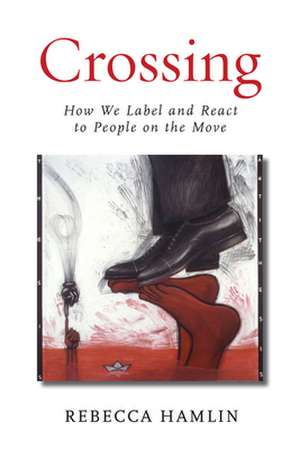
Crossing
Autor Rebecca Hamlinen Limba Engleză Hardback – 11 mai 2021
Preț: 616.87 lei
Preț vechi: 761.57 lei
-19%
Puncte Express: 925
Carte tipărită la comandă
Livrare economică 18 noiembrie-02 decembrie
Livrare prin curier în România Termenul estimat este afișat lângă disponibilitate.
Transport gratuit pentru acest produs Plată online sau ramburs, în funcție de opțiunile comenzii.
Retur gratuit în 14 zile Comandă securizată și suport în română.
Specificații
ISBN-13: 9781503610606
ISBN-10: 1503610608
Pagini: 224
Dimensiuni: 155 x 231 x 20 mm
Greutate: 0.42 kg
Editura: Stanford University Press
ISBN-10: 1503610608
Pagini: 224
Dimensiuni: 155 x 231 x 20 mm
Greutate: 0.42 kg
Editura: Stanford University Press
Notă biografică
Rebecca Hamlin is Associate Professor of Legal Studies and Political Science at the University of Massachusetts, Amherst. She is the author of Let Me Be a Refugee (2014).
Cuprins
1. The Migrant/Refugee Binary
2. Uneven Sovereignties
3. Academic Study
4. The United Nations High Commissioner for Refugees
5. The Global South
6. Arrivals in Europe
7. American Public Discourse
8. Beyond Binary Thinking
2. Uneven Sovereignties
3. Academic Study
4. The United Nations High Commissioner for Refugees
5. The Global South
6. Arrivals in Europe
7. American Public Discourse
8. Beyond Binary Thinking