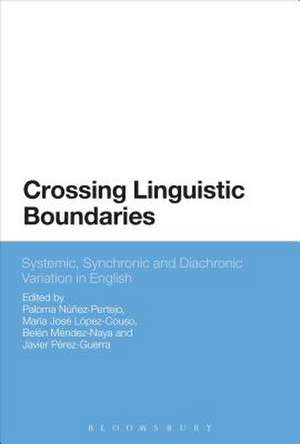
Crossing Linguistic Boundaries: Systemic, Synchronic and Diachronic Variation in English
Editat de Dr Paloma Núñez-Pertejo, Dr María José López-Couso, Dr Belén Méndez-Naya, Dr Javier Pérez-Guerraen Limba Engleză Hardback – 26 dec 2019
Approaching tensions in the areas of English phonology and phonetics, pragmatics, semantics, morphology and syntax, chapters discuss not only British and American English but also a wide variety of geographical variants. Containing synchronic and diachronic studies covering different periods in the history of English, Crossing Linguistic Boundaries will appeal to anyone interested in linguistic variation in English.
Preț: 850.50 lei
Preț vechi: 1263.59 lei
-33%
Puncte Express: 1276
Carte tipărită la comandă
Livrare economică 01-15 decembrie
Livrare prin curier în România Termenul estimat este afișat lângă disponibilitate.
Transport gratuit pentru acest produs Plată online sau ramburs, în funcție de opțiunile comenzii.
Retur gratuit în 14 zile Comandă securizată și suport în română.
Specificații
ISBN-13: 9781350053854
ISBN-10: 1350053856
Pagini: 288
Dimensiuni: 156 x 234 mm
Greutate: 0.58 kg
Editura: Bloomsbury Publishing
Colecția Bloomsbury Academic
Locul publicării:London, United Kingdom
ISBN-10: 1350053856
Pagini: 288
Dimensiuni: 156 x 234 mm
Greutate: 0.58 kg
Editura: Bloomsbury Publishing
Colecția Bloomsbury Academic
Locul publicării:London, United Kingdom
Cuprins
Foreword
Introduction (Paloma Núñez-Pertejo, University of Santiago de Compostela, Spain; María José López-Couso, University of Santiago de Compostela, Spain; Belén Méndez-Naya, University of Santiago de Compostela, Spain; Javier Pérez-Guerra, University of Vigo, Spain)
Part I: Tensioning the system
1. Prosodic templates in English idiom and fixed expressions, Raymond Hickey (University of Duisburg and Essen, Germany)
2. Word-search as word-formation? The case of uh and um, Gunnel Tottie (University of Zurich, Switzerland)
3. Demonstratives licensed by cultural co-presence, Ryan B. Doran (University of Regina, Canada) and Gregory Ward (Northwestern University, USA)
4. The fall and rise of English any, Nikolaus Ritt, Andreas Baumann and Christina Prömer (University of Vienna, Austria)
5. Revisiting 'it-extraposition': The historical development of constructions with matrices (it)/(there) be + NP followed by a complement clause, Kristin Davidse (KU Leuven, Belgium) and An Van Linden (University of Liège, Belgium)
6. On grammatical change and linguistic environments, Bert Cornillie (KU Leuven, Belgium)
7. Grammaticalizing adverbs of English: the case of still, Diana Lewis (University of Aix-Marseille, France)
Part II: Synchronic and diachronic variation
8. How British is Gibraltar English? Manfred Krug, Ole Schützler and Valentin Werner (University of Bamberg, Germany)
9. Singular THEY in Asian Englishes: A case of linguistic democratization?, Lucía Loureiro-Porto (University of the Balearic Islands, Spain)
10. It is important that mandatives (should) be studied across different World Englishes and from a construction grammar perspective, Marianne Hundt (University of Zurich, Switzerland).
11. The stative progressive in Singapore English: a panchronic perspective, Debra Ziegeler and Christophe Lenoble (University of Sorbonne Nouvelle-Paris 3, France)
Index
Introduction (Paloma Núñez-Pertejo, University of Santiago de Compostela, Spain; María José López-Couso, University of Santiago de Compostela, Spain; Belén Méndez-Naya, University of Santiago de Compostela, Spain; Javier Pérez-Guerra, University of Vigo, Spain)
Part I: Tensioning the system
1. Prosodic templates in English idiom and fixed expressions, Raymond Hickey (University of Duisburg and Essen, Germany)
2. Word-search as word-formation? The case of uh and um, Gunnel Tottie (University of Zurich, Switzerland)
3. Demonstratives licensed by cultural co-presence, Ryan B. Doran (University of Regina, Canada) and Gregory Ward (Northwestern University, USA)
4. The fall and rise of English any, Nikolaus Ritt, Andreas Baumann and Christina Prömer (University of Vienna, Austria)
5. Revisiting 'it-extraposition': The historical development of constructions with matrices (it)/(there) be + NP followed by a complement clause, Kristin Davidse (KU Leuven, Belgium) and An Van Linden (University of Liège, Belgium)
6. On grammatical change and linguistic environments, Bert Cornillie (KU Leuven, Belgium)
7. Grammaticalizing adverbs of English: the case of still, Diana Lewis (University of Aix-Marseille, France)
Part II: Synchronic and diachronic variation
8. How British is Gibraltar English? Manfred Krug, Ole Schützler and Valentin Werner (University of Bamberg, Germany)
9. Singular THEY in Asian Englishes: A case of linguistic democratization?, Lucía Loureiro-Porto (University of the Balearic Islands, Spain)
10. It is important that mandatives (should) be studied across different World Englishes and from a construction grammar perspective, Marianne Hundt (University of Zurich, Switzerland).
11. The stative progressive in Singapore English: a panchronic perspective, Debra Ziegeler and Christophe Lenoble (University of Sorbonne Nouvelle-Paris 3, France)
Index
Recenzii
The contributions in this innovative volume by leading scholars in English Linguistics explore the fascinating 'tensions' that occur at the boundaries of the traditional linguistic domains of syntax, morphology, semantics/pragmatics and phonetics/phonology from diachronic, synchronic and cross-varietal perspectives. Highly recommended.
How to account for uh and um in written English or the structural impact of Discourse Traditions over time? In this engaging volume, leading experts address the huge variability of English by discussing existing, emerging and co-evolving features of the language and show how understanding them requires insights from different linguistic disciplines.
How to account for uh and um in written English or the structural impact of Discourse Traditions over time? In this engaging volume, leading experts address the huge variability of English by discussing existing, emerging and co-evolving features of the language and show how understanding them requires insights from different linguistic disciplines.