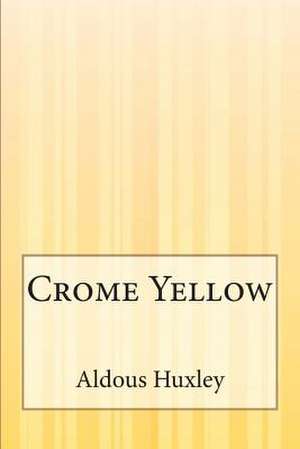
Crome Yellow
Autor Aldous Huxleyen Limba Engleză Paperback
Preț: 56.06 lei
Puncte Express: 84
Carte disponibilă
Livrare economică 16-30 noiembrie
Livrare prin curier în România Termenul estimat este afișat lângă disponibilitate.
Transport gratuit de la 400.00 lei Plată online sau ramburs, în funcție de opțiunile comenzii.
Retur gratuit în 14 zile Comandă securizată și suport în română.
Specificații
ISBN-13: 9781505422207
ISBN-10: 1505422205
Pagini: 174
Dimensiuni: 152 x 229 x 9 mm
Greutate: 0.24 kg
Editura: CREATESPACE
ISBN-10: 1505422205
Pagini: 174
Dimensiuni: 152 x 229 x 9 mm
Greutate: 0.24 kg
Editura: CREATESPACE
V-ar putea interesa
-
 To the LighthouseVirginia WoolfPreț: 28.01 lei
 -
 Antic HayAldous Huxley-18%Preț: 59.20 lei72.33 lei
 -
 Point Counter PointAldous Huxley-16%Preț: 68.70 lei81.70 lei
 -
 Brave New WorldAldous HuxleyPreț: 58.71 lei
 -
 Your Inner FishNeil Shubin-5%Preț: 88.05 lei92.67 lei
 -
 Keep the Aspidistra FlyingGeorge Orwell-26%Preț: 53.15 lei71.65 lei
 -
 The Picture of Dorian GrayOscar WildePreț: 35.93 lei
 -
 Pride and PrejudiceJane AustenPreț: 44.28 lei
 -
 HuxleyBen Mauro-21%Preț: 157.99 lei199.74 lei
 -
 CandideVoltairePreț: 32.48 lei
 -
 A. E. HousmanA. E. HousmanPreț: 70.16 lei
 -
 The History ManMalcolm Bradbury-40%Preț: 46.43 lei77.42 lei
 -
 Preț: 130.36 lei
 -
 Our EveningsAlan HollinghurstPreț: 73.72 lei
 -
 The Pilgrim's ProgressJohn BunyanPreț: 46.43 lei
 -
 Jeeves AgainAlan TitchmarshPreț: 157.86 lei
 -
 If Nick Drake Came to My HouseMackenzie CrookPreț: 120.08 lei
 -
 The Bonfire of the InsanitiesJohn CracePreț: 121.47 lei
 -
 DublinersJames JoycePreț: 28.01 lei
 -
 Life With PicassoFrancoise Gilot-26%Preț: 69.81 lei93.97 lei
 -
 What Ho! P. G. Wodehouse on ClassPaul KentPreț: 49.37 lei
 -
 Preț: 34.20 lei
 -
 The Great Gatsby: 100th Anniversary Edition (The Original 1925 Classic)F. Scott Fitzgerald-13%Preț: 19.85 lei22.82 lei
 -
 The Doors of Perception & Heaven and HellAldous Huxley-5%Preț: 48.06 lei50.59 lei
Descriere
Descriere de la o altă ediție sau format:
WITH AN INTRODUCTION BY MALCOLM BRADBURY
Denis Stone, a naive young poet, is invited to stay at Crome, a country house renowned for its gatherings of 'bright young things'.
Notă biografică
Aldous Leonard Huxley (1894 - 1963) was an English writer, novelist, philosopher and prominent member of the Huxley family. He graduated from Balliol College at the University of Oxford with a first class honours in English literature. The author of nearly fifty books, he was best known for his novels including Brave New World, set in a dystopian future; for non-fiction works, such as The Doors of Perception, which recalls experiences when taking a psychedelic drug; and a wide-ranging output of essays. Early in his career Huxley edited the magazine Oxford Poetry and published short stories and poetry. Mid career and later, he published travel writing, film stories and scripts. He spent the later part of his life in the United States, living in Los Angeles from 1937 until his death. In 1962, a year before his death, he was elected Companion of Literature by the Royal Society of Literature. Huxley was a humanist, pacifist and satirist. He later became interested in spiritual subjects such as parapsychology and philosophical mysticism, in particular universalism. By the end of his life, Huxley was widely acknowledged as one of the pre-eminent intellectuals of his time. He was nominated for the Nobel Prize in Literature in seven different years.