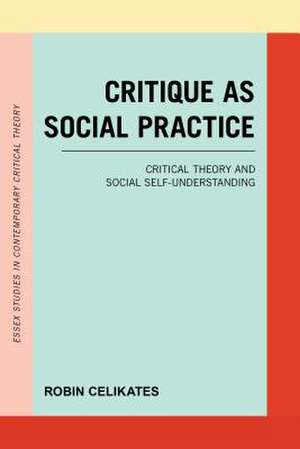
Critique as Social Practice: Critical Theory and Social Self-Understanding
Autor Robin Celikates Traducere de Naomi van Steenbergenen Limba Engleză Paperback – 10 sep 2019
The translation of this work was funded by Geisteswissenschaften International - Translation Funding for Humanities and Social Sciences from Germany, a joint initiative of the Fritz Thyssen Foundation, the German Federal Foreign Office, the collecting society VG WORT and the Börsenverein des Deutschen Buchhandels (German Publisher & Booksellers Association)
Preț: 285.17 lei
Preț vechi: 371.01 lei
-23%
Puncte Express: 428
Carte tipărită la comandă
Livrare economică 27 octombrie-10 noiembrie
Livrare prin curier în România Termenul estimat este afișat lângă disponibilitate.
Transport gratuit de la 400.00 lei Plată online sau ramburs, în funcție de opțiunile comenzii.
Retur gratuit în 14 zile Comandă securizată și suport în română.
Specificații
ISBN-13: 9781786604637
ISBN-10: 1786604639
Pagini: 238
Dimensiuni: 150 x 226 x 16 mm
Greutate: 0.35 kg
Editura: Bloomsbury Publishing
Colecția Rowman & Littlefield
Locul publicării:New York, United States
ISBN-10: 1786604639
Pagini: 238
Dimensiuni: 150 x 226 x 16 mm
Greutate: 0.35 kg
Editura: Bloomsbury Publishing
Colecția Rowman & Littlefield
Locul publicării:New York, United States
Cuprins
Preface, Axel Honneth / Acknowledgements / 1. Introduction / 2. 'I See Something You Cannot See': The Model of the Break / 3. 'Follow the Agents': The Model of Symmetry / 4. Critical Theory as Reconstructive Critique / 5. Conclusion / Bibliography
Recenzii
Celikates's book is a
key part of an important resurgence in the tradition
of critical theory. Critique as Social Practice forms the
basis for Celikates's more recent work on social
philosophy and civil disobedience, while also
providing important resources for the broader
scholarly conversation on critical theory and the place
of critique in the contemporary social and political
environment.
Celikates' important contribution lies in outlining a methodological egalitarianism that overcomes the external-internal 'dichotomy' (108) and the limits of each approach. . . . Celikates' work is an important contribution to the question of how critical theorists, given their emancipatory aims, should address the oppressed.
Celikates presents an insightful critical reconstruction of three influential models of the relation between the European, male critical theorist and the people about whom he theorises in the works of Bourdieu, Boltanski and psychoanalysis, and of the French-German debates around them. This fine translation makes this important contribution to the history of European critical theory available to English-language students and scholars.
How do we articulate the theoretical critique of the social order and the criticisms made by ordinary people in everyday life? The solution Celikates proposes, based on the Frankfurt School's interpretation of psychoanalysis, is highly original and very promising. This is a fundamental work for all those wishing to take advantage of both the empirical study of society and the contributions of philosophy, from the perspective of social change.
Critique as Social Practice takes up a crucial question for all those undertaking socially engaged academic work: under conditions of ideology, what epistemic standing does the critical theorist have in relation to those suffering injustice in whose name the theory is constructed? Celikates illuminates how external critique (drawing on insights and norms from other (theoretical, political) contexts) and internal critique (drawing on insights and norms of practitioners) are inadequate. He goes on to defend the idea of reconstructive critique that begins with the critical practices of those embedded in unjust systems, but also requires an evaluation of the adequacy of those practices, recognizing that injustice can also compromise our abilities to know. In Celikates' view, ideology critique is properly understood as second-order epistemic critique. It is a brilliant book that reframes the contemporary challenges of critical theory and offers a deeply compelling and nuanced response.
Celikates subjects the familiar refrain that critique is a form of practice to a systematic, rigorous, and illuminating analysis. His conception of reconstructive critique as a form of social practice shows as much respect for the critical capacities of agents as it does awareness of the dangers of ideological distortions. The result is a highly original and compelling articulation of the distinctive methodology of critical theory.
key part of an important resurgence in the tradition
of critical theory. Critique as Social Practice forms the
basis for Celikates's more recent work on social
philosophy and civil disobedience, while also
providing important resources for the broader
scholarly conversation on critical theory and the place
of critique in the contemporary social and political
environment.
Celikates' important contribution lies in outlining a methodological egalitarianism that overcomes the external-internal 'dichotomy' (108) and the limits of each approach. . . . Celikates' work is an important contribution to the question of how critical theorists, given their emancipatory aims, should address the oppressed.
Celikates presents an insightful critical reconstruction of three influential models of the relation between the European, male critical theorist and the people about whom he theorises in the works of Bourdieu, Boltanski and psychoanalysis, and of the French-German debates around them. This fine translation makes this important contribution to the history of European critical theory available to English-language students and scholars.
How do we articulate the theoretical critique of the social order and the criticisms made by ordinary people in everyday life? The solution Celikates proposes, based on the Frankfurt School's interpretation of psychoanalysis, is highly original and very promising. This is a fundamental work for all those wishing to take advantage of both the empirical study of society and the contributions of philosophy, from the perspective of social change.
Critique as Social Practice takes up a crucial question for all those undertaking socially engaged academic work: under conditions of ideology, what epistemic standing does the critical theorist have in relation to those suffering injustice in whose name the theory is constructed? Celikates illuminates how external critique (drawing on insights and norms from other (theoretical, political) contexts) and internal critique (drawing on insights and norms of practitioners) are inadequate. He goes on to defend the idea of reconstructive critique that begins with the critical practices of those embedded in unjust systems, but also requires an evaluation of the adequacy of those practices, recognizing that injustice can also compromise our abilities to know. In Celikates' view, ideology critique is properly understood as second-order epistemic critique. It is a brilliant book that reframes the contemporary challenges of critical theory and offers a deeply compelling and nuanced response.
Celikates subjects the familiar refrain that critique is a form of practice to a systematic, rigorous, and illuminating analysis. His conception of reconstructive critique as a form of social practice shows as much respect for the critical capacities of agents as it does awareness of the dangers of ideological distortions. The result is a highly original and compelling articulation of the distinctive methodology of critical theory.