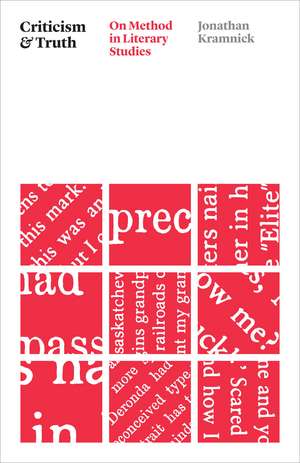
Criticism and Truth: On Method in Literary Studies: Thinking Literature
Autor Professor Jonathan Kramnicken Limba Engleză Paperback – 4 dec 2023
Does literary criticism offer truths about the world? In Criticism and Truth, Jonathan Kramnick offers a new and surprising account of criticism’s power by zeroing in on its singular method: close reading. Long recognized as the distinctive technique of literary studies, close reading is the critic’s way of pursuing arguments and advancing knowledge, as well as the primary skill taught in the English major. But it is also more than that—a creative, immersive, and transformative writing practice that fosters a unique kind of engagement with the world. Drawing on the rich and varied landscape of contemporary criticism, Kramnick changes how we think about the basic tools of literary analysis, including the art of in-text quotation, summary, and other reading methods, helping us to see them as an invaluable form of humanistic expertise. Criticism and Truth is a call to arms, making a powerful case for the necessity of both literature and criticism within a multidisciplinary university.
As the humanities fight for survival in contemporary higher education, the study of literature doesn’t need more plans for reform. Rather, it needs a defense of the work already being done and an account of why it should flourish. This is what Criticism and Truth offers, in vivid and portable form.
| Toate formatele și edițiile | Preț | Express |
|---|---|---|
| Paperback (1) | 132.48 lei 3-5 săpt. | +7.52 lei 6-10 zile |
| University of Chicago Press – 4 dec 2023 | 132.48 lei 3-5 săpt. | +7.52 lei 6-10 zile |
| Hardback (1) | 556.21 lei 6-8 săpt. | |
| University of Chicago Press – 4 dec 2023 | 556.21 lei 6-8 săpt. |



Preț: 132.48 lei
Puncte Express: 199
Preț estimativ în valută:
23.44€ • 27.25$ • 20.32£
23.44€ • 27.25$ • 20.32£
Carte disponibilă
Livrare economică 11-25 februarie
Livrare express 27-31 ianuarie pentru 17.51 lei
Preluare comenzi: 021 569.72.76
Specificații
ISBN-13: 9780226830537
ISBN-10: 0226830535
Pagini: 144
Dimensiuni: 140 x 216 x 13 mm
Greutate: 0.18 kg
Ediția:First Edition
Editura: University of Chicago Press
Colecția University of Chicago Press
Seria Thinking Literature
ISBN-10: 0226830535
Pagini: 144
Dimensiuni: 140 x 216 x 13 mm
Greutate: 0.18 kg
Ediția:First Edition
Editura: University of Chicago Press
Colecția University of Chicago Press
Seria Thinking Literature
Notă biografică
Jonathan Kramnick is the Maynard Mack Professor of English and director of the Lewis Walpole Library at Yale University. He is the author of Making the English Canon, Actions and Objects from Hobbes to Richardson, and Paper Minds, the latter also published by the University of Chicago Press.
Cuprins
Preface
Introduction: Craft Knowledge
Chapter 1: Method Talk
Chapter 2: Close Reading
Chapter 3: Skilled Practice
Chapter 4: Interpretation and Creativity
Chapter 5: Verification
Coda: Public Criticism for a Public Humanities
Acknowledgments
Notes
Index
Introduction: Craft Knowledge
Chapter 1: Method Talk
Chapter 2: Close Reading
Chapter 3: Skilled Practice
Chapter 4: Interpretation and Creativity
Chapter 5: Verification
Coda: Public Criticism for a Public Humanities
Acknowledgments
Notes
Index
Recenzii
“Here is the study of literary critical method we needed—a slim volume capable of displacing shelves of manifestos on the future of the discipline. What do literary critics know, and how do they know it? Criticism and Truth grounds our distinctive epistemology in everyday practices—how we quote and paraphrase our objects of study, share the medium of language with them, and build plot summaries. It captures the brilliance of literary critics everywhere, yet only Jonathan Kramnick could have written this gemlike book.”
“In a highly skilled performance of his own, Kramnick discloses the artistry and creativity embedded in routine acts of close reading. Such methodological reflection is long overdue and marks an important step toward making literary critics' tacit values and abilities intelligible to themselves.”
“Criticism and Truth doesn’t just declare a truce in the method wars: it shows that our squabbling has obscured the deeper truth of a shared disciplinary craft. Lavishing his own considerable analytic gifts on the unfairly unloved genre of contemporary criticism, Kramnick beautifully describes—for what feels like the first time—what literary scholars do, and why their everyday virtuosity matters.”
“Animated by ardency and urgency, written in pellucid prose, argued with finesse and flair, Criticism and Truth is both beautiful and true. It persuades even as it galvanizes. Kramnick’s taut, elegant book should be read widely, its moral passion a beacon for all of us who care about the fate of literature and the humanities.”
"Criticism and Truth comes out swinging. . . . asserting in its final pages that 'the study of literature … keeps alive values of truth, justice, and beauty that support collective flourishing'. A reader couldn’t ask for a clearer defence. . . . Kramnick explains how close reading. . . is different from other disciplines, and how such close attention – not to what a reader hopes or believes a work says, but to what it is actually saying – breeds rigour and objectivity."
"The authorʼs meticulous analysis offers an eye-opening take on literary criticism as a creative process . . . English scholars will want to take a look."
"[Kramnick] expresses alarm at the prospects of academic literary criticism’s continued existence as a recognized field of study within the contemporary university. . . . Articulating the place of literature in 'collective human flourishing'—or specifying what distinguishes literature from other kinds of written language, for that matter— falls outside Kramnick’s project at hand. Bracketing such questions. . . gives the book its quality of extreme concentration and lucidity in the pursuit of the common element in thriving academic literary criticism: the element that must be preserved, lest the whole discipline disappear. . . . [Criticism and Truth] merits attention beyond its field."
"Within that field of inquiry, Kramnick’s is a vital book indeed, in the senses of both lively and necessary. . . . The book’s most vital respondents will ultimately be those emergent and future scholars for whose sake, principally, it aims to describe and celebrate and defend what we do as scholars of literature. But Criticism and Truth is also a clarion call to senior scholars to join in that work."
"An erudite, closely argued and engaging essay, even something of a tract for the times."
"[A] significant new entrant in the ongoing effort to characterize and defend the value of literary study . . . Kramnick offers a newfound respect for the everyday practices of criticism."
"Kramnick’s central claim in Criticism and Truth is that close reading, the signature method of literary criticism, is not a form of reading but a form of writing. Unlike other contributions to state-of-the-field debates, he focuses not on methods of reading or classroom practice, but on the method of academic scholarship. It is the published research, he says, that is the true lifeblood of the discipline."
"It’s a common observation in the discipline of English that for some time now we have lacked a shared object of study. We no longer all read the same core set of texts, and thus, some of us feel, we can no longer talk to each other. . . . But a recent phenomenon seems to be bringing us together again, a new set of texts that we can collectively pore over, interpret, and debate incessantly: books, articles, blog posts, and tweets about the history, current crises, and imminent demise of English as an academic discipline. Jonathan Kramnick’s Criticism and Truth enters this crowded field relatively quietly. Its tone is neither strident nor melancholic but calmly celebratory. Rather than taking the polemical tone of other metadisciplinary manifestos, it aims at the straightforward description of academic literary criticism as it is practiced (at least by those who work primarily on literary texts in English). . . . The focus on practice makes this book a refreshing alternative to historical or sociological views from an Olympian vantage."
"One of the gratifications of reading Kramnick’s fine book, Criticism and Truth: On Method in Literary Studies, is the pleasure of watching somebody
think. His intention is to defend “literary criticism’s standing as a contribution to knowledge” (vii), its epistemic status and claim to creativity—its claim to 'tell the truth' (98) in the face of 'an extinction event in the history of knowledge' (2)."
think. His intention is to defend “literary criticism’s standing as a contribution to knowledge” (vii), its epistemic status and claim to creativity—its claim to 'tell the truth' (98) in the face of 'an extinction event in the history of knowledge' (2)."
"In Criticism and Truth, Kramnick, who teaches at Yale, watches Ph.D. programs contract and the old theory wars fossilize and struggles to find some common ground beyond the critical battles of years past."