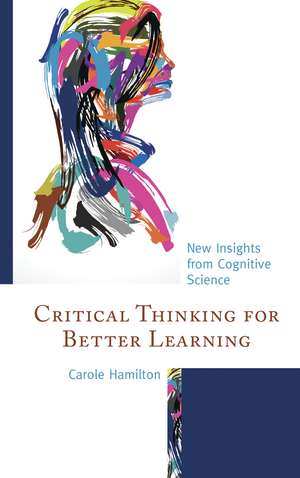
Critical Thinking for Better Learning: New Insights from Cognitive Science
Autor Carole Hamiltonen Limba Engleză Hardback – 8 aug 2016
Preț: 397.81 lei
Preț vechi: 551.58 lei
-28%
Puncte Express: 597
Carte tipărită la comandă
Livrare economică 07-21 noiembrie
Livrare prin curier în România Termenul estimat este afișat lângă disponibilitate.
Transport gratuit de la 400.00 lei Plată online sau ramburs, în funcție de opțiunile comenzii.
Retur gratuit în 14 zile Comandă securizată și suport în română.
Specificații
ISBN-13: 9781475827781
ISBN-10: 1475827784
Pagini: 132
Dimensiuni: 158 x 232 x 14 mm
Greutate: 0.36 kg
Editura: Bloomsbury Publishing
Colecția Rowman & Littlefield
Locul publicării:New York, United States
ISBN-10: 1475827784
Pagini: 132
Dimensiuni: 158 x 232 x 14 mm
Greutate: 0.36 kg
Editura: Bloomsbury Publishing
Colecția Rowman & Littlefield
Locul publicării:New York, United States
Cuprins
Preface
Acknowledgments
Introduction
Section I:How Students Learn Best
Chapter 1: We Learn through Analogies
Section II:Why Much of Our Teaching is Ineffective
Chapter 2: How We Should (and Should Not) Teach
Section III: Teaching to the Student's Natural Learning Style
Chapter 3: Where to Focus: Identify Threshold Concepts
Chapter 4:What to Teach: Choose Topics and Texts that Exemplify Threshold Concepts
Chapter 5:How to Teach: Design Lessons that Compel Students to Confront their Misconceptions
Chapter 6:How to Assess: Design Ways to Gauge Students' Critical Thinking
Conclusion
Appendix A: How People Learn
Appendix B: Analogy as the Core of Cognition
Appendix C: Student Retention with Schemas and Analogies
Appendix D: Threshold Concepts
Appendix E: Sample Threshold Concepts and Skills
Appendix F: Sample Student Challenges
Appendix G: How to Assess Critical Thinking
Recommended Reading/Viewing
References
Acknowledgments
Introduction
Section I:How Students Learn Best
Chapter 1: We Learn through Analogies
Section II:Why Much of Our Teaching is Ineffective
Chapter 2: How We Should (and Should Not) Teach
Section III: Teaching to the Student's Natural Learning Style
Chapter 3: Where to Focus: Identify Threshold Concepts
Chapter 4:What to Teach: Choose Topics and Texts that Exemplify Threshold Concepts
Chapter 5:How to Teach: Design Lessons that Compel Students to Confront their Misconceptions
Chapter 6:How to Assess: Design Ways to Gauge Students' Critical Thinking
Conclusion
Appendix A: How People Learn
Appendix B: Analogy as the Core of Cognition
Appendix C: Student Retention with Schemas and Analogies
Appendix D: Threshold Concepts
Appendix E: Sample Threshold Concepts and Skills
Appendix F: Sample Student Challenges
Appendix G: How to Assess Critical Thinking
Recommended Reading/Viewing
References