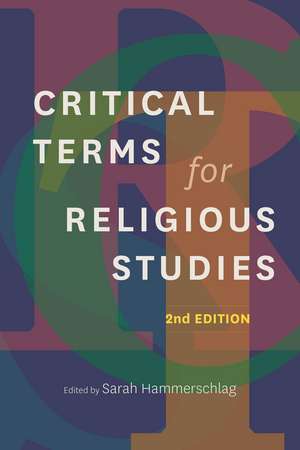
Critical Terms for Religious Studies, Second Edition: Critical Terms
Editat de Sarah Hammerschlagen Limba Engleză Paperback – 21 mai 2025
First published nearly thirty years ago, Critical Terms for Religious Studies proved a vital resource for an emerging interdisciplinary conversation. We still use much of the same language in the study of religion, but fresh concerns have both changed the meaning of terms and given rise to new terms altogether. This edition consists of twenty-three entirely new essays that offer students and scholars alike the tools to historicize and evaluate the shifting role of familiar and emerging critical terms in religious studies.
These are “critical terms” both because they are important in our cultural moment and because thinking through them reveals how religions are embedded in and shaped by material, social, economic, and political forces. A shared conviction unites contributors from a range of traditions and methodologies: a recognition that our world is saturated by the persistence of religious traditions as shape-shifting (not static or transcendent) forces of authority, as powerful today as ever before.
Din seria Critical Terms
-
 Preț: 233.89 lei
 -
 Preț: 262.94 lei
 -
 Preț: 235.86 lei
 -
 Preț: 256.81 lei
 -
 Preț: 261.66 lei
 - 18%
 Preț: 193.72 lei
Preț: 235.19 lei
Nou
Puncte Express: 353
Preț estimativ în valută:
41.62€ • 48.80$ • 36.55£
41.62€ • 48.80$ • 36.55£
Carte disponibilă
Livrare economică 22 ianuarie-05 februarie
Livrare express 07-13 ianuarie pentru 34.70 lei
Preluare comenzi: 021 569.72.76
Specificații
ISBN-13: 9780226839851
ISBN-10: 0226839850
Pagini: 432
Ilustrații: 1 halftones
Dimensiuni: 152 x 229 x 25 mm
Greutate: 0.59 kg
Ediția:Second Edition
Editura: University of Chicago Press
Colecția University of Chicago Press
Seria Critical Terms
ISBN-10: 0226839850
Pagini: 432
Ilustrații: 1 halftones
Dimensiuni: 152 x 229 x 25 mm
Greutate: 0.59 kg
Ediția:Second Edition
Editura: University of Chicago Press
Colecția University of Chicago Press
Seria Critical Terms
Notă biografică
Sarah Hammerschlag is the John Nuveen Professor at the University of Chicago Divinity School. Her books include Devotion: Three Inquiries in Religion, Literature, and Political Imagination, also published by the University of Chicago Press.
Cuprins
Introduction, by Sarah Hammerschlag
1. Catastrophe, by Levi McLaughlin
2. Disability, by Sarah Imhoff
3. Faith, by Constance M. Furey
4. Feeling, by Nancy Khalek
5. Fetish, by Sarah Hammerschlag
6. Identity, by Eleanor Craig
7. Image, by James Robson
8. Law, by Noah Salomon
9. Life, by Rafael Rachel Neis
10. Matter, by Matthew Engelke
11. Memory, by Ryan Coyne
12. Mind, by Dan Arnold
13. Money, by Andrea R. Jain
14. Nature, by Mary-Jane Rubenstein
15. Power, by Amy Hollywood
16. Practice, by Elizabeth Pérez
17. Race, by Terrence L. Johnson
18. (Virtual) Reality, by Christopher G. White
19. Reason, by Alireza Doostdar
20. Religion, by Kathryn Lofton
21. Sex, by Benjamin H. Dunning
22. Sound, by Nicholas Harkness
23. Text, by Samuel P. Catlin
Acknowledgments
Contributors
Index
1. Catastrophe, by Levi McLaughlin
2. Disability, by Sarah Imhoff
3. Faith, by Constance M. Furey
4. Feeling, by Nancy Khalek
5. Fetish, by Sarah Hammerschlag
6. Identity, by Eleanor Craig
7. Image, by James Robson
8. Law, by Noah Salomon
9. Life, by Rafael Rachel Neis
10. Matter, by Matthew Engelke
11. Memory, by Ryan Coyne
12. Mind, by Dan Arnold
13. Money, by Andrea R. Jain
14. Nature, by Mary-Jane Rubenstein
15. Power, by Amy Hollywood
16. Practice, by Elizabeth Pérez
17. Race, by Terrence L. Johnson
18. (Virtual) Reality, by Christopher G. White
19. Reason, by Alireza Doostdar
20. Religion, by Kathryn Lofton
21. Sex, by Benjamin H. Dunning
22. Sound, by Nicholas Harkness
23. Text, by Samuel P. Catlin
Acknowledgments
Contributors
Index
Recenzii
“Critical Terms for Religious Studies does not seek to police scholarship in the field. Instead, each chapter conjoins various discourses to help students imagine more interesting avenues of research and to help those lucky enough to be faculty create more diverse and appealing classes. Thanks to Hammerschlag’s shrewd editorial vision, the next twenty-five years of the study of religion should prove to be even more compelling than the last.”
“The critical terms assembled here are not a list of so many keywords that one needs to launch a study of religion (no such list exists). Rather, each of the essays, authored by some of the leading scholars of today and tomorrow, offers a new vantage point from which to consider religion by focusing on a seemingly ordinary concept—life, law, matter, etc. A welcome update on the broad scope of the scholarship on religion and its immediate promise.”
"Rather than focusing on theological concepts that might be used by only one religious tradition, such as the Christian understanding of its own tradition, this handbook focuses on larger methodological definitions used by scholars of many traditions, such as "memory," "life," and "law." . . . This is a useful handbook, especially for introductory classes on methodologies in religious studies or in graduate seminars on theory and method, which are common in many graduate programs. Additionally, professors and researchers will find this handbook useful for updated scholarship on concepts they may already be employing in their work."