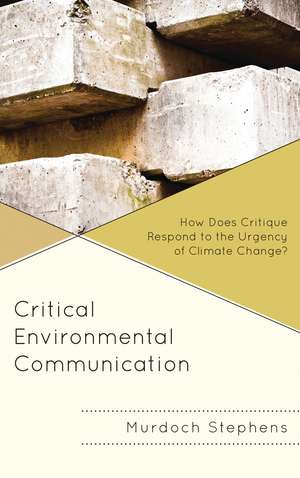
Critical Environmental Communication: How Does Critique Respond to the Urgency of Climate Change?: Environmental Communication and Nature: Conflict and Ecoculture in the Anthropocene
Autor Murdoch Stephensen Limba Engleză Hardback – 25 apr 2018










Preț: 611.29 lei
Preț vechi: 913.56 lei
-33%
Puncte Express: 917
Carte tipărită la comandă
Livrare economică 07-21 decembrie
Livrare prin curier în România Termenul estimat este afișat lângă disponibilitate.
Transport gratuit pentru acest produs Plată online sau ramburs, în funcție de opțiunile comenzii.
Retur gratuit în 14 zile Comandă securizată și suport în română.
Specificații
ISBN-13: 9781498570879
ISBN-10: 1498570879
Pagini: 256
Dimensiuni: 159 x 248 x 23 mm
Greutate: 0.57 kg
Editura: Bloomsbury Publishing
Colecția Lexington Books
Seria Environmental Communication and Nature: Conflict and Ecoculture in the Anthropocene
Locul publicării:New York, United States
ISBN-10: 1498570879
Pagini: 256
Dimensiuni: 159 x 248 x 23 mm
Greutate: 0.57 kg
Editura: Bloomsbury Publishing
Colecția Lexington Books
Seria Environmental Communication and Nature: Conflict and Ecoculture in the Anthropocene
Locul publicării:New York, United States
V-ar putea interesa
-
 -33%Preț: 325.02 lei482.20 lei
 -
 -37%Preț: 659.45 lei1053.69 lei
 -
 Audience Responses to Real Media Violence: The Knockout GameMary Grace Antony-23%Preț: 310.69 lei405.36 lei
 -
 -29%Preț: 345.00 lei483.69 lei
 -
 Communication and Control: Tools, Systems, and New DimensionsRobert MacDougall-33%Preț: 649.67 lei975.93 lei
 -
 Living with Television NowMichael Morgan-9%Preț: 1100.78 lei1209.64 lei
 -
 -25%Preț: 218.06 lei291.42 lei
 -
 -23%Preț: 319.58 lei415.63 lei
 -
 -36%Preț: 675.29 lei1056.66 lei
 -
 Social Media and Social MovementsBaris Çoban-23%Preț: 722.14 lei937.85 lei
 -
 -28%Preț: 347.25 lei484.86 lei
 -
 -27%Preț: 279.42 lei385.35 lei
 -
 Ethical Journalism in a Populist Age: The Democratically Engaged JournalistStephen J. A. Ward-24%Preț: 225.93 lei298.66 lei
 -
 Advances in Communications & Media Research: Volume 6Anthony V Stavros-26%Preț: 1168.60 lei1587.83 lei
 -
 -18%Preț: 650.26 lei793.00 lei
 -
 Preț: 375.68 lei
 -
 Preț: 438.12 lei
 -
 Preț: 378.85 lei
 -
 Preț: 224.39 lei
 -
 Preț: 442.35 lei
 -
 Preț: 246.46 lei
 -
 Preț: 245.43 lei
 -
 Preț: 246.88 lei
 -
 Preț: 246.26 lei
Cuprins
Chapter 1. Introduction
Chapter 2. Critique and Climate Change in Sloterdijk
Chapter 3. Critique and Climate Change in Zizek
Chapter 4. Critique and Climate Change in Morton
Chapter 5. Critique and Climate Change in Latour
References
Index
About the Author
Chapter 2. Critique and Climate Change in Sloterdijk
Chapter 3. Critique and Climate Change in Zizek
Chapter 4. Critique and Climate Change in Morton
Chapter 5. Critique and Climate Change in Latour
References
Index
About the Author
Recenzii
Murdoch Stephens has taken on the difficult task of sorting through and understanding much ignored critical theory relevant to environmental communication and has written an essential read for anyone interested in critical theory and environmental communication.
Bucking a bias that insists on environmental communication as a crisis discipline that justifies an incoherent activism and smug moralism, in Critical Environmental Communication Murdoch Stephens advocates a return to thinking and theory. In a sustained and thoughtful engagement with such provocative thinkers as Latour, Zizek, Morton, and Sloterdijk, Stephens forces us to reconsider the grounds of our thinking and activism. As Stephens' vital intervention argues, theory is not a necessary detour but the way itself that enables a thinking and acting that exceeds a mindless activism that pursues the media-amplified crisis du jour.
By bringing four notable and provocative theorists into the orbit of environmental communication, Stephens's work will reinvigorate discussions among environmental communication scholars about the possibilities for critique and critical scholarship.
Bucking a bias that insists on environmental communication as a crisis discipline that justifies an incoherent activism and smug moralism, in Critical Environmental Communication Murdoch Stephens advocates a return to thinking and theory. In a sustained and thoughtful engagement with such provocative thinkers as Latour, Zizek, Morton, and Sloterdijk, Stephens forces us to reconsider the grounds of our thinking and activism. As Stephens' vital intervention argues, theory is not a necessary detour but the way itself that enables a thinking and acting that exceeds a mindless activism that pursues the media-amplified crisis du jour.
By bringing four notable and provocative theorists into the orbit of environmental communication, Stephens's work will reinvigorate discussions among environmental communication scholars about the possibilities for critique and critical scholarship.