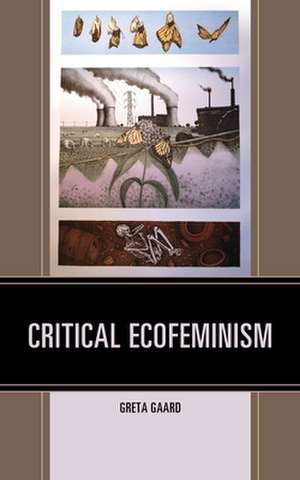
Critical Ecofeminism: Ecocritical Theory and Practice
Autor Greta Gaarden Limba Engleză Paperback – 30 mai 2019
Had Plumwood lived another ten years, she might have described her work as "Anthropocene Ecofeminism," "Critical Material Ecofeminism," "Posthumanist Anticolonial Ecofeminism"-all of these inflections are present in her work.
Here, Critical Ecofeminism advances upon Plumwood's intellectual, activist, and scholarly work by exploring its implications for a range of contemporary perspectives and issues--critical animal studies, plant studies, sustainability studies, environmental justice, climate change and climate justice, masculinities and sexualities. With the insights available through a critical ecofeminism, these diverse eco-justice perspectives become more robust.
| Toate formatele și edițiile | Preț | Express |
|---|---|---|
| Paperback (1) | 270.94 lei 6-8 săpt. | |
| Bloomsbury Publishing – 30 mai 2019 | 270.94 lei 6-8 săpt. | |
| Hardback (1) | 609.19 lei 6-8 săpt. | |
| Bloomsbury Publishing – 16 iun 2017 | 609.19 lei 6-8 săpt. |
Din seria Ecocritical Theory and Practice
- nou
 Preț: 510.09 lei
 - 32%
 Preț: 490.44 lei
 - 25%
 Preț: 248.50 lei
 -
 Preț: 221.42 lei
 - 23%
 Preț: 304.85 lei
 - 34%
 Preț: 522.06 lei
 - 34%
 Preț: 646.16 lei
 - 22%
 Preț: 327.89 lei
 - 23%
 Preț: 659.91 lei
 - 23%
 Preț: 326.64 lei
 - 34%
 Preț: 583.60 lei
 - 18%
 Preț: 771.87 lei
 - 22%
 Preț: 344.88 lei
 - 34%
 Preț: 608.34 lei
 - 34%
 Preț: 540.73 lei
 - 15%
 Preț: 658.41 lei
 - 34%
 Preț: 585.37 lei
 - 34%
 Preț: 625.66 lei
 - 34%
 Preț: 533.12 lei
 - 34%
 Preț: 553.55 lei
 - 15%
 Preț: 654.79 lei
 - 22%
 Preț: 334.98 lei
 - 34%
 Preț: 540.95 lei
 - 34%
 Preț: 542.15 lei
 - 34%
 Preț: 570.86 lei
 - 34%
 Preț: 522.80 lei
 - 34%
 Preț: 553.62 lei
 - 34%
 Preț: 645.34 lei
 - 23%
 Preț: 712.50 lei
 - 22%
 Preț: 336.13 lei
 - 15%
 Preț: 652.61 lei
 - 34%
 Preț: 552.54 lei
 - 22%
 Preț: 330.55 lei
 - 23%
 Preț: 313.00 lei
 - 34%
 Preț: 552.37 lei
 - 34%
 Preț: 571.71 lei
 - 34%
 Preț: 523.39 lei
 - 26%
 Preț: 705.88 lei
 - 31%
 Preț: 504.14 lei
 - 32%
 Preț: 503.19 lei
 - 31%
 Preț: 503.96 lei
 - 30%
 Preț: 570.62 lei
 - 34%
 Preț: 608.76 lei
Preț: 270.94 lei
Preț vechi: 367.30 lei
-26% Recomandat
Puncte Express: 406
Preț estimativ în valută:
47.95€ • 56.04$ • 41.63£
47.95€ • 56.04$ • 41.63£
Carte tipărită la comandă
Livrare economică 20 februarie-06 martie
Preluare comenzi: 021 569.72.76
Specificații
ISBN-13: 9781498533607
ISBN-10: 1498533604
Pagini: 252
Ilustrații: 1 b/w illustrations; 4 b/w photos; 3 tables;
Dimensiuni: 148 x 226 x 18 mm
Greutate: 0.36 kg
Editura: Bloomsbury Publishing
Colecția Lexington Books
Seria Ecocritical Theory and Practice
Locul publicării:New York, United States
ISBN-10: 1498533604
Pagini: 252
Ilustrații: 1 b/w illustrations; 4 b/w photos; 3 tables;
Dimensiuni: 148 x 226 x 18 mm
Greutate: 0.36 kg
Editura: Bloomsbury Publishing
Colecția Lexington Books
Seria Ecocritical Theory and Practice
Locul publicării:New York, United States
Cuprins
Introduction: Critical Ecofeminism
Theory
Chapter 1: Just Ecofeminist Sustainability
Chapter 2: Plants and Animals
Illuminations
Chapter 3: Milk
Chapter 4: Fireworks
Chapter 5: Animals in Space
Climates
Chapter 6: Climate Justice
Chapter 7: Cli-Fi Narratives
Chapter 8: Queering the Climate
Epilogue
Theory
Chapter 1: Just Ecofeminist Sustainability
Chapter 2: Plants and Animals
Illuminations
Chapter 3: Milk
Chapter 4: Fireworks
Chapter 5: Animals in Space
Climates
Chapter 6: Climate Justice
Chapter 7: Cli-Fi Narratives
Chapter 8: Queering the Climate
Epilogue
Recenzii
Critical Ecofeminism extends the discussion of ecofeminism, a field of study that connects ecology with feminism, which in turn connects paternalism and capitalism with the domination of women and nature. Adding "critical" to the equation makes a big difference between tying sociopolitical hegemonies and the current climate change crisis. It emphasizes "reproduction" as opposed to "production," and adds the critical steps to sustainability. Gaard (English, Univ. of Wisconsin, River Falls)-editor of Ecofeminism: Women, Animals, Nature (CH, Dec'93, 31-2177) and author of Ecological Politics: Ecofeminists and the Greens (CH, Nov'98, 36-1540)-advances her argument in favor of a radical environmentalism that confronts, on all levels of culture, the meaning of a viable future for the Earth. Gaard mixes scholarly practice with creative writing and activism to extend the subject matter into many disciplines, including "ecocomposition." She advocates a just ecofeminist sustainability for plants and animals and illustrates sociopolitical-economic factors present in the culture of milk, fireworks, and animals in space that need to change. She promotes climate justice, reevaluations of "cli-fi" (i.e., climate fiction) narratives, and queering the climate. The bibliography and references alone provide a map for future studies in technology, climatology, literary ecocriticism, and activism. Summing Up: Recommended. Upper-division undergraduates; faculty and researchers.
Critical Ecofeminism is a comprehensive and rigorous piece of work . . . Gaard's voice is distinctly unique, and her project is enriched by confessions of how critical ecofeminism has informed her own movements through a range of shifting identities in the natural world. It is testament to her strength and self-assurance as a scholar that she melds the work of so many thinkers - and, most notably, the life-story of Val Plumwood - to restore the foundations of eco-justice for future studies. There is much to be learnt from Critical Ecofeminism; lay-readers will be interested in titbits from hard science and Gaard's problematisation of "harmless" narratives and rituals, while students and scholars may be more concerned with anti-feminist trends pervading mainstream environmentalism. But most important for the following generation of ecocritics is the unspoken graciousness of Gaard's approach: a political praxis of listening, not individualist leaning-in.
This is a phenomenal book, beautifully written, powerfully argued, and supported by an extraordinary range and depth of theory and evidence. I have been profoundly moved by this work and have been reminded once again that Greta Gaard is one of the most important thinkers and activist-scholars of our time.
An engaging and highly readable monograph by one of ecofeminism's most insightful scholars, Critical Ecofeminism is a stunning achievement. Gaard gives a reflective account of ecofeminism's evolution as an intersectional framework for interrogating socio-environmental relations and a politics of solidarity that demands eco-justice for all species. Her book provides welcome vindication for those who have remained convinced of ecofeminism's critical power despite thirty years of mischaracterization in most corners of the academy.
Critical Ecofeminism is a comprehensive and rigorous piece of work . . . Gaard's voice is distinctly unique, and her project is enriched by confessions of how critical ecofeminism has informed her own movements through a range of shifting identities in the natural world. It is testament to her strength and self-assurance as a scholar that she melds the work of so many thinkers - and, most notably, the life-story of Val Plumwood - to restore the foundations of eco-justice for future studies. There is much to be learnt from Critical Ecofeminism; lay-readers will be interested in titbits from hard science and Gaard's problematisation of "harmless" narratives and rituals, while students and scholars may be more concerned with anti-feminist trends pervading mainstream environmentalism. But most important for the following generation of ecocritics is the unspoken graciousness of Gaard's approach: a political praxis of listening, not individualist leaning-in.
This is a phenomenal book, beautifully written, powerfully argued, and supported by an extraordinary range and depth of theory and evidence. I have been profoundly moved by this work and have been reminded once again that Greta Gaard is one of the most important thinkers and activist-scholars of our time.
An engaging and highly readable monograph by one of ecofeminism's most insightful scholars, Critical Ecofeminism is a stunning achievement. Gaard gives a reflective account of ecofeminism's evolution as an intersectional framework for interrogating socio-environmental relations and a politics of solidarity that demands eco-justice for all species. Her book provides welcome vindication for those who have remained convinced of ecofeminism's critical power despite thirty years of mischaracterization in most corners of the academy.