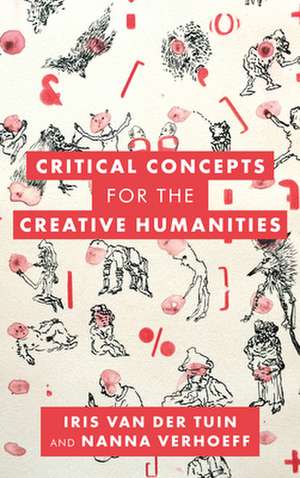
Critical Concepts for the Creative Humanities
Autor Iris van der Tuin, Nanna Verhoeffen Limba Engleză Paperback – 15 feb 2022
Critical Concepts for the Creative Humanities is the first book to outline and define the specific and evolving field of the creative humanities and provides the field's nascent bibliography.
Preț: 211.31 lei
Preț vechi: 265.30 lei
-20%
Puncte Express: 317
Carte tipărită la comandă
Livrare economică 09-23 iunie
Specificații
ISBN-13: 9781538147740
ISBN-10: 1538147742
Pagini: 268
Dimensiuni: 150 x 226 x 18 mm
Greutate: 0.38 kg
Editura: Bloomsbury Publishing
Colecția Rowman & Littlefield
Locul publicării:New York, United States
ISBN-10: 1538147742
Pagini: 268
Dimensiuni: 150 x 226 x 18 mm
Greutate: 0.38 kg
Editura: Bloomsbury Publishing
Colecția Rowman & Littlefield
Locul publicării:New York, United States
Cuprins
Acknowledgements
Introduction
Accent
Accident
Affect
Ambient
Architecture, Architexture
Assembling
Asterisk *
Between No-Longer and Not-Yet
Both/And
Brackets [], Parentheses ()
Care, Ethics of Care
Cartography, Performative Cartography
Classifixation
Collage
Collective Imaginings
Condition
Contagion
Contingency
Crossing
Curation
Dash - , Hyphen -
Deixis
Diffraction
Dirt
Dispositif
Dramaturgy
Eco-, Ecology
Encounter
Engagement
Failure
Figuration
Following
Friction
Generation, Generative
Gesture
Glow
Habit
Hashtag #
Implication
Interface
Irreducibility, Irreduction
Kaleidoscope, Kaleidoscopic
Making Kin, Unkinning
Micrology
Mode, Modality, Multi-Modality
Navigation
Openness
Pluriverse
Prefiguration
Procedure
Proposition
Punctuation
Randomization
Rhythm
Risk
Scale, Scaling
Scape, -scapes
Situation, Situatedness
Somatechnics
Speculation
Sticky, Stickiness
Surface
Sympathy
Synchrony, Synchronicity
Theoretical Object, Knowledge Object
Trace, Tracing
Trans-, Transing
Unlearning
Wonder
Zetesis
INDEX of Concepts
INDEX of Names
Bibliography
About the Authors
Introduction
Accent
Accident
Affect
Ambient
Architecture, Architexture
Assembling
Asterisk *
Between No-Longer and Not-Yet
Both/And
Brackets [], Parentheses ()
Care, Ethics of Care
Cartography, Performative Cartography
Classifixation
Collage
Collective Imaginings
Condition
Contagion
Contingency
Crossing
Curation
Dash - , Hyphen -
Deixis
Diffraction
Dirt
Dispositif
Dramaturgy
Eco-, Ecology
Encounter
Engagement
Failure
Figuration
Following
Friction
Generation, Generative
Gesture
Glow
Habit
Hashtag #
Implication
Interface
Irreducibility, Irreduction
Kaleidoscope, Kaleidoscopic
Making Kin, Unkinning
Micrology
Mode, Modality, Multi-Modality
Navigation
Openness
Pluriverse
Prefiguration
Procedure
Proposition
Punctuation
Randomization
Rhythm
Risk
Scale, Scaling
Scape, -scapes
Situation, Situatedness
Somatechnics
Speculation
Sticky, Stickiness
Surface
Sympathy
Synchrony, Synchronicity
Theoretical Object, Knowledge Object
Trace, Tracing
Trans-, Transing
Unlearning
Wonder
Zetesis
INDEX of Concepts
INDEX of Names
Bibliography
About the Authors
Recenzii
This is an animate lexicon, overflowing with pulsating and creative concepts. Van der Tuin and Verhoeff are engaged with what concepts can do, and what they can make happen, rather than trying to capture a spurious 'classifixation' of what they are. The authors do not so much offer definitions as stage a series of potentialities, novel directions in which to take concepts, or indeed, to be taken by them. The conceptual territory traversed is at once familiar and foreign, provoking feelings of the uncanny. This brilliant and seriously playful work enacts its own incitement to the reader: to connect, to create, to articulate, and to activate new ways of thinking-being, in the service of a vibrant future.
This book is a gem. The ways that the authors approach the dictionary format, through the notion of concepts-in-the-making, arts-based creative methods and practices, is innovative and entirely appropriate to its aim to compile and expand the creative humanities. The authors are both leaders in their fields and are ideally positioned and eminently experienced. Their ground-breaking conceptual approach goes beyond a textbook and performs the field that it explores.
Exploring the potentialities of creative humanities, this book will contribute substantially to the research field. The book's strengths are its focus on concepts as always performative and methodological, and engagement with nature-culture and theory-practice complexities and openness. The authors represent a strong theoretical foundation and thoroughness. There is absolutely a need for didactic texts like this, that are fitting for the contemporary interdisciplinary and collaborative research culture of a new generation of thinkers and makers.
In Critical Concepts for the Creative Humanities, van der Tuin and Verhoeff have created new and original conceptual pathways for exploring the multiple and complexly intertwining lines connecting theoretical and creative practice, and intellectual and sensory experience. This is a bold book, and its influence is bound to be transformative of current and future directions in the arts and humanities.
This book is a gem. The ways that the authors approach the dictionary format, through the notion of concepts-in-the-making, arts-based creative methods and practices, is innovative and entirely appropriate to its aim to compile and expand the creative humanities. The authors are both leaders in their fields and are ideally positioned and eminently experienced. Their ground-breaking conceptual approach goes beyond a textbook and performs the field that it explores.
Exploring the potentialities of creative humanities, this book will contribute substantially to the research field. The book's strengths are its focus on concepts as always performative and methodological, and engagement with nature-culture and theory-practice complexities and openness. The authors represent a strong theoretical foundation and thoroughness. There is absolutely a need for didactic texts like this, that are fitting for the contemporary interdisciplinary and collaborative research culture of a new generation of thinkers and makers.
In Critical Concepts for the Creative Humanities, van der Tuin and Verhoeff have created new and original conceptual pathways for exploring the multiple and complexly intertwining lines connecting theoretical and creative practice, and intellectual and sensory experience. This is a bold book, and its influence is bound to be transformative of current and future directions in the arts and humanities.