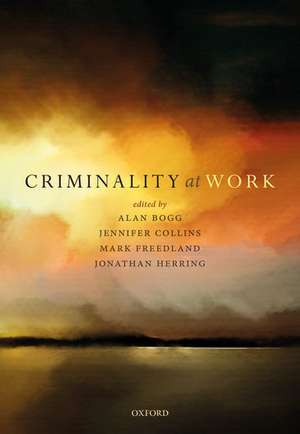
Criminality at Work
Editat de Alan Bogg, Jennifer Collins, Mark Freedland, Jonathan Herringen Limba Engleză Hardback – 12 mar 2020
Preț: 1128.12 lei
Preț vechi: 1658.62 lei
-32%
Puncte Express: 1692
Carte disponibilă
Livrare economică 06-11 noiembrie
Livrare prin curier în România Termenul estimat este afișat lângă disponibilitate.
Transport gratuit pentru acest produs Plată online sau ramburs, în funcție de opțiunile comenzii.
Retur gratuit în 14 zile Comandă securizată și suport în română.
Specificații
ISBN-13: 9780198836995
ISBN-10: 0198836996
Pagini: 586
Dimensiuni: 176 x 246 x 39 mm
Greutate: 1.21 kg
Editura: OUP OXFORD
Colecția OUP Oxford
Locul publicării:Oxford, United Kingdom
ISBN-10: 0198836996
Pagini: 586
Dimensiuni: 176 x 246 x 39 mm
Greutate: 1.21 kg
Editura: OUP OXFORD
Colecția OUP Oxford
Locul publicării:Oxford, United Kingdom
V-ar putea interesa
-
 American Exceptionalism in Crime and PunishmentKevin R. Reitz-21%Preț: 543.29 lei687.76 lei
 -
 -23%Preț: 371.55 lei482.98 lei
 -
 -30%Preț: 427.74 lei608.69 lei
 -
 -32%Preț: 611.12 lei897.81 lei
 -
 -13%Preț: 466.69 lei537.18 lei
 -
 Rights, Gender and Family LawJulie Wallbank-15%Preț: 423.91 lei498.71 lei
 -
 The Zombie SquadWanda Bentley-TalesPreț: 145.75 lei
 -
 ROTVILLEB. Bentley SummersPreț: 189.62 lei
 -
 Resocialising Europe in a Time of CrisisNicola Countouris-11%Preț: 653.40 lei734.17 lei
 -
 Taylor, L: Elliott & Quinn's Criminal LawLouise TaylorPreț: 421.40 lei
 -
 Accepted: 101 Super Secrets to College Admission and SuccessJennifer CollinsPreț: 124.52 lei
 -
 Reimagining EqualityNancy E DowdPreț: 346.41 lei
 -
 -14%Preț: 859.10 lei998.94 lei
Recenzii
This edited collection elegantly presents a comprehensive and multifaceted account of the modern intersection of work and criminal law ... This book will appeal to Common Law labour lawyers, criminal lawyers, and those interested in how the long-held norms of one area of the law can be found, applied, and even improved in another ... This "miscellany of legal curiosities" is a masterful curation of works which skilfully demonstrates the rich seams to be mined where criminal law and labour consolidate under political pressure to create "criminality at work". This book provides what I expect will be an enduring foundation for much scholarship to come.
Notă biografică
Professor Alan Bogg's academic career started at the University of Birmingham, where he was a lecturer between 2000 and 2003. He was then elected as a Law Fellow at Hertford College, Oxford, lecturing at the Faculty of Law, University of Oxford. He was a Professor of Labour Law at the University of Oxford until July 2017, and Senior Tutor at Hertford College. He is currently an Emeritus Fellow at Hertford College, Oxford, and teaches law at the University of Bristol as a Professor of Labour Law since July 2017.Dr Jennifer Collins is a Senior Lecturer in Law at the University of Bristol, having joined the Law School as a Lecturer in 2014. Prior to herappointment at Bristol, she lectured at St Peter's College, Oxford, from 2011 until 2014. She read Law as an Undergraduate and Postgraduate at the University of Oxford, reading for a BA in Law, the Bachelor in Civil Law, and a DPhil in Law.Professor Mark Freedland's academic career has been spent at the University of Oxford, in which he was until 2012 Professor of Employment Law and a Law Fellow of St John's College. He is currently Emeritus Professor of Employment Law at the University of Oxford, Emeritus Research Fellow of St John's College Oxford, and also an Honorary Professor in the Faculty of Laws of University College London where he was originally a student. In 2000, he was made Docteur honoris causa, University of Paris II (Pantheon-Assas); in 2002, he was elected as a Fellow of the British Academy (FBA); in 2013, he was appointed as a Queen's Counsel Honoris Causa (QC (Hon)).Professor Jonathan Herring is currently Professor of Law and DW Wolfe-Clarendon Fellow at Exeter College, University of Oxford. Previously, he was a Fellow in Law at New Hall, Cambridge.