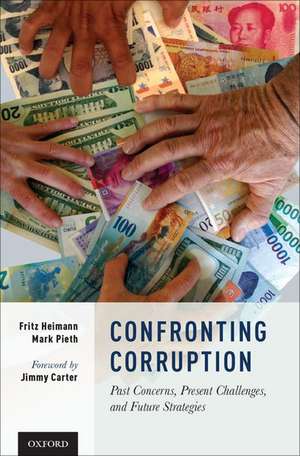
Confronting Corruption: Past Concerns, Present Challenges, and Future Strategies
Autor Fritz Heimann, Mark Piethen Limba Engleză Paperback – 4 ian 2018
Descoperim în Confronting Corruption un model de analiză pragmatic, construit pe ideea că transparența radicală, impusă de globalizare și comunicațiile digitale, reprezintă singura cale viabilă pentru erodarea secretomaniei specifice actelor de corupție. Autorii nu se limitează la o expunere teoretică, ci propun un cadru de acțiune pentru următorul deceniu, fundamentat pe evaluarea succeselor și, mai ales, a eșecurilor programelor internaționale demarate după Războiul Rece. Reținem abordarea lor asupra modului în care corupția subminează nu doar economia, ci și protecția mediului sau drepturile omului, oferind o perspectivă integrată asupra securității globale.
Remarcăm rigoarea cu care Fritz Heimann și Mark Pieth disecă mecanismele mituiri comerciale internaționale și ale alegerilor fraudate. Stilul este unul autoritar, susținut de experiența vastă a autorilor în prima linie a acestei lupte. Dacă The Internationalisation of Corruption de Clare Fletcher v-a oferit cadrul teoretic și sociologic al fenomenului, această carte publicată de Oxford University Press oferă instrumentele practice și strategiile diferențiate necesare pentru a trece de la diagnoză la reformă. Lectura dezvăluie cum noile tehnologii pot echilibra terenul de joc, transformând supravegherea publică într-un mecanism de control mai eficient decât tratatele diplomatice clasice. Este o analiză esențială pentru înțelegerea modului în care competiția corectă în comerțul global poate fi restaurată prin politici de integritate adaptate erei digitale.
Preț: 371.55 lei
Preț vechi: 482.98 lei
-23%
Carte tipărită la comandă
Livrare economică 20 noiembrie-01 decembrie
Specificații
ISBN-10: 0190458348
Pagini: 312
Dimensiuni: 155 x 231 x 20 mm
Greutate: 0.44 kg
Editura: Oxford University Press
Colecția OUP USA
Locul publicării:New York, United States
V-ar putea interesa
-
 Criminally Ignorant: Why the Law Pretends We Know What We Don'tAlexander Sarch-17%Preț: 603.06 lei727.14 lei
 -
 -31%Preț: 663.94 lei961.87 lei
 -
 The Grammar of Criminal Law: Volume Two: International Criminal LawGeorge P. Fletcher-31%Preț: 708.70 lei1024.80 lei
 -
 Prevention and the Limits of the Criminal LawAndrew Ashworth-31%Preț: 917.14 lei1337.64 lei
 -
 The Principle of Mutual Recognition in EU LawChristine Janssens-31%Preț: 982.85 lei1426.86 lei
 -
 Anti-Bribery Laws in Common Law JurisdictionsStuart H. Deming-33%Preț: 1488.80 lei2217.04 lei
 -
 -35%Preț: 807.77 lei1240.78 lei
 -
 -31%Preț: 1000.32 lei1450.90 lei
 -
 Punishing Race: A Continuing American DilemmaMichael Tonry-21%Preț: 255.21 lei323.25 lei
 -
 George Fletcher's Essays on Criminal LawRussell Christopher-31%Preț: 694.17 lei1007.42 lei
 -
 The OECD Convention on BriberyMark Pieth-11%Preț: 674.42 lei757.79 lei
 -
 American Criminal JusticeFrederick T. DavisPreț: 162.35 lei
 -
 Financing TerrorismMark Pieth-15%Preț: 662.37 lei779.26 lei
 -
 -34%Preț: 513.42 lei781.54 lei
 -
 Investigating European Fraud in the EU Member StatesProfessor Alessandro Bernardi-26%Preț: 205.93 lei278.10 lei
 -
 Negotiation and Conflict Resolution in Criminal PracticeRebecca BromwichPreț: 390.76 lei
 -
 Corporate Criminal LiabilityMark Pieth-18%Preț: 1211.83 lei1471.65 lei
De ce să citești această carte
Recomandăm această carte profesioniștilor din domeniul juridic, politologilor și managerilor care operează în piețe emergente. Cititorul va câștiga o înțelegere profundă a modului în care mecanismele de control actuale pot fi optimizate. Este un ghid strategic care explică de ce reformele eșuează și cum pot fi utilizate instrumentele digitale pentru a asigura transparența în instituțiile publice și private.
Despre autor
Fritz Heimann și Mark Pieth sunt recunoscuți la nivel internațional drept piloni ai mișcării globale împotriva corupției. Fritz Heimann a fost unul dintre fondatorii Transparency International, aducând o experiență juridică vastă din sectorul corporativ, în timp ce Mark Pieth este profesor de drept penal și a prezidat Grupul de Lucru OECD privind Mita. Expertiza lor combinată acoperă atât elaborarea de politici publice, cât și implementarea practică a standardelor de integritate în afaceri, oferind lucrării o autoritate incontestabilă în domeniul legislației penale și al guvernanței globale.
Descriere
Recenzii
Fritz Heimann and Mark Pieth have combined their vast wisdom, brilliant legal skills, and practical experience to write this important book Confronting Corruption. They were actively involved when I founded Transparency International (TI), and I worked closely with both as our transparency concept achieved world-wide usage. This book captures in a vivid language the highlights and complexities of corruption issues, as well as the successes and occasional backsliding of the global fight against the cancer of corruption." Prof. Dr. Peter Eigen, Founder of Transparency International
Two decades ago, I met two amazing gentlemen: Mark Pieth, a renowned professor of criminal law and Fritz Heimann, a top grade corporate lawyer. Mark brought to the fight against corruption his scientific expertise of the phenomenon and Fritz, a deep understanding of the corporate world. Here, they provide a rare insight into the most corrosive human behavior of our time: corruption." Akere Muna (Of Lincoln's Inn, London), Barrister-at-law, Sanctions Commissioner of the African Development Bank
A fascinating, behind-the-scenes look at the global anti-corruption movement by two practical idealists who were present at the creation and who have been anchors of the effort. A comprehensive and insightful overview of the accomplishments and frustrations of advocacy with realistic proposals for reform." Prof. Dr. Susan Rose-Ackermann, Yale Law School
Notă biografică
Cuprins
- Foreword
- Acknowledgments
- Abbreviations
- Part I: Setting the Scene
- CHAPTER 1: INTRODUCTION
- 1 FIFA, a criminal organization?
- 2 The Malaysian Wealth Fund '1MDB'
- 3 Panama Papers
- CHAPTER 2: WHY THE GROWING CONCERN ABOUT CORRUPTION?
- 1 Present at the Creation
- 2 Putting Corruption on the International Agenda
- 3 Need for Action
- 4 Reasons for Continuing Resistance
- 5 Growth of Anti-corruption Capability
- 6 Expansion of Global Economy
- 7 Digital Communications
- CHAPTER 3: THE POLITICS OF ANTI-CORRUPTION
- 1 Transparency International and Its Politics
- 2 International Organizations
- a OECD
- b UNODC
- c G20
- d World Bank
- e International Chamber of Commerce
- f FIFA
- 3 Governments
- a United States
- b UK
- c Nordic Countries
- d China
- e Bangladesh
- 4 Role of Media
- 5 Growth of Anticorruption Movement
- 6 Government Departments
- 7 Private Industry
- 8 NGOs
- 9 Professional Organizations
- 10 Universities
- 11 Illicit Activities
- 12 Major Political Influences
- a Tone at the Top
- b Power of the Legal Establishment
- c Role of Civil Society
- d People Power
- e Counter Actions
- CHAPTER 4: WHAT IS CORRUPTION?
- 1 A 'cancer' to be rooted out?
- 2 Giving and taking
- 3 Legal definitions
- 4 Corruption comes in different forms
- 5 A systemic perspective
- 6 What is the common denominator?
- 7 Are we sure that corruption is harmful?
- 8 How big is the problem?
- 9 Why have we chosen to fight corruption now?
- 10 Are we making a difference?
- Part II: Drivers of Change
- CHAPTER 5: EVOLUTION OF TRANSPARENCY INTERNATIONAL
- 1 Peter Eigen and the World Bank
- 2 The Genesis of TI
- 3 Organizing TI
- a Meeting with Amnesty International
- b Organization Meeting at Dutch Foreign Ministry
- c Berlin Launch Conference
- d Ecuador Meeting
- e Jeremy Pope becomes Managing Director
- f Growth of National Chapter Network
- g Publication of TI Index
- 4 Conventions Advocacy
- a OECD Convention
- b TI Progress Reports on Enforcement
- c United Nations Convention against Corruption
- d Evolution of TI Management
- e The 2005 Election
- CHAPTER 6: THE UNITED STATES: FOREIGN CORRUPT PRACTICES ACT AND CAMPAIGN FINANCING
- 1 Colonial Heritage
- 2 Constitutional Debates
- 3 Yazoo Controversy
- 4 Passage of 14th Amendment
- 5 Construction of Panama Canal
- 6 Watergate
- 7 Foreign Corrupt Practices Act
- 8 Citizens United Case
- CHAPTER 7: BRIBING FOREIGN OFFICIALS: THE OECD ANTI-CORRUPTION INSTRUMENTS
- 1 Is bribery a necessary evil?
- 2 The US Foreign Corrupt Practices Act
- 3 The initiative and first steps in the OECD
- 4 The 1994 Recommendation and the Follow-up
- 5 Implementing the Convention
- 6 The crisis
- 7 Overcoming the crisis: the UK Bribery Act 2010
- 8 Uneven application
- 9 Further challenges
- 10 A new step forward: the 2009 Recommendation
- 11 A final positive experience
- 12 Conclusion
- CHAPTER 8: THE UN CONVENTION AGAINST CORRUPTION
- 1 Global Significance
- 2 The Politics of UNCAC
- 3 The United Nations Convention against Corruption: anti-corruption's expanding frontier
- a Overview of the United Nations Convention Against Corruption
- b Provisions directly affecting international business
- c Strengthening national integrity systems
- d The implementation review mechanism
- Part III: Pervasive Trouble Spots
- CHAPTER 9: BANKING AND FINANCE
- 1 Grand corruption and money flows
- 2 A new topic altogether
- 3 Expansion
- 4 Current status of rules against corruption-money laundering
- 5 Asset Recovery
- 6 Is Asset Recovery working?
- 7 Conclusion
- CHAPTER 10: EXTRACTIVE INDUSTRIES
- 1 The 'resource curse'
- 2 Publish what you pay
- 3 The Extractive Industries Transparency Initiative
- 4 The struggle for regulation
- a United States: Section 1504 of the Dodd-Frank Act
- b EU: revision of its Transparency and Bookkeeping Directives
- 5 Regulating trading?
- 6 Collective action as a way forward?
- CHAPTER 11: INFRASTRUCTURE AND CONSTRUCTION
- 1 The risks
- 2 What needs to be done?
- CHAPTER 12: AERONAUTICS AND DEFENSE
- 1 What are the particular risks in defense procurement?
- 2 The key role of defense offsets
- 3 Specific corruption risk related to offsets
- 4 How to prevent corruption in the defense industries?
- CHAPTER 13: THE ART MARKET
- 1 Challenges
- 2 Self-regulation?
- 3 International law?
- CHAPTER 14: THE PHARMACEUTICAL INDUSTRY
- 1 Challenges
- 2 What needs to be done?
- CHAPTER 15: SPORTS GOVERNING BODIES: THE FIFA EXPERIENCE
- 1 Emotions and big business
- 2 Multinational enterprises and quasi-intergovernmental organizations
- 3 Old Boys suddenly becoming rich
- 4 FIFA a company in trouble or a criminal organization?
- 5 The responsibility of the host country
- 6 What's wrong with self-regulation?
- 7 Example FIFA
- 8 International regulation
- 9 What is on the current reform list?
- CHAPTER 16: DEVELOPMENT ASSISTANCE
- 1 Its logic
- 2 Is development assistance effective?
- 3 Donor interest
- 4 Tolerating embezzlement?
- 5 Is there a way out of the dilemma?
- 6 Oil-for-Food
- a The official Programme
- b Planned Distribution of Oil Proceeds
- c What went wrong?
- d Oil Surcharges - Flow of Funds
- e Humanitarian Contract Kickbacks - Flow of Funds
- f Illicit Income Received by Iraq under the Programme
- 7 The Contribution of the IFIs
- Part IV: Criminal Law and other Forms of Regulation
- CHAPTER 17: STRENGTHS AND LIMITATIONS OF CRIMINAL LAW
- 1 Is criminal law really that essential to combating bribery?
- 2 Who is a 'foreign public official'?
- 3 What about the eternal 'facilitation payments'?
- 4 Individuals versus corporate liability
- 5 Watch your agents!
- 6 The proof is in the pudding
- 7 Are prosecutors and courts out of their depths?
- 8 Do we need a Supranational Criminal Court for large scale corruption?
- CHAPTER 18: BEYOND CRIMINAL LAW: ADMINISTRATIVE SANCTIONS AND PREVENTIVE MEASURES
- 1 Regulatory sanctions
- 2 Debarment by MDBs
- 3 Automatic debarment?
- 4 Is debarment always the best solution?
- 5 Dealing with corruption in arbitration procedures
- 6 Prevention
- Part V: Private Sector Responses
- CHAPTER 19: PRIVATE SECTOR RESPONSE TO CORRUPTION
- 1 Major Trends
- 2 Evolution of Compliance
- a Role of NGOs
- b UN Global Compact
- c Industry Sector Initiatives: Wolfsberg
- d Other Industry Sector Initiatives
- Extractive Industries Transparency Initiative (EITI)
- Construction Sector Transparency (CoST)
- Aerospace and Defense (IFBEC)
- 3 Common Problem Areas
- a Gifts, Entertainment and Travel Expenses
- b Lobbyists and Sales Representatives
- c Political Contributions
- d Avoiding Extortion
- e Private-to-Private Bribery
- f Facilitation Payments
- g Foreign Subsidiaries and Joint Ventures
- 4 Psychology of Corrupt Conduct
- a Type A
- b Type B
- c Type C
- 5 Factors Needed to Influence Corporate Culture
- a Tone at the top is important
- b Transparent Rules
- c Leadership selection
- 6 Moving Anti-corruption to the Next Level
- CHAPTER 20: COLLECTIVE ACTION
- 1 Why collective action?
- 2 From an academic think piece to a practical solution
- 3 What is collective action?
- 4 Is collective action really necessary?
- Part VI: Moving Forward
- CHAPTER 21: WHAT HAVE WE ACHIEVED?
- 1 Achievements and challenges
- 2 Accomplishments
- 3 Challenges
- CHAPTER 22: GLOBALIZATION AND DIGITAL REVOLUTION
- 1 Globalization
- a Globalization of Corruption
- b Impact of Globalization on Law Enforcement
- 2 Digital Revolution
- a Cyber Forensics
- b Digital Initiatives
- c The Political Impact
- d Awareness Raising
- CHAPTER 23: DIFFERENT STRATEGIES FOR DIFFERENT COUNTRIES
- 1 Countries with Strong Democratic Institutions
- 2 Countries with Weaker Democratic Institutions
- 3 Countries with Autocratic Governments
- a Working with China
- b Working with Russia
- c The Arab Spring and its Implications for the Middle East and North Africa
- 4 Failed States
- 5 Long-Term Strategy Perspective
- Bibliography
- Index