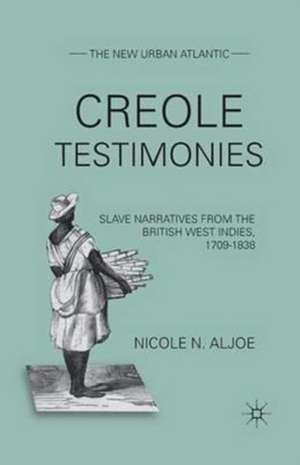
Creole Testimonies: The New Urban Atlantic
Autor N. Aljoeen Limba Engleză Paperback – 15 dec 2011




Preț: 695.97 lei
Preț vechi: 848.75 lei
-18%
Puncte Express: 1044
Carte tipărită la comandă
Livrare economică 07-21 decembrie
Livrare prin curier în România Termenul estimat este afișat lângă disponibilitate.
Transport gratuit pentru acest produs Plată online sau ramburs, în funcție de opțiunile comenzii.
Retur gratuit în 14 zile Comandă securizată și suport în română.
Specificații
ISBN-13: 9781349341108
ISBN-10: 134934110X
Pagini: 200
Ilustrații: XII, 185 p.
Dimensiuni: 140 x 216 x 12 mm
Greutate: 0.26 kg
Ediția:1st edition 2012
Editura: Palgrave MacMillan
Colecția The New Urban Atlantic
Seria The New Urban Atlantic
Locul publicării:New York, United States
ISBN-10: 134934110X
Pagini: 200
Ilustrații: XII, 185 p.
Dimensiuni: 140 x 216 x 12 mm
Greutate: 0.26 kg
Ediția:1st edition 2012
Editura: Palgrave MacMillan
Colecția The New Urban Atlantic
Seria The New Urban Atlantic
Locul publicării:New York, United States
V-ar putea interesa
-
 -29%Preț: 80.72 lei113.63 lei
 -
 The Lives of the Poets: A SelectionSamuel Johnson-17%Preț: 90.19 lei109.32 lei
 -
 An Anthology of Elizabethan Prose FictionPaul Salzman-17%Preț: 72.39 lei87.36 lei
 -
 Arabian Nights' EntertainmentsRobert L. Mack-16%Preț: 100.54 lei119.18 lei
 -
 The New Oxford Book of Eighteenth-Century Verse: ReissueRoger Lonsdale-16%Preț: 97.45 lei116.68 lei
 -
 Preț: 403.27 lei
 -
 -15%Preț: 665.66 lei783.13 lei
 -
 MacbethProf. Eric Rasmussen-18%Preț: 66.70 lei81.72 lei
 -
 John Milton's 'Paradise Lost'Noam Reisner-11%Preț: 155.28 lei174.85 lei
 -
 The Shakespeare HandbookDr Andrew Hiscock-16%Preț: 216.07 lei257.82 lei
 -
 Preț: 64.09 lei
 -
 Doctor Faustus: A critical guideProfessor Sara Munson Deats-14%Preț: 234.01 lei272.78 lei
 -
 The RenegadoPhilip Massinger-16%Preț: 122.23 lei145.98 lei
Cuprins
'So Much Things to Say': The Creole Testimonies of British West Indian Slaves The Forms of Creole Testimony: A Poetics of Fragmentation The Creole Voices of West Indian Slave Narratives 'Going to Law': Legal Discourse and Testimony in Early West Indian Slave Narratives Zombie Testimony: Creole Religious Discourse in West Indian Slave Narratives Creole Testimony and the Black Atlantic: Re-Mapping the Early Slave Narrative
Recenzii
'Creole Testimonies will become the standard work on West Indian slave narratives and ex-slave narratives. Aljoe accurately points out that scholars and readers have long preferred the North American ex-slave narratives, such as Frederick Douglass's, because through them shines a single seemingly authentic author . . . Creole Testimonies argues for the centrality of these narratives based on their collaborative nature, in which several voices, including the slave's or freed-person's, argued about black humanity and the legitimacy of slavery and based on their reflection of West Indian culture and even Caribbean topography - fragments assembled by men and women into a meaningful whole.' - John Saillant, professor of English and History, Western Michigan University
Notă biografică
NICOLE N. ALJOE Assistant Professor at Northeastern University, USA.