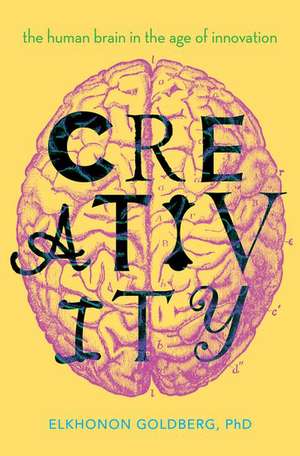
Creativity: The Human Brain in the Age of Innovation
Autor Elkhonon Goldbergen Limba Engleză Hardback – 31 ian 2019
Preț: 211.09 lei
Preț vechi: 251.39 lei
-16%
Puncte Express: 317
Carte tipărită la comandă
Livrare economică 04-09 decembrie
Livrare prin curier în România Termenul estimat este afișat lângă disponibilitate.
Transport gratuit de la 400.00 lei Plată online sau ramburs, în funcție de opțiunile comenzii.
Retur gratuit în 14 zile Comandă securizată și suport în română.
Specificații
ISBN-13: 9780190466497
ISBN-10: 0190466499
Pagini: 296
Dimensiuni: 155 x 239 x 23 mm
Greutate: 0.54 kg
Editura: Oxford University Press
Colecția OUP USA
Locul publicării:New York, United States
ISBN-10: 0190466499
Pagini: 296
Dimensiuni: 155 x 239 x 23 mm
Greutate: 0.54 kg
Editura: Oxford University Press
Colecția OUP USA
Locul publicării:New York, United States
V-ar putea interesa
-
 Mathematics for NeuroscientistsFabrizio Gabbiani-19%Preț: 629.23 lei774.70 lei
 -
 Translational Immunotherapy of Brain TumorsJohn H. Sampson-5%Preț: 1042.89 lei1097.78 lei
 -
 Executive Functions in Health and DiseaseElkhonon Goldberg-20%Preț: 755.71 lei946.44 lei
 -
 -22%Preț: 713.95 lei912.61 lei
 -
 Sleep and Neurologic DiseaseMitchell G. Miglis-25%Preț: 452.62 lei599.80 lei
 -
 Signalers and Receivers: Mechanisms and Evolution of Arthropod CommunicationMichael D. Greenfield-30%Preț: 546.51 lei785.90 lei
 -
 The Lost Self: Pathologies of the Brain and IdentityTodd E. Feinberg-27%Preț: 523.03 lei718.90 lei
 -
 Luria's Legacy in the 21st CenturyAnne-Lise Christensen-30%Preț: 458.46 lei657.31 lei
 -
 -30%Preț: 617.44 lei879.74 lei
 -
 Neuroscience of Rule-Guided BehaviorSilvia A. Bunge-31%Preț: 684.61 lei988.02 lei
 -
 The New Executive Brain: Frontal Lobes in a Complex WorldElkhonon GoldbergPreț: 166.16 lei
 -
 Spatial Representation in AnimalsSue Healy-32%Preț: 541.51 lei790.99 lei
 -
 -30%Preț: 501.08 lei719.35 lei
 -
 -31%Preț: 923.12 lei1336.33 lei
 -
 Autism: Mind and BrainUta Frith-34%Preț: 700.07 lei1055.08 lei
 -
 -27%Preț: 559.26 lei767.44 lei
 -
 -28%Preț: 481.12 lei670.15 lei
 -
 The Brain as a Tool: A Neuroscientist's AccountRay Guillery-27%Preț: 511.25 lei701.08 lei
 -
 -30%Preț: 262.08 lei373.84 lei
 -
 The Neural Basis of Human Belief SystemsFrank KruegerPreț: 471.20 lei
 -
 Contemporary Neuropsychology and the Legacy of LuriaElkhonon Goldberg-15%Preț: 472.24 lei555.58 lei
 -
 Brain Games: Reflections on His Moral CharacterElkhonon GoldbergPreț: 72.04 lei
 -
 -49%Preț: 54.99 lei107.27 lei
 -
 Multiple Sclerosis: Bench to BedsideAlexzander A. A. Asea-24%Preț: 900.91 lei1185.40 lei
 -
 -5%Preț: 1164.07 lei1225.33 lei
 -
 COMPEN VIVO MONIT REAL-TIME (V2)Wilson George S-18%Preț: 1042.62 lei1271.49 lei
Recenzii
well written and wide-ranging ... Throughout the book, Goldberg embraces a strongly first-person presentation, which adds to the interest and memorability of his account.
Countless contributions have dealt with the psychological, socio-cultural, cognitive, evolutionary aspects of creativity. The neuroanatomical and physiological aspects have been explored to a limited extent: which is odd, as creativity is the product of brain's activity. Elkhonon Goldberg's book has the brain as its undisputed main character; this makes it uniquely important. The role of the brain's physiology and anatomy in the generation of creativity, with the frontal lobe and the prefrontal cortex in the privileged position, are discussed exhaustively and masterfully. Goldberg is a first rate neuroscientist and a born writer.
In Creativity, Elkhonon Goldberg is subtle, judicious, relentlessly curious, fun and brutally honest about what neuroscience knows, and doesn't know, about the subject. He guides us through decades of research, to show that perhaps the most striking thing about our plastic organ of creativity, is that, while there are certain basic patterns in the creative brain, they are only starting points; the brainâs circuitry, being so plastic, likely has just as many different ways of helping to produce creative states, as there are human ways of being creative. No one interested in the neuroscience of creativity can afford to miss this book.
Dr. Goldberg has obviously travelled extensively and his observations and experiences seem like a beautifully written journey in themselves until he leads one to the point where he reveals even more involving aspects of creativity in other cultures and even species. As far as this book is concerned, Dr. Goldberg clearly knows what he's doing when it comes to Creativity.
What an inspired marriage of Creativity and Neuroscience (big C, big N), officiated by a brave scientist and original thinker. This book will spark new research, new toolkits, new conversations
Elkhonon Goldberg's new book, Creativity: The Human Brain in the Age of Innovation is a very insightful study of our brains in a time of accelerating and multi-dimensional change. It is the fruit of both scholarly research and many decades of experience. Creativity is a wonderful addition to Dr. Goldberg's body of work.
Elkhonon Goldberg, PhD, a leading-edge neuropsychologist and broad-ranging thinker, has provided a brilliant, synthetic account of human creativity. A sophisticated understanding of brain function is combined with insights from contemporary psychology, evolutionary biology, and cross-cultural studies to elucidate the key processes underlying innovation in the arts, sciences and all areas of human endeavor.
Countless contributions have dealt with the psychological, socio-cultural, cognitive, evolutionary aspects of creativity. The neuroanatomical and physiological aspects have been explored to a limited extent: which is odd, as creativity is the product of brain's activity. Elkhonon Goldberg's book has the brain as its undisputed main character; this makes it uniquely important. The role of the brain's physiology and anatomy in the generation of creativity, with the frontal lobe and the prefrontal cortex in the privileged position, are discussed exhaustively and masterfully. Goldberg is a first rate neuroscientist and a born writer.
In Creativity, Elkhonon Goldberg is subtle, judicious, relentlessly curious, fun and brutally honest about what neuroscience knows, and doesn't know, about the subject. He guides us through decades of research, to show that perhaps the most striking thing about our plastic organ of creativity, is that, while there are certain basic patterns in the creative brain, they are only starting points; the brainâs circuitry, being so plastic, likely has just as many different ways of helping to produce creative states, as there are human ways of being creative. No one interested in the neuroscience of creativity can afford to miss this book.
Dr. Goldberg has obviously travelled extensively and his observations and experiences seem like a beautifully written journey in themselves until he leads one to the point where he reveals even more involving aspects of creativity in other cultures and even species. As far as this book is concerned, Dr. Goldberg clearly knows what he's doing when it comes to Creativity.
What an inspired marriage of Creativity and Neuroscience (big C, big N), officiated by a brave scientist and original thinker. This book will spark new research, new toolkits, new conversations
Elkhonon Goldberg's new book, Creativity: The Human Brain in the Age of Innovation is a very insightful study of our brains in a time of accelerating and multi-dimensional change. It is the fruit of both scholarly research and many decades of experience. Creativity is a wonderful addition to Dr. Goldberg's body of work.
Elkhonon Goldberg, PhD, a leading-edge neuropsychologist and broad-ranging thinker, has provided a brilliant, synthetic account of human creativity. A sophisticated understanding of brain function is combined with insights from contemporary psychology, evolutionary biology, and cross-cultural studies to elucidate the key processes underlying innovation in the arts, sciences and all areas of human endeavor.
Notă biografică
Elkhonon Goldberg, PhD, ABPP, is a scientist, clinician, and educator. He is Director of Luria Neuroscience Institute and Clinical Professor in the Department of Neurology, NYU School of Medicine. Goldberg is internationally renowned for his research in cognitive neuroscience and clinical neuropsychology. He has authored several widely acclaimed books which have been translated into many languages. He lectures worldwide. Goldberg is also a clinician with an active practice in neuropsychology.