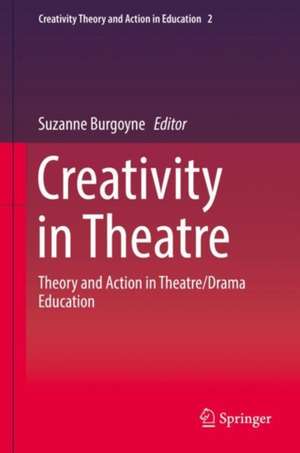
Creativity in Theatre
Editat de Suzanne Burgoyneen Limba Engleză Hardback – 4 oct 2018
În peisajul literaturii de specialitate, Creativity in Theatre se distinge printr-o abordare riguroasă, menită să elimine prăpastia dintre studiul creativității ca disciplină teoretică și practica pedagogică de pe scenă. Spre deosebire de manualele tehnice clasice, această lucrare editată de Suzanne Burgoyne propune o viziune integrată, susținând că teatrul nu este doar o formă de interpretare a unui text preexistent, ci un proces viu de generare a cunoașterii. Subliniem modul în care volumul utilizează descoperiri recente din științele cognitive pentru a valida intuițiile practice ale pedagogilor, demonstrând cum antrenamentul imaginației și explorarea identităților alternative dezvoltă încrederea în asumarea riscurilor.
Cititorii familiarizați cu Creativity: the Actor in Performance de Helen Trenos vor aprecia aici o perspectivă mult mai largă; dacă lucrarea lui Trenos se concentrează pe momentul performanței scenice, volumul de față extinde analiza asupra întregului proces educațional și a impactului său social. Structura este organizată logic în trei părți: prima analizează rolul creativ al actorului în echipa de producție, a doua oferă un instrumentar de activități practice — de la paradigma improvizației la proxemica spectacolelor pop-up — iar ultima secțiune explorează formarea identității tinerilor prin teatru. Merită menționat capitolul dedicat reformării modelului educațional bazat pe extraversie, o perspectivă rară și necesară în domeniu. Față de A Theatre Laboratory Approach to Pedagogy and Creativity, care se concentrează pe un studiu de caz specific (Odin Teatret), lucrarea publicată de Springer oferă un cadru teoretic și practic mult mai diversificat, aplicabil în varii contexte academice.
Preț: 838.48 lei
Preț vechi: 1103.27 lei
-24%
Carte tipărită la comandă
Livrare economică 02-09 noiembrie
Specificații
ISBN-10: 3319789279
Pagini: 304
Ilustrații: XV, 287 p. 22 illus., 8 illus. in color.
Dimensiuni: 160 x 241 x 21 mm
Greutate: 0.68 kg
Ediția:1st ed. 2018
Editura: Springer
Locul publicării:Cham, Switzerland
V-ar putea interesa
-
 -18%Preț: 246.10 lei298.73 lei
 -
 Real-World Theatre EducationChip RomePreț: 220.30 lei
 -
 Visible Learning: FeedbackJohn HattiePreț: 257.56 lei
 -
 Theatre of Good IntentionsD. Snyder-Young-15%Preț: 611.37 lei719.26 lei
 -
 Drama Teacher's Survival Guide II: A Complete Toolkit for Theatre ArtsMargaret F JohnsonPreț: 106.25 lei
 -
 -25%Preț: 219.52 lei292.31 lei
 -
 Story Drama in the Special Needs Classroom: Step-by-Step Lesson Plans for Teaching through Dramatic PlayJessica Perich Perich Carleton-21%Preț: 164.38 lei207.13 lei
 -
 New Directions in Teaching Theatre ArtsAnne Fliotsos-18%Preț: 859.76 lei1048.49 lei
De ce să citești această carte
Această carte este esențială pentru profesorii de teatru și cercetătorii care doresc să fundamenteze pedagogia dramatică pe baze științifice. Cititorul câștigă acces la strategii concrete de predare a creativității ca abilitate transferabilă, înțelegând totodată cum teatrul poate modela personalitatea și capacitatea de colaborare. Este o resursă valoroasă pentru oricine crede că scena este un laborator de dezvoltare umană, nu doar un spațiu de divertisment.
Cuprins
Part I Are Actors Creative?.- 1. The Actor’s Real Role on the Production Team. Tony Noice and Helga Noice.- 2. Creative Acting. Robert Barton.- Part II Activities for Teaching Creativity.- 3. The Improv Paradigm: Three Principles that Spur Creativity in the Classroom. Clayton D. Drinko.- 4. Dreamwork for Dramatic Writing: An Organic Approach to Magic and Creativity. David A. Crespy.- 5. Performative Embodiment as Learning Catalyst: Exploring the Use of Drama/Theatre Practices in an Arts Integration Course for Non-Majors. Kathryn Dawson.- 6. Creativity, Intimate Publics and the Proxemics of Pop Up Poetry Performance. Anne Harris and Stacy Holman Jones.- 7. Reforming Theatrical Education from its Extrovert-based Model. Rob Roznowski.- 8. Teaching the Creative Process: An Essential and Portable Skill. Lynne Porter.- Part III Creating the Self.- 9. Staging Our Selves: Towards a Theory of Relationality, Possibility, and Creative Youth Selfhood. Kathleen Gallagher and Scott Mealey.- 10. A Vygotskian Argument for Teaching Drama in Secondary Schools. Harry Daniels and Emma Downes.- 11. Creativity and the Cybernetics of Self: Drama, Embodied Creation and Feedback Processes. Susan Davis.- Part IV Drama, Theatre, Therapy, Creativity.- 12. Psychodrama and Creativity in Education. John Nolte.- 13. Reconnecting Learning to Development through Performance Ensembles. Carrie Lobman.- Part V Crossing Disciplinary Boundaries.- 14. Enhancing Creativity with Neurofeedback in the Performing Arts: Actors, Musicians, Dancers. John H. Gruzelier.- 15. Creativity Theory and Action in Bioengineering Class. Ferris M. Pfeiffer, Suzanne Burgoyne, Heather K. Hunt, Johannes Strobel, Rachel E. Bauer, Jennie J. Pardoe, Simonita Perales Simkins, Mary Elaine Vansant, Joshua Saboorizadeh, Kate Busselle, William Palmer.- Part VI Assessment.- 16. Assessing Creativity as a Student Learning Outcome in Theatre Education. Marcelo Schmidt and Mark Charney.
Caracteristici
Descriere
People who don’t know theatre may think the only creative artist in the field is the playwright--with actors, directors, and designers mere “interpreters” of the dramatist’s vision. Historically, however, creative mastery and power have passed through different hands. Sometimes, the playwright did the staging. In other periods, leading actors demanded plays be changed to fatten their roles. The late 19th and 20th centuries saw “the rise of the director,” in which director and playwright struggled for creative dominance. But no matter where the balance of power rested, good theatre artists of all kinds have created powerful experiences for their audience.
The purpose of this volume is to bridge the interdisciplinary abyss between the study of creativity in theatre/drama and in other fields. Sharing theories, research findings, and pedagogical practices, the authors and I hope to stimulate discussion among creativity and theatre scholar/teachers, as well as multidisciplinary research.
Theatre educators know from experience that performance classes enhance student creativity. This volume is the first to bring together perspectives from multiple disciplines on how drama pedagogy facilitates learning creativity. Drawing on current findings in cognitive science, as well as drama teachers’ lived experience, the contributors analyze how acting techniques train the imagination, allow students to explore alternate identities, and discover the confidence to take risks. The goal is to stimulate further multidisciplinary investigation of theatre education and creativity, with the intention of benefitting both fields.