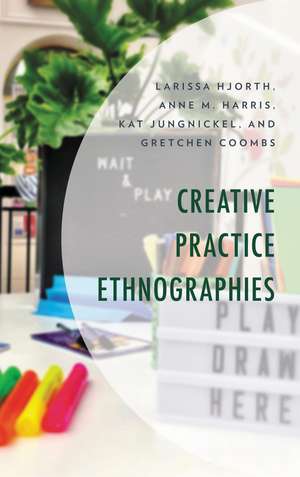
Creative Practice Ethnographies
Autor Larissa Hjorth, Anne M. Harris, Kat Jungnickel, Gretchen Coombsen Limba Engleză Hardback – noi 2019
| Toate formatele și edițiile | Preț | Express |
|---|---|---|
| Paperback (1) | 243.41 lei 43-57 zile | |
| Bloomsbury Publishing – 15 oct 2021 | 243.41 lei 43-57 zile | |
| Hardback (1) | 623.99 lei 43-57 zile | |
| Bloomsbury Publishing – noi 2019 | 623.99 lei 43-57 zile |
Preț: 623.99 lei
Preț vechi: 734.10 lei
-15%
Puncte Express: 936
Preț estimativ în valută:
110.34€ • 126.53$ • 95.36£
110.34€ • 126.53$ • 95.36£
Carte tipărită la comandă
Livrare economică 27 aprilie-11 mai
Specificații
ISBN-13: 9781498572125
ISBN-10: 149857212X
Pagini: 200
Ilustrații: 50 b/w photos;
Dimensiuni: 160 x 233 x 19 mm
Greutate: 0.5 kg
Editura: Bloomsbury Publishing
Colecția Lexington Books
Locul publicării:New York, United States
ISBN-10: 149857212X
Pagini: 200
Ilustrații: 50 b/w photos;
Dimensiuni: 160 x 233 x 19 mm
Greutate: 0.5 kg
Editura: Bloomsbury Publishing
Colecția Lexington Books
Locul publicării:New York, United States
Cuprins
List of Figures
Acknowledgments
Introduction: Doing Creative Practice Ethnographies
Chapter 1: Doing Collaborative and Creative Interdisciplinary Research
Section I: Invitations & Encounters
Chapter 2: Creative Invitations
Chapter 3: Speculative Encounters
Section II: Mapping & Mobilities
Chapter 4: Understanding Mapping
Chapter 5: Making Mobilities
Section III: Play & Performance
Chapter 6: Social Play
Chapter 7: Performing Futures
Conclusion
Bibliography
About the Authors
Acknowledgments
Introduction: Doing Creative Practice Ethnographies
Chapter 1: Doing Collaborative and Creative Interdisciplinary Research
Section I: Invitations & Encounters
Chapter 2: Creative Invitations
Chapter 3: Speculative Encounters
Section II: Mapping & Mobilities
Chapter 4: Understanding Mapping
Chapter 5: Making Mobilities
Section III: Play & Performance
Chapter 6: Social Play
Chapter 7: Performing Futures
Conclusion
Bibliography
About the Authors
Recenzii
Authors Hjorth, Harris, Coombs (all, RMIT University, Australia), and Jungnickel (Univ. of London, UK) assert early on that creative practice ethnography represents a collision of art and anthropology, with artists and creatives (including scholars) using contemporary tools to tell nuanced, revealing, and socially important stories for a broad audience. For scholars seeking deeper meaning in their work, this book lays out concrete examples of a core theme introduced early and often: producing socially impactful research. Interested readers should start with the introduction, as the authors do a spectacular job of providing context for their volume, offering a robust discussion of terms such as "techniques," "translation," and "transmission," which are often contested within academic circles. This reviewer especially appreciated how the text invites readers to more deeply consider core assumptions, examples, and challenges of using creative practice to tell compelling and rigorous stories. Although the subject matter might only be of deep interest to scholars, the book's prose makes this a quick and accessible read for anyone looking to understand the logic and practice of creative practice ethnography. For all scholars, this study is a compelling addition for our methodological toolboxes. Summing Up: Highly recommended. Upper-division undergraduates through faculty; professionals.
This very timely publication gives academics and students in the humanities and beyond a rich and strong framework to think about productive and innovative synergies between creative practice and ethnographic approaches. The authors have succeeded in writing a very clear and well-structured book that sets out the scope of creative practice ethnographies and their methodological implications. This book is particularly compelling as it shows how creative practice ethnographies 'work' through a series of case studies that are not only inspirational and analytical, but also center around core concerns in the field such as participation, performativity, embodiment, and materiality. Creative Practice Ethnographies is a must-read for researchers working in diverse areas, such as practice-based-research, game studies, critical geography, (post)digital studies, media anthropology, and gender studies.
Creative Practice Ethnographies maps the turn to social practice across the creative arts. Focused on the modes of ethnographic practice, this book is divided into sections that provide examples of applied research in the field, where collaborative, co-designed practice lends itself to the potentials of social change through creative methods. The economic matrix behind the social is recast as play, and the value of play is highlighted in the practice examples that provide an index for the breadth of societal changes and perception shifts brought about by the practice. This is a valuable text for teachers, researchers, and practitioners seeking to generate new forms of play as a social facilitator.
This very timely publication gives academics and students in the humanities and beyond a rich and strong framework to think about productive and innovative synergies between creative practice and ethnographic approaches. The authors have succeeded in writing a very clear and well-structured book that sets out the scope of creative practice ethnographies and their methodological implications. This book is particularly compelling as it shows how creative practice ethnographies 'work' through a series of case studies that are not only inspirational and analytical, but also center around core concerns in the field such as participation, performativity, embodiment, and materiality. Creative Practice Ethnographies is a must-read for researchers working in diverse areas, such as practice-based-research, game studies, critical geography, (post)digital studies, media anthropology, and gender studies.
Creative Practice Ethnographies maps the turn to social practice across the creative arts. Focused on the modes of ethnographic practice, this book is divided into sections that provide examples of applied research in the field, where collaborative, co-designed practice lends itself to the potentials of social change through creative methods. The economic matrix behind the social is recast as play, and the value of play is highlighted in the practice examples that provide an index for the breadth of societal changes and perception shifts brought about by the practice. This is a valuable text for teachers, researchers, and practitioners seeking to generate new forms of play as a social facilitator.