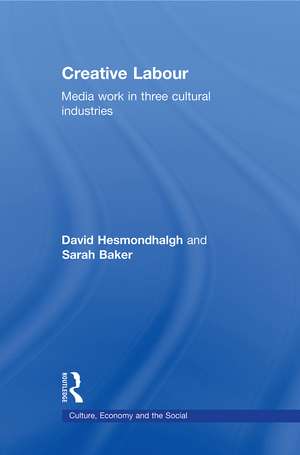
Creative Labour: Media Work in Three Cultural Industries: CRESC
Autor David Hesmondhalgh, Sarah Bakeren Limba Engleză Paperback – 20 apr 2011
Through its close analysis of key issues - such as tensions between commerce and creativity, the conditions and experiences of workers, alienation, autonomy, self-realisation, emotional and affective labour, self-exploitation, and how possible it might be to produce ‘good work’ - Creative Labour makes a major contribution to our understanding of the media, of work, and of social and cultural change. In addition, the book undertakes an extensive exploration of the creative industries, spanning numerous sectors including television, music and journalism.
This book provides a comprehensive and accessible account of life in the creative industries in the 21st century. It is a major piece of research and a valuable study aid for both undergraduate and postgraduate students of subjects including business and management studies, sociology of work, sociology of culture, and media and communications.
Din seria CRESC
-
 Preț: 382.25 lei
 -
 Preț: 369.03 lei
 - 15%
 Preț: 463.64 lei
 - 18%
 Preț: 1135.30 lei
 - 18%
 Preț: 1246.62 lei
 -
 Preț: 466.23 lei
 - 18%
 Preț: 1315.57 lei
 - 15%
 Preț: 425.17 lei
 -
 Preț: 444.29 lei
 - 15%
 Preț: 444.99 lei
 - 18%
 Preț: 1248.98 lei
 -
 Preț: 463.49 lei
 - 18%
 Preț: 1257.26 lei
 -
 Preț: 486.72 lei
 - 18%
 Preț: 1262.94 lei
 - 18%
 Preț: 1112.94 lei
 - 15%
 Preț: 466.54 lei
 - 15%
 Preț: 466.19 lei
 - 18%
 Preț: 1807.16 lei
 -
 Preț: 413.43 lei
 - 15%
 Preț: 427.52 lei
 - 15%
 Preț: 435.94 lei
 - 18%
 Preț: 1250.55 lei
 - 15%
 Preț: 501.28 lei
 - 8%
 Preț: 430.86 lei
 - 18%
 Preț: 1254.12 lei
 - 15%
 Preț: 441.01 lei
 - 18%
 Preț: 1258.16 lei
 - 18%
 Preț: 1252.01 lei
 - 18%
 Preț: 1257.60 lei
 -
 Preț: 462.43 lei
 - 18%
 Preț: 1645.56 lei
 - 18%
 Preț: 791.01 lei
 - 15%
 Preț: 426.44 lei
 - 18%
 Preț: 1258.16 lei
 - 18%
 Preț: 1122.22 lei
 -
 Preț: 432.79 lei
 - 18%
 Preț: 1112.48 lei
 - 18%
 Preț: 1112.48 lei
Preț: 466.69 lei
Puncte Express: 700
Carte tipărită la comandă
Livrare economică 25 noiembrie-09 decembrie
Livrare prin curier în România Termenul estimat este afișat lângă disponibilitate.
Transport gratuit pentru acest produs Plată online sau ramburs, în funcție de opțiunile comenzii.
Retur gratuit în 14 zile Comandă securizată și suport în română.
Specificații
ISBN-13: 9780415677738
ISBN-10: 0415677734
Pagini: 280
Ilustrații: 1 black & white illustrations, 1 black & white line drawings
Dimensiuni: 156 x 234 x 15 mm
Greutate: 0.51 kg
Ediția:1
Editura: Taylor & Francis
Colecția Routledge
Seria CRESC
Locul publicării:Oxford, United Kingdom
ISBN-10: 0415677734
Pagini: 280
Ilustrații: 1 black & white illustrations, 1 black & white line drawings
Dimensiuni: 156 x 234 x 15 mm
Greutate: 0.51 kg
Ediția:1
Editura: Taylor & Francis
Colecția Routledge
Seria CRESC
Locul publicării:Oxford, United Kingdom
V-ar putea interesa
-
 -28%Preț: 368.24 lei511.68 lei
 -
 The Coaching Relationship: Putting People FirstStephen PalmerPreț: 319.60 lei
 -
 101 Coaching Strategies and TechniquesGladeana McMahonPreț: 258.35 lei
 -
 Work Integrated Learning: A Guide to Effective PracticeLesley CooperPreț: 355.73 lei
 -
 The Corporate AthleteJack L GroppelPreț: 183.78 lei
 -
 Competency-Based Recruitment and SelectionRobert Wood-8%Preț: 482.02 lei523.93 lei
 -
 CompensationBarry A. Gerhart-18%Preț: 819.30 lei999.14 lei
 -
 Why Music MattersDavid HesmondhalghPreț: 229.19 lei
 -
 Management and Leadership DevelopmentChristopher Mabey-18%Preț: 840.57 lei1025.09 lei
 -
 -23%Preț: 148.64 lei193.38 lei
Public țintă
Postgraduate and UndergraduateCuprins
1. Introduction: can creative labour be good work? Part 1 2. A model of good and bad work 3. The specificity of creative labour Part 2 4. The management of autonomy, creativity and commerce 5. Pay, hours, security, involvement, esteem and freedom 6. Creative careers, self-realisation and sociality 7. Emotional and affective labour 8. Creative products, good and bad 9. Audiences, quality and the meaning of creative work 10. The politics of good and bad work Bibliography Appendix: The Interviews
Notă biografică
David Hesmondhalgh is Professor of Media, Music and Culture in the School of Media and Communication at the University of Leeds. He is the author of The Cultural Industries (SAGE, 2019); Culture, Economy and Politics: The Case of New Labour (Palgrave, 2015, co-written with Kate Oakley, David Lee and Melissa Nisbett); Why Music Matters (Wiley-Blackwell, 2013); and Creative Labour: Media Work in Three Cultural Industries (Routledge, 2011, co-written with Sarah Baker). He is also editor or co-editor of eight other books or special journal issues on media, music and culture, including a special issue of Popular Communication (co-edited with Anamik Saha) on Race and Cultural Production; The Media and Social Theory (Routledge, co-edited with Jason Toynbee, 2008) and Media and Society, 6th edition (Bloomsbury, co-edited with James Curran, 2019). He was born and raised in Accrington, Lancashire, did his first degree in English Language and Literature at the University of Oxford, and received his PhD from Goldsmiths University of London in 1996. He lives in Yorkshire with his partner, the philosopher Helen Steward, and they have two adult children, Rosa and Joe.
Recenzii
‘A major new study of creative labour. This is an important book that will become a classic in the field. Required reading for anyone interested in the nature, experience and quality of work in the media and cultural industries.’ – Rosalind Gill, Professor of Social and Cultural Analysis, King’s College London, UK
'This will be a model for others to emulate, in its clarity of thought and expression, thoroughness of analysis, and respect for the particularities of the lives it explores. I can only hope that it receives ample flattery of imitation by inspiring others to follow in its footsteps.’ – Larry Gross, Professor and Director, The Annenberg School for Communication & Journalism, University of Southern California
'Anyone interested in the so-called creative or cultural industries will find this book essential reading.' – Peter Golding, Professor and Pro-Vice Chancellor, Northumbria University, UK
‘Hesmondhalgh and Baker’s thorough and intelligent analysis of the nature and experience of work in television, magazine publishing and music, draws-out the characteristic features and the ambiguities of work inherent in these segments of the economy. Their close examination of the meaning of "good" and "bad" work takes the discussion onto another plane and makes the book of wide contemporary relevance across the economy as a whole.’ – John Storey, Professor of Human Resource Management at The Open University Business School, UK
"Creative Labour is ambitious in scope and depth, rewarding the careful reader with a dazzling range of accounts of the daily working lives of ‘creatives’. Most compelling are the authors’ political commitments, commitments they re-state as the book ends. Hesmondhalgh and Baker ponder the possibilities of the spreading of the rewards of ‘good’ creative labour far beyond the cultural industries, noting that their investigation is as much about social justice as it is about individual experience and satisfaction at work." – Cultural Sociology
'This will be a model for others to emulate, in its clarity of thought and expression, thoroughness of analysis, and respect for the particularities of the lives it explores. I can only hope that it receives ample flattery of imitation by inspiring others to follow in its footsteps.’ – Larry Gross, Professor and Director, The Annenberg School for Communication & Journalism, University of Southern California
'Anyone interested in the so-called creative or cultural industries will find this book essential reading.' – Peter Golding, Professor and Pro-Vice Chancellor, Northumbria University, UK
‘Hesmondhalgh and Baker’s thorough and intelligent analysis of the nature and experience of work in television, magazine publishing and music, draws-out the characteristic features and the ambiguities of work inherent in these segments of the economy. Their close examination of the meaning of "good" and "bad" work takes the discussion onto another plane and makes the book of wide contemporary relevance across the economy as a whole.’ – John Storey, Professor of Human Resource Management at The Open University Business School, UK
"Creative Labour is ambitious in scope and depth, rewarding the careful reader with a dazzling range of accounts of the daily working lives of ‘creatives’. Most compelling are the authors’ political commitments, commitments they re-state as the book ends. Hesmondhalgh and Baker ponder the possibilities of the spreading of the rewards of ‘good’ creative labour far beyond the cultural industries, noting that their investigation is as much about social justice as it is about individual experience and satisfaction at work." – Cultural Sociology
Descriere
What is it like to work in the media? Are media jobs more ‘creative’ than those in other sectors? This book explores these issues in the creative industries, using a combination of original research and a synthesis of existing studies.