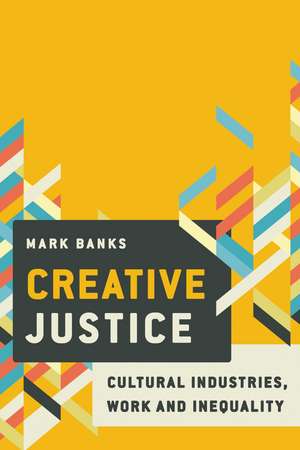
Creative Justice: Cultural Industries, Work and Inequality
Autor Mark Banksen Limba Engleză Hardback – 21 mar 2017
Aimed at students and scholars across a range of disciplines including Sociology, Media and Communication, Cultural Studies, Critical Management Studies,and Human Geography, Creative Justice examines the evidence for - and proposes some solutions to - the problem of obtaining fairer and more equalitarian systems of arts and cultural work.
Preț: 816.01 lei
Preț vechi: 1184.47 lei
-31%
Puncte Express: 1224
Carte tipărită la comandă
Livrare economică 02-16 decembrie
Livrare prin curier în România Termenul estimat este afișat lângă disponibilitate.
Transport gratuit pentru acest produs Plată online sau ramburs, în funcție de opțiunile comenzii.
Retur gratuit în 14 zile Comandă securizată și suport în română.
Specificații
ISBN-13: 9781786601285
ISBN-10: 1786601281
Pagini: 176
Ilustrații: 3 tables
Dimensiuni: 152 x 232 x 18 mm
Greutate: 0.48 kg
Editura: Bloomsbury Publishing
Colecția Rowman & Littlefield
Locul publicării:New York, United States
ISBN-10: 1786601281
Pagini: 176
Ilustrații: 3 tables
Dimensiuni: 152 x 232 x 18 mm
Greutate: 0.48 kg
Editura: Bloomsbury Publishing
Colecția Rowman & Littlefield
Locul publicării:New York, United States
Cuprins
1. Introduction: Cultural Work and Justice / 2. Justice for Cultural Objects / 3. Practices, Ethics and Cultural Work / 4. Talent, Merit and Arts Education / 5. The Long Day Closes? Access and Opportunity in Cultural Work / 6. The Wages of Art: 'Basic Economics' or Basic Inequality? / 7. Concepts for Creative Justice / Bibliography / Index / About the Author
Recenzii
Banks demolishes the "creative industries" hype about the new meritocracy of cultural work. Balancing data analysis with social theory, his valuable study shows that, after a brief interregnum when absolute beginners were able to scale the heights, the cultural sector is once again becoming a domain of class consolidation.
In recent years, theoretically informed and normatively committed critique has been in short supply in the cultural field. Consultants' reports and the dreary output of policy wonks have conquered the imaginative space. In this book, drawing on several critical traditions, Mark Banks has broadened the scope of debate, taking culture 'in itself' seriously. By daringly constituting 'creative justice' as an object and vantage-point he skewers current delusions about the nature of cultural work and education and proposes remedies to present inequalities. But will he be heeded?
Mark Banks makes music out of the social necessity of normative judgement. Creative Justice starts by "paying respect" to the cultural object and subject in normative reasoning and action. How do we advance it? By seeking parity of cultural participation, robust economic redistribution of cultural opportunity and enforcement of fair pay, but especially by facing the paramount responsibility to reduce harm in a world where horrific harms of hate and extreme thought threaten to engulf popular reason. Yes, justice can be done. And it may be creative.
'An intriguing exploration of the difficulty of evaluating cultural work and cultural objects. In this excellent book, Mark Banks carefully unpicks the theoretical accounts that reduce artistic value to either a social construction or a crude economic calculation. Instead, he seeks to reclaim gradations of 'good' in both practices and products, while at the same time exposing the distortions within the contemporary cultural industries that result from increasing social inequality.'
In recent years, theoretically informed and normatively committed critique has been in short supply in the cultural field. Consultants' reports and the dreary output of policy wonks have conquered the imaginative space. In this book, drawing on several critical traditions, Mark Banks has broadened the scope of debate, taking culture 'in itself' seriously. By daringly constituting 'creative justice' as an object and vantage-point he skewers current delusions about the nature of cultural work and education and proposes remedies to present inequalities. But will he be heeded?
Mark Banks makes music out of the social necessity of normative judgement. Creative Justice starts by "paying respect" to the cultural object and subject in normative reasoning and action. How do we advance it? By seeking parity of cultural participation, robust economic redistribution of cultural opportunity and enforcement of fair pay, but especially by facing the paramount responsibility to reduce harm in a world where horrific harms of hate and extreme thought threaten to engulf popular reason. Yes, justice can be done. And it may be creative.
'An intriguing exploration of the difficulty of evaluating cultural work and cultural objects. In this excellent book, Mark Banks carefully unpicks the theoretical accounts that reduce artistic value to either a social construction or a crude economic calculation. Instead, he seeks to reclaim gradations of 'good' in both practices and products, while at the same time exposing the distortions within the contemporary cultural industries that result from increasing social inequality.'