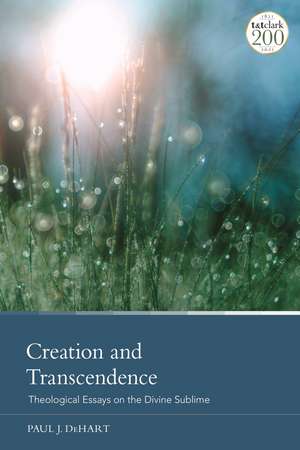
Creation and Transcendence: Theological Essays on the Divine Sublime
Autor Professor Paul J. DeHarten Limba Engleză Paperback – 17 noi 2022
Paul J. DeHart examines the special mode of divine transcendence (God's infinity) and investigates areas where accepting an infinite God presents challenging questions to Christian theology. He discusses what "saving knowledge" or "faith" would have to look like when confronted by such an unlimited conception of deity, and ponders how the doctrine of God's trinity can be brought into harmony with radical notions of transcendence, as well as ways the doctrine of creation itself is threatened when the radical otherness of the creator's mind is not maintained.
DeHart engages with a diverse range of figures: Jean-Luc Marion, Schleiermacher, Kierkegaard, Kathryn Tanner, John Milbank and Rowan Williams, to illustrate his conviction. This volume deals with deep conceptual issues, indicating that creation ex nihilo remains a lively topic in contemporary theology.
Preț: 220.63 lei
Preț vechi: 299.52 lei
-26%
Puncte Express: 331
Carte tipărită la comandă
Livrare economică 30 noiembrie-14 decembrie
Livrare express 24-30 octombrie pentru 110.16 lei
Livrare prin curier în România Termenul estimat este afișat lângă disponibilitate.
Transport gratuit de la 400.00 lei Plată online sau ramburs, în funcție de opțiunile comenzii.
Retur gratuit în 14 zile Comandă securizată și suport în română.
Specificații
ISBN-13: 9780567698742
ISBN-10: 0567698742
Pagini: 304
Dimensiuni: 156 x 234 x 21 mm
Greutate: 0.43 kg
Editura: Bloomsbury Publishing
Colecția T&T Clark
Locul publicării:London, United Kingdom
ISBN-10: 0567698742
Pagini: 304
Dimensiuni: 156 x 234 x 21 mm
Greutate: 0.43 kg
Editura: Bloomsbury Publishing
Colecția T&T Clark
Locul publicării:London, United Kingdom
Cuprins
Introduction
Part One: Cultus Mentis: Accommodating the Endless Object
1. Can Pascal Forgive Descartes? God's Ambiguous Infinity
2. Absolute Dependence or Infinite Desire: Subjective Alignment with God
in Schleiermacher and Kierkegaard
3. "The Passage from Mind to Heart is So Long . . ." Kierkegaard's Repetition
and the Ontology of Agency
4. f(S)I/s :The Instance of Pattern in Kathryn Tanner's Theology
Part Two: Dogma and the Infinite God: Trinity, Christology, Grace
5. On the Contrary: Thomistic Second Thoughts on Eberhard Jüngel
6. John Milbank's Divine Comedy: Not Funny Enough
Part Three: Aquinas and God's Ideas: The Impossible Mind of the Creator
7: "Nothing in this book is true, but it's exactly how things are"
8. Eclipse of the Divine Mind: The Divine Ideas as Anti-Platonic Epistemology
9. The Creature Makes Itself: The Divine Ideas as Anti-Platonic Soteriology
10. Improvising the Paradigms: The Divine Ideas as Anti-Platonic Ontology
Bibliography
Index
Part One: Cultus Mentis: Accommodating the Endless Object
1. Can Pascal Forgive Descartes? God's Ambiguous Infinity
2. Absolute Dependence or Infinite Desire: Subjective Alignment with God
in Schleiermacher and Kierkegaard
3. "The Passage from Mind to Heart is So Long . . ." Kierkegaard's Repetition
and the Ontology of Agency
4. f(S)I/s :The Instance of Pattern in Kathryn Tanner's Theology
Part Two: Dogma and the Infinite God: Trinity, Christology, Grace
5. On the Contrary: Thomistic Second Thoughts on Eberhard Jüngel
6. John Milbank's Divine Comedy: Not Funny Enough
Part Three: Aquinas and God's Ideas: The Impossible Mind of the Creator
7: "Nothing in this book is true, but it's exactly how things are"
8. Eclipse of the Divine Mind: The Divine Ideas as Anti-Platonic Epistemology
9. The Creature Makes Itself: The Divine Ideas as Anti-Platonic Soteriology
10. Improvising the Paradigms: The Divine Ideas as Anti-Platonic Ontology
Bibliography
Index
Recenzii
The author offers a scintillating resume of contemporary theology from the arresting viewpoint of free creation, showing how some thinkers have failed to take that obvious starting point, as well as those who have illuminated us thereby. DeHart turns a profound study into an exciting read.
The order of the world to God is a basic theme of Christian vocation and so of theology. Getting it wrong distorts our self-understanding and service. Drawing superb and sometimes startling lessons from Aquinas, Kierkegaard, and others, Paul DeHart gets it right. This book is smart, learned, and wise.
The order of the world to God is a basic theme of Christian vocation and so of theology. Getting it wrong distorts our self-understanding and service. Drawing superb and sometimes startling lessons from Aquinas, Kierkegaard, and others, Paul DeHart gets it right. This book is smart, learned, and wise.