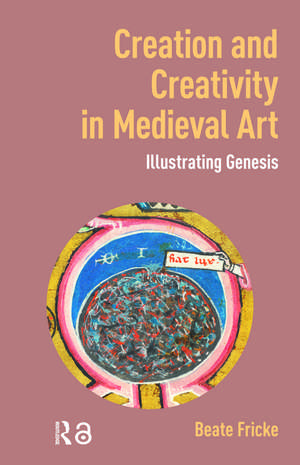
Creation and Creativity in Medieval Art: Illustrating Genesis
Autor Beate Frickeen Limba Engleză Paperback – 16 oct 2026
Preț: 374.72 lei
Preț vechi: 421.87 lei
-11% Precomandă
Puncte Express: 562
Carte nepublicată încă
Livrare prin curier în România Precomanda se expediază când titlul devine disponibil.
Transport gratuit de la 400.00 lei Plată online sau ramburs, în funcție de opțiunile comenzii.
Retur gratuit în 14 zile Comandă securizată și suport în română.
Doresc să fiu notificat când acest titlu va fi disponibil:
Se trimite...
Specificații
ISBN-13: 9781041177708
ISBN-10: 1041177704
Pagini: 286
Dimensiuni: 174 x 246 mm
Ediția:1
Editura: Taylor & Francis
Colecția Routledge
Locul publicării:Oxford, United Kingdom
ISBN-10: 1041177704
Pagini: 286
Dimensiuni: 174 x 246 mm
Ediția:1
Editura: Taylor & Francis
Colecția Routledge
Locul publicării:Oxford, United Kingdom
V-ar putea interesa
-
 Apocalypse IlluminatedRichard K. Emmerson-19%Preț: 452.29 lei558.39 lei
 -
 The Magic Books: A History of Enchantment in 20 Medieval ManuscriptsAnne Lawrence-MathersPreț: 247.33 lei
 -
 Art Is: A Journey into the LightMakoto FujimuraPreț: 185.69 lei
 -
 Craftsman's HandbookCennio D'Andrea Cennini-20%Preț: 71.42 lei89.06 lei
 -
 Medieval ModernAlexander Nagel-21%Preț: 186.94 lei237.84 lei
 -
 The Book of KellsBernard Meehan-17%Preț: 78.67 lei95.23 lei
 -
 Penned and PaintedLucy Freeman Sandler-10%Preț: 208.34 lei230.37 lei
 -
 Preț: 384.83 leiRecomandat
 -
 How to Read Medieval ArtWendy A. SteinPreț: 177.77 lei
 -
 Illuminating Women in the Medieval WorldChristine SciaccaPreț: 192.86 lei
 -
 Preț: 440.91 lei
 -
 Preț: 230.26 lei
 -
 Illuminated ManuscriptsRichard Hayman-27%Preț: 46.24 lei63.34 lei
 -
 The Book of Kells: Unlocking the EnigmaVictoria Whitworth-25%Preț: 207.29 lei277.69 lei
 -
 The Medieval Scriptorium: Making Books in the Middle AgesSara J. CharlesPreț: 166.56 lei
 -
 Illumino: A History of Medieval Britain in 12 Illuminated ManuscriptsMichelle P. BrownPreț: 194.99 lei
 -
 The Medieval Scriptorium: Making Books in the Middle AgesSara J. CharlesPreț: 94.14 lei
 -
 Preț: 219.36 lei
 -
 The Book of MiraclesTill-Holger BorchertPreț: 237.66 lei
 -
 Hildegard Von Bingen: In the Heart of GodSara Salvadori-20%Preț: 180.38 lei225.91 lei
Public țintă
AcademicCuprins
Acknowledgments, Introduction, 1. Creator and Artist, 2. Creating the Cosmos, 3. Creation and Composition, Conclusion, Index, Illustrations
Notă biografică
Before joining the University of Bern (Switzerland) in 2017, Beate Fricke was Professor for Medieval Art at the University of California, Berkeley. Her research focuses on the history of cultural heritage, sculpture, image theories, and objects as archives of a history of applied arts, materiality, knowledge transfer and trade in the global Middle Ages. Together with Finbarr Barry Flood she co-authored the monograph Tales things Tell. Material Histories of Early Globalisms, 2023. She was Principal investigator of the research project Global Horizons in Pre-Modern Art (ERC) and is leading the project The Inheritance of Looting. Medieval Trophies to Modern Museums (SNF). She is founder and Editor-in-chief of the journal 21: Inquiries into Art, History, and the Visual. Beiträge zur Kunstgeschichte und Visuellen Kultur (link: https://21-inquiries.eu/en)
Descriere
This book traces the artists' thinking in their own work and then contextualizes those visual cues within the context of philosophical arguments about the creation of the world. It also considers how Western medieval artists, in inventing original illuminations and experimenting with new representational modes, suggest potential analogies between their own work, God's acts of creation, and nature's generative force.