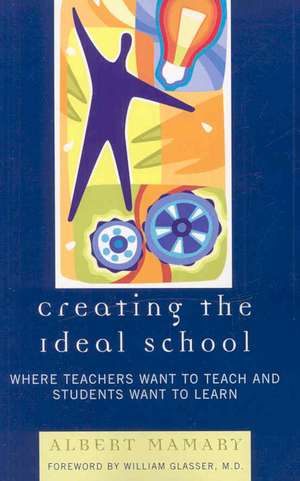
Creating the Ideal School: Where Teachers Want to Teach and Students Want to Learn
Autor Albert Mamary Cuvânt înainte de William Glasser, M.D.en Limba Engleză Paperback – 20 aug 2007
Preț: 384.73 lei
Preț vechi: 554.37 lei
-31%
Puncte Express: 577
Carte tipărită la comandă
Livrare economică 08-22 decembrie
Livrare prin curier în România Termenul estimat este afișat lângă disponibilitate.
Transport gratuit de la 400.00 lei Plată online sau ramburs, în funcție de opțiunile comenzii.
Retur gratuit în 14 zile Comandă securizată și suport în română.
Specificații
ISBN-13: 9781578866199
ISBN-10: 1578866197
Pagini: 313
Dimensiuni: 148 x 226 x 22 mm
Greutate: 0.5 kg
Editura: Bloomsbury Publishing
Colecția R&L Education
Locul publicării:New York, United States
ISBN-10: 1578866197
Pagini: 313
Dimensiuni: 148 x 226 x 22 mm
Greutate: 0.5 kg
Editura: Bloomsbury Publishing
Colecția R&L Education
Locul publicării:New York, United States
Cuprins
1 Here We Go Again
2 Characteristics of an Ideal School
3 It's All in the Perception
4 The School
5 Vision and Mission
6 Best Knowledge, Research Literature, and Data
7 Beliefs, Values, and Dominant Philosophy
8 Relationships, Culture, and Dominant Psychology
9 Children as Students
10 Teaching, Learning, and the Teacher
11 Curriculum Planning
12 Classroom Practices
13 The Principal
14 Continuing Assessment, Renewal, and Improvement
15 Continuing Professional Education for Staff
2 Characteristics of an Ideal School
3 It's All in the Perception
4 The School
5 Vision and Mission
6 Best Knowledge, Research Literature, and Data
7 Beliefs, Values, and Dominant Philosophy
8 Relationships, Culture, and Dominant Psychology
9 Children as Students
10 Teaching, Learning, and the Teacher
11 Curriculum Planning
12 Classroom Practices
13 The Principal
14 Continuing Assessment, Renewal, and Improvement
15 Continuing Professional Education for Staff
Recenzii
Creating the Ideal School is a carefully considered, heartfelt philosophy of teaching-a philosophy of and for education that is nothing short of electrifying. A philosophy that unequivocally states that, given time, every child is capable of learning. A philosophy that not only proposes but that has shown, experientially, that it works. This book is an extraordinary and necessary enterprise.
Creating the Ideal School is a vital and timely book, documenting the best practices associated with demonstrated high standards for student performance and systems design in a time of rapid change for American public schools. The Mamary method breaks away from the factory models of the past, bringing contemporary educators carefully prescribed methods of delivering precise support to all learners in time, on time, every time. Teachers in my district were heard to say, to scream, to hoist on banners in the hall: 'We Love Al.' At a time when the rest of the nation bemoans standardized testing and the rigors of systems adjustments tailored to failing schools, Al Mamary has invested in the future by bringing us hope and instructional improvements by design. These he has in abundance.
I sincerely believe our political decision-makers in Washington and the U.S. Department of Education should make sure that every key educational decision-maker at national and state levels and every public and private school in our nation receives at least one copy of Creating the Ideal School, as this would be the best possible investment in credible, cost-effective schooling for all of our children and youth.
In my book, The Quality School, I wrote "[Albert Mamary's] Johnson City Schools are probably the best model in the United States of what could be called quality schools." Anyone interested in improving student achievement and preparing our students to compete in the world market will find this book rewarding and a must read. Creating the Ideal School will be useful in the training of new teachers and administrators as well as those who have been in the profession a long time.
This is a unique guide for school leaders. I can imagine a harried building- or district-level administrator relating to the clarity and reasonableness of the author's ideas. The prose is straightforward and conversational. Mamary talks to the reader as though he or she is across the table with a pot of coffee and some time to spend.
Creating the Ideal School is a vital and timely book, documenting the best practices associated with demonstrated high standards for student performance and systems design in a time of rapid change for American public schools. The Mamary method breaks away from the factory models of the past, bringing contemporary educators carefully prescribed methods of delivering precise support to all learners in time, on time, every time. Teachers in my district were heard to say, to scream, to hoist on banners in the hall: 'We Love Al.' At a time when the rest of the nation bemoans standardized testing and the rigors of systems adjustments tailored to failing schools, Al Mamary has invested in the future by bringing us hope and instructional improvements by design. These he has in abundance.
I sincerely believe our political decision-makers in Washington and the U.S. Department of Education should make sure that every key educational decision-maker at national and state levels and every public and private school in our nation receives at least one copy of Creating the Ideal School, as this would be the best possible investment in credible, cost-effective schooling for all of our children and youth.
In my book, The Quality School, I wrote "[Albert Mamary's] Johnson City Schools are probably the best model in the United States of what could be called quality schools." Anyone interested in improving student achievement and preparing our students to compete in the world market will find this book rewarding and a must read. Creating the Ideal School will be useful in the training of new teachers and administrators as well as those who have been in the profession a long time.
This is a unique guide for school leaders. I can imagine a harried building- or district-level administrator relating to the clarity and reasonableness of the author's ideas. The prose is straightforward and conversational. Mamary talks to the reader as though he or she is across the table with a pot of coffee and some time to spend.