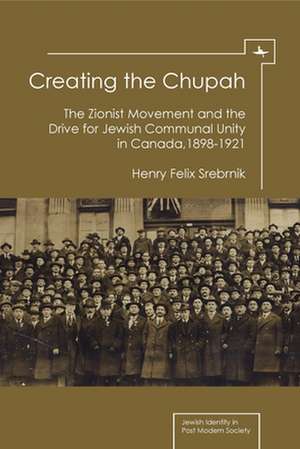
Creating the Chupah: The Zionist Movement and the Drive for Jewish Communal Unity in Canada, 1898-1921: Jewish Identities in Post-Modern Society
Autor Henry Felix Srebrniken Limba Engleză Hardback – sep 2011

Preț: 549.46 lei
Preț vechi: 740.27 lei
-26%
Puncte Express: 824
Carte disponibilă
Livrare economică 09-23 noiembrie
Livrare express 24-30 octombrie pentru 94.87 lei
Livrare prin curier în România Termenul estimat este afișat lângă disponibilitate.
Transport gratuit pentru acest produs Plată online sau ramburs, în funcție de opțiunile comenzii.
Retur gratuit în 14 zile Comandă securizată și suport în română.
Specificații
ISBN-13: 9781936235711
ISBN-10: 1936235714
Pagini: 270
Dimensiuni: 156 x 234 x 19 mm
Greutate: 0.56 kg
Ediția:New.
Editura: Academic Studies Press
Colecția Academic Studies Press
Seria Jewish Identities in Post-Modern Society
Locul publicării:Boston, MA, United States
ISBN-10: 1936235714
Pagini: 270
Dimensiuni: 156 x 234 x 19 mm
Greutate: 0.56 kg
Ediția:New.
Editura: Academic Studies Press
Colecția Academic Studies Press
Seria Jewish Identities in Post-Modern Society
Locul publicării:Boston, MA, United States
V-ar putea interesa
-
 -27%Preț: 80.29 lei109.89 lei
 -
 The Definition of Anti-SemitismKenneth L. Marcus-11%Preț: 340.85 lei382.27 lei
 -
 -24%Preț: 192.53 lei253.67 lei
 -
 Goodbye East EndDavid MerronPreț: 114.49 lei
 -
 Preț: 444.17 lei
 -
 -19%Preț: 454.27 lei560.83 lei
 -
 New DiasporaVictoria AaronsPreț: 315.32 lei
 -
 Will to FreedomEgon BalasPreț: 155.02 lei
 -
 Jews and Genes: The Genetic Future in Contemporary Jewish ThoughtRabbi Elliot N. DorffPreț: 333.42 lei
 -
 The Rag RaceAdam D MendelsohnPreț: 246.55 lei
 -
 -26%Preț: 630.74 lei851.90 lei
 -
 -26%Preț: 550.16 lei740.73 lei
 -
 The Image of Jews in Contemporary ChinaJames R. Ross-18%Preț: 655.91 lei799.89 lei
 -
 The Righteous of the WehrmachtSimon Malkès-17%Preț: 74.67 lei90.38 lei
 -
 History, Memory, and Jewish IdentityIra Robinson-25%Preț: 514.64 lei682.64 lei
 -
 Spatial Concepts of Lithuania in the Long Nineteenth CenturyDarius Staliūnas-18%Preț: 709.49 lei865.23 lei
 -
 -25%Preț: 511.57 lei679.68 lei
 -
 -23%Preț: 784.54 lei1018.88 lei
 -
 Life in Transit: Jews in Postwar Lodz, 1945-1950Shimon Redlich-19%Preț: 709.51 lei875.95 lei
Recenzii
This pioneering study makes a major contribution to the history of Canadian Jewry by arguing that Zionism has historically been a unifying factor within the community. During the formative period 1898-1921, Zionism was not a source of divisiveness, as it was in the neighbouring United States, but a shared arena in which the Canadian Jewish community expressed its ideological and political divisions. Employing primary sources, largely in Yiddish, Srebrnik discusses the role of Zionism in community-building and in the process sheds light on an area of scholarly study that has too long been neglected.