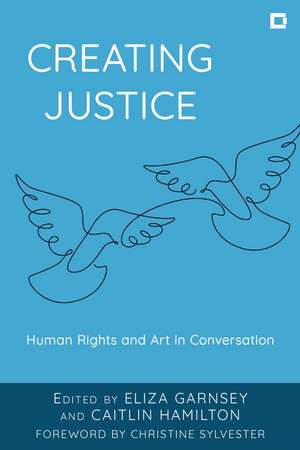
Creating Justice: Human Rights and Art in Conversation: Creative Interventions in Global Politics
Editat de Eliza Garnsey, Caitlin Hamilton Cuvânt înainte de Christine Sylvesteren Limba Engleză Paperback – 16 dec 2024
In this edited volume, twenty-seven artists and scholars, working across a range of practices and approaches, answer these questions - and many more - through a series of conversations. They offer deeply personal reflections on creative labour, sharing original and rich insights into a range of ongoing social and political struggles, violent conflicts, and human rights abuses.




Preț: 256.31 lei
Preț vechi: 325.75 lei
-21%
Puncte Express: 384
Carte tipărită la comandă
Livrare economică 27 noiembrie-11 decembrie
Livrare prin curier în România Termenul estimat este afișat lângă disponibilitate.
Transport gratuit de la 400.00 lei Plată online sau ramburs, în funcție de opțiunile comenzii.
Retur gratuit în 14 zile Comandă securizată și suport în română.
Specificații
ISBN-13: 9781538196366
ISBN-10: 1538196360
Pagini: 246
Ilustrații: 24 BW Illustrations
Dimensiuni: 148 x 226 x 16 mm
Greutate: 0.34 kg
Editura: Bloomsbury Publishing
Colecția Rowman & Littlefield
Seria Creative Interventions in Global Politics
Locul publicării:New York, United States
ISBN-10: 1538196360
Pagini: 246
Ilustrații: 24 BW Illustrations
Dimensiuni: 148 x 226 x 16 mm
Greutate: 0.34 kg
Editura: Bloomsbury Publishing
Colecția Rowman & Littlefield
Seria Creative Interventions in Global Politics
Locul publicării:New York, United States
Cuprins
List of Figures
Foreword
Acknowledgments
Chapter 1. Introduction: A note from the editors
Chapter 2. Public Interventions: A conversation between Amy Sanchez Arteaga, Misael G. Diaz, and Tania Islas Weinstein
Chapter 3. Painting and Photography: A conversation between Jane Lydon and Danie Mellor
Chapter 4. Performance: A conversation between Iman Aoun and Toni Shapiro-Phim
Chapter 5. Architecture: A conversation between Tiziana Panizza Kassahun and Konstantinos Pittas
Chapter 6. Jewellery: A conversation between Su san Cohn and Caitlin Hamilton
Chapter 7. Textiles: A conversation between Christine Andrä and Laura Antonia Coral Velásquez
Chapter 8. Installations: A conversation between eL Seed and Arnaud Kurze
Chapter 9. Poetry and Performance: A conversation between Garima Dutt and Choman Hardi
Chapter 10. Documentary Film: A conversation between Andrea Durbach and Dean Gibson
Chapter 11. Photography: A conversation between Shahidul Alam and Roland Bleiker
Chapter 12. Sculpture: A conversation between Tatiana Fernández-Maya and Carey Newman
Chapter 13. Music and Documentary Films: A conversation between Eda Elif Tibet and Enzo Ikah
Chapter 14. Visual Arts: A conversation between Rachel Kerr and Milena Michalski
About the Editors
Foreword
Acknowledgments
Chapter 1. Introduction: A note from the editors
Chapter 2. Public Interventions: A conversation between Amy Sanchez Arteaga, Misael G. Diaz, and Tania Islas Weinstein
Chapter 3. Painting and Photography: A conversation between Jane Lydon and Danie Mellor
Chapter 4. Performance: A conversation between Iman Aoun and Toni Shapiro-Phim
Chapter 5. Architecture: A conversation between Tiziana Panizza Kassahun and Konstantinos Pittas
Chapter 6. Jewellery: A conversation between Su san Cohn and Caitlin Hamilton
Chapter 7. Textiles: A conversation between Christine Andrä and Laura Antonia Coral Velásquez
Chapter 8. Installations: A conversation between eL Seed and Arnaud Kurze
Chapter 9. Poetry and Performance: A conversation between Garima Dutt and Choman Hardi
Chapter 10. Documentary Film: A conversation between Andrea Durbach and Dean Gibson
Chapter 11. Photography: A conversation between Shahidul Alam and Roland Bleiker
Chapter 12. Sculpture: A conversation between Tatiana Fernández-Maya and Carey Newman
Chapter 13. Music and Documentary Films: A conversation between Eda Elif Tibet and Enzo Ikah
Chapter 14. Visual Arts: A conversation between Rachel Kerr and Milena Michalski
About the Editors
Recenzii
A tour de force across several academic disciplines and artforms, this refreshingly innovative volume creatively reconsiders human rights abuses through exciting, mutually illuminating boundary crossings between the academic and the artistic worlds, too often out of sync with each other. Combining grounded theorizing with autobiographical testimony, it is a must read for anyone seeking to understand the messy and ever-changing reality of political violence and to imagine a way forward.
This is an innovative and exciting collection. Drawing together an impressive range of scholars and artists, working across different media and traditions, the assembled conversations illuminate the numerous ways that the arts can contribute to the pursuit of human rights around the world. Rich, rewarding, and challenging, Creating Justice will be of interest to scholars and human rights practitioners.
Art is one of our best inventions. In this volume artists and scholars explore how artworks are able to resist and transform the structural violence inherent in Human Rights failures. A welcome contribution to understanding the epistemic differences as well as the ethical and political overlaps between art practice and IR scholarship.
This is an innovative and exciting collection. Drawing together an impressive range of scholars and artists, working across different media and traditions, the assembled conversations illuminate the numerous ways that the arts can contribute to the pursuit of human rights around the world. Rich, rewarding, and challenging, Creating Justice will be of interest to scholars and human rights practitioners.
Art is one of our best inventions. In this volume artists and scholars explore how artworks are able to resist and transform the structural violence inherent in Human Rights failures. A welcome contribution to understanding the epistemic differences as well as the ethical and political overlaps between art practice and IR scholarship.