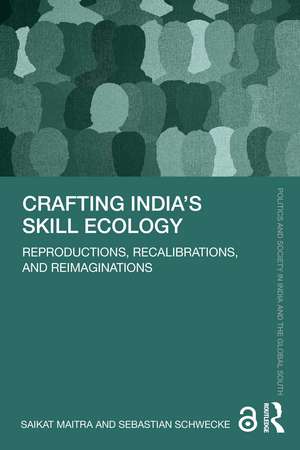
Crafting India's Skill Ecology: Reproductions, Recalibrations, and Reimaginations: Politics and Society in India and the Global South
Editat de Saikat Maitra, Sebastian Schweckeen Limba Engleză Paperback – 26 noi 2025
Focusing on industrial training from the late colonial period – particularly the 1930s – through Nehruvian state-led industrialisation and into the era of neoliberal reform, the book explores how skilling became a terrain of collaboration and contestation between the state and the capital. It also reveals how social relations influence the legitimacy of skills, determining what forms of labour are seen as ‘skilled’ or ‘unskilled’ and for whom.
Combining perspectives from history, political science, and colonial and postcolonial studies, this interdisciplinary work offers fresh insights into the politics of labour and development in South Asia. It will be essential reading for scholars and researchers in modern history, political science, sociology, economics, social policy, and Asian studies.



Preț: 381.86 lei
Puncte Express: 573
Carte disponibilă
Livrare economică 16-30 noiembrie
Livrare express 31 octombrie-06 noiembrie pentru 36.21 lei
Livrare prin curier în România Termenul estimat este afișat lângă disponibilitate.
Transport gratuit de la 400.00 lei Plată online sau ramburs, în funcție de opțiunile comenzii.
Retur gratuit în 14 zile Comandă securizată și suport în română.
Specificații
ISBN-13: 9781032995649
ISBN-10: 1032995645
Pagini: 342
Ilustrații: 14
Dimensiuni: 156 x 234 x 19 mm
Greutate: 0.48 kg
Ediția:1
Editura: Taylor & Francis
Colecția Routledge
Seria Politics and Society in India and the Global South
Locul publicării:Oxford, United Kingdom
ISBN-10: 1032995645
Pagini: 342
Ilustrații: 14
Dimensiuni: 156 x 234 x 19 mm
Greutate: 0.48 kg
Ediția:1
Editura: Taylor & Francis
Colecția Routledge
Seria Politics and Society in India and the Global South
Locul publicării:Oxford, United Kingdom
Public țintă
PostgraduateCuprins
1. Introduction Section I: Historical approaches to the study of the skill ecology 2. Skilling and mis-skilling managers: The Indian Institute of Management, business education, and Indian capitalism, 1964 - 1980 3. Having time passed: Education, skill development, control, and labour in prisons of colonial India 4. Practicing skills, processing skins: Urdu manuals on developing tanning as a rural trade (1940-1946) Section II: Skill as making, producing, doing 5. Skills, caste, and class in an eastern Indian steel town, 1950s-2000s 6. Haptic knowledge: Artisanal skills, labour, and embodied knowledge practices 7. Skilling as a mode of doing: Techniques and trajectories of street vending in Delhi’s weekly bazaars Section III: Skilling at the margins of the skill ecology 8.The skills of ‘city-makers’: Waste-work in small-town India 9. Beyond the algorithm: The significance of skill in platform work 10. “Learning computers”: Skilling, working, and waiting in Seelampur Section IV: Sociology of vocational training 11. Towards a gender transformative vision of TVET in India: Student experiences and labour market trajectories in India's contemporary TVET 12. Perceptions of teachers in Indian polytechnics: An exploratory study of the attractiveness in India in the higher vocational sector 13. Employment challenges of the Indian youth: An overview of the Indian VET sector
Recenzii
“With her characteristic brilliance and perspicacity, Mary E. John makes a signal contribution to feminist scholarship in this book. Her genealogy of child marriage draws upon historical, comparative, and intersecting analytical frameworks. This deep and nuanced contextualization compels us to consider afresh what we had long assumed we knew about a familiar subject. Her argument about "compulsory marriage," which she introduces to reframe the discussion of child marriage, offers an important conceptual advance that will likely become a valuable new resource in the feminist toolkit. This is one of the most original and exciting feminist interventions to come along in a while.” — Mrinalini Sinha, Alice Freeman Palmer Professor of History, University of Michigan, USA
“This elegantly incisive book by Mary E. John, one of India’s leading feminist scholars, challenges us to interrogate some of the myths of reason and progress that we complacently live by. Her object of study is public discourse and social policy on the issue of child marriage, a ‘social problem’ which, for close on two centuries, has been an object of attention by Indian social reformers, women’s movement activists, and latterly, in a global context, by international development agencies. In a tour de force, John decodes the intricacies of various data sets and the assumptions that drive them, to suggest that it is not child-marriage that is the problem for Indian women, but rather the ‘compulsory’ nature of marriage itself which must be the frame of reference for genuine change.” — Patricia Uberoi, Retired Professor, Institute of Economic Growth & Chairperson, Institute of Chinese Studies, New Delhi, India
“This elegantly incisive book by Mary E. John, one of India’s leading feminist scholars, challenges us to interrogate some of the myths of reason and progress that we complacently live by. Her object of study is public discourse and social policy on the issue of child marriage, a ‘social problem’ which, for close on two centuries, has been an object of attention by Indian social reformers, women’s movement activists, and latterly, in a global context, by international development agencies. In a tour de force, John decodes the intricacies of various data sets and the assumptions that drive them, to suggest that it is not child-marriage that is the problem for Indian women, but rather the ‘compulsory’ nature of marriage itself which must be the frame of reference for genuine change.” — Patricia Uberoi, Retired Professor, Institute of Economic Growth & Chairperson, Institute of Chinese Studies, New Delhi, India
Notă biografică
Saikat Maitra is a faculty member in the Public Policy and Management Group in the Indian Institute of Management, Calcutta, India.
Sebastian Schwecke is the founding director of the Max Weber Forum for South Asian Studies (MWF) in Delhi, India.
Sebastian Schwecke is the founding director of the Max Weber Forum for South Asian Studies (MWF) in Delhi, India.
Descriere
This volume traces how the discourse of skill evolved in colonial and postcolonial India, from the mid-nineteenth century to the present neoliberal era.