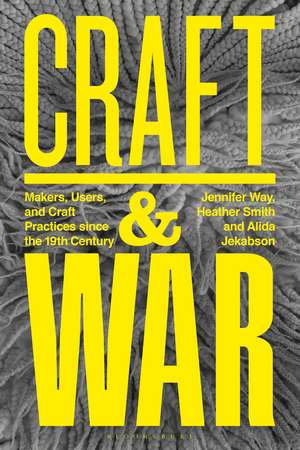
Craft and War
Editat de Alida R. Jekabson, Heather Smith, Jennifer Wayen Limba Engleză Paperback – 11 iun 2026
Chapters look at the impact of colonization on making practices and acts of preserving cultural heritage in times of dislocation and migration. Authors provide insights into repurposing tools of oppression and the appropriation of material culture as a device of warfare, in addition to embroidery and tactics of resistance, and the role of craft and folk art in international feminist peace activism. Organized into four thematic sections, this book reveals how craft developed in different regions during and after armed conflicts, including research on trench art and objects, quilts and rugs commissioned in wartime, and ceramics and the art of commemoration. Craft and War also provides a breadth of analysis on crafting as a rehabilitative activity and traces government initiatives across different countries for postwar healing involving crafts.
This important contribution to modern craft history addresses multiple facets of a rich and complex subject to provide cross-national, cultural and chronological comparisons of craft's participation in situations of conflict and stages of war.
| Toate formatele și edițiile | Preț | Express |
|---|---|---|
| Paperback (1) | 174.86 lei Precomandă | |
| Bloomsbury Publishing – 11 iun 2026 | 174.86 lei Precomandă | |
| Hardback (1) | 488.00 lei Precomandă | |
| Bloomsbury Publishing – 11 iun 2026 | 488.00 lei Precomandă |
Preț: 174.86 lei
Preț vechi: 210.38 lei
-17% Precomandă
Puncte Express: 262
Preț estimativ în valută:
30.92€ • 36.45$ • 26.69£
30.92€ • 36.45$ • 26.69£
Carte nepublicată încă
Doresc să fiu notificat când acest titlu va fi disponibil:
Se trimite...
Specificații
ISBN-13: 9781350345478
ISBN-10: 1350345474
Pagini: 352
Ilustrații: 59 colour illus.
Dimensiuni: 156 x 234 mm
Editura: Bloomsbury Publishing
Locul publicării:London, United Kingdom
ISBN-10: 1350345474
Pagini: 352
Ilustrații: 59 colour illus.
Dimensiuni: 156 x 234 mm
Editura: Bloomsbury Publishing
Locul publicării:London, United Kingdom
Cuprins
List of Figures
Acknowledgements
Introduction
Part I. Reviving Presence
1. Eco-critical Entanglements: San Pottery, Genocide, Historical Archaeology, and Indigenous Knowledge, Wendy Gers (Hanze University of Applied Sciences, the Netherlands)
2. Material Recovery through Hand-Built Talismans and Other Sensing Objects, Cindy Mochizuki (Independent Scholar, Canada)
Part II. Making Do
3. Crafting War, Handling Conflict: Trench Art, from Object to Embodied World, Nicholas J. Saunders (University of Bristol, UK)
4. Textile Handicrafts as Tactics of Resistance in and after Auschwitz: The Example of Lisa Pinhas in Context, Anne Röhl (University of Siegen, Germany)
5. An Aesthetic Ecosystem in Adrian Pepe's Untitled Braided Shearlings: Art and Resilience in Lebanon, Jessica Gershultz (University of St Andrews, UK)
Part III. Craft in Displacement
6. Passing the Thread: Craft and Latvian National Dress in Post-War Displaced Communities, Alida Jekabson (University of California, Santa Barbara, USA)
7. Memory, Mediation, and Affordances in Colombia's Mampuján Tapestries, Antonio Sánchez Gómez (Parsons School of Design, The New School, USA)
Part IV. Organizing Women
8. Intermediaries of Craft in 20th Century Morocco and Algeria, Maia Nichols (University of California, San Diego, USA)
9. Quilting for a Cause: Forgetting and Remembering First World War Signature Fundraising Quilts in Canada, Heather Smith (Western University, Canada)
10. Another History of Indian Handicraft: Partition of India, Rehabilitation, and Women's Work, Chandan Bose (Indian Institute of Technology, India)
Part V. Craft and Healing
11. Modern Craft in the Aftermath of War: The Case of the Disabled Soldiers' Embroidery Industry, 1918-1971, Joseph McBrinn (Ulster University, UK)
12. Craft Therapy in Imperial Military, Medical, and Museum Spaces, 1939-45, Imogen Wiltshire (University of Lincoln, UK)
13. Clay and Combat: Exploring the Embodied Experience of War through Ceramic Practice, Christopher McHugh (Ulster University, UK)
Part VI. Politics of Friendship
14. A Rose-Colored Reunion: Craft in White-Civil War Veteran Reconciliation, Sarah Ann Burgos (Museum of the Virginia National Guard, USA)
15. Women's Caravan of Peace, 1958: Craft, Folk art, and sisterhood fighting the Cold War Divide, Valeria Fulop-Pochon (University of Bristol, UK)
16. Exhibiting Diplomacy in Cold War North Korea: The Role of Craft and Juche in North Korea's International Friendship Exhibition, Karlee Bergendorff (Duke University, USA)
List of Contributors
Index
Acknowledgements
Introduction
Part I. Reviving Presence
1. Eco-critical Entanglements: San Pottery, Genocide, Historical Archaeology, and Indigenous Knowledge, Wendy Gers (Hanze University of Applied Sciences, the Netherlands)
2. Material Recovery through Hand-Built Talismans and Other Sensing Objects, Cindy Mochizuki (Independent Scholar, Canada)
Part II. Making Do
3. Crafting War, Handling Conflict: Trench Art, from Object to Embodied World, Nicholas J. Saunders (University of Bristol, UK)
4. Textile Handicrafts as Tactics of Resistance in and after Auschwitz: The Example of Lisa Pinhas in Context, Anne Röhl (University of Siegen, Germany)
5. An Aesthetic Ecosystem in Adrian Pepe's Untitled Braided Shearlings: Art and Resilience in Lebanon, Jessica Gershultz (University of St Andrews, UK)
Part III. Craft in Displacement
6. Passing the Thread: Craft and Latvian National Dress in Post-War Displaced Communities, Alida Jekabson (University of California, Santa Barbara, USA)
7. Memory, Mediation, and Affordances in Colombia's Mampuján Tapestries, Antonio Sánchez Gómez (Parsons School of Design, The New School, USA)
Part IV. Organizing Women
8. Intermediaries of Craft in 20th Century Morocco and Algeria, Maia Nichols (University of California, San Diego, USA)
9. Quilting for a Cause: Forgetting and Remembering First World War Signature Fundraising Quilts in Canada, Heather Smith (Western University, Canada)
10. Another History of Indian Handicraft: Partition of India, Rehabilitation, and Women's Work, Chandan Bose (Indian Institute of Technology, India)
Part V. Craft and Healing
11. Modern Craft in the Aftermath of War: The Case of the Disabled Soldiers' Embroidery Industry, 1918-1971, Joseph McBrinn (Ulster University, UK)
12. Craft Therapy in Imperial Military, Medical, and Museum Spaces, 1939-45, Imogen Wiltshire (University of Lincoln, UK)
13. Clay and Combat: Exploring the Embodied Experience of War through Ceramic Practice, Christopher McHugh (Ulster University, UK)
Part VI. Politics of Friendship
14. A Rose-Colored Reunion: Craft in White-Civil War Veteran Reconciliation, Sarah Ann Burgos (Museum of the Virginia National Guard, USA)
15. Women's Caravan of Peace, 1958: Craft, Folk art, and sisterhood fighting the Cold War Divide, Valeria Fulop-Pochon (University of Bristol, UK)
16. Exhibiting Diplomacy in Cold War North Korea: The Role of Craft and Juche in North Korea's International Friendship Exhibition, Karlee Bergendorff (Duke University, USA)
List of Contributors
Index
Recenzii
This volume offers a veritable warren of enticing essays, spanning archival, historical, contemporary, Western, and non-Western perspectives.
These essays air out marvelous examples of humanity's dirty laundry by identifying many a 'subversive stitch' (often by a woman) that realized survival and resistance --and also distinct ways that craft has been co-opted into a nationalist symbol. The authors illuminate specific instances when the human penchant for genocide and civil war disrupted indigenous and artisanal knowledge and savor the expansive field of crafted objects as an immense archive of lived experience and emotions.
These essays air out marvelous examples of humanity's dirty laundry by identifying many a 'subversive stitch' (often by a woman) that realized survival and resistance --and also distinct ways that craft has been co-opted into a nationalist symbol. The authors illuminate specific instances when the human penchant for genocide and civil war disrupted indigenous and artisanal knowledge and savor the expansive field of crafted objects as an immense archive of lived experience and emotions.