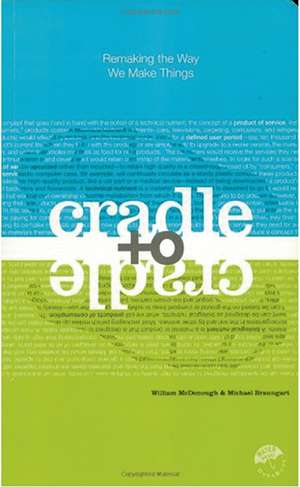
Cradle to Cradle
Autor William McDonough, Michael Braungarten Limba Engleză Paperback – 31 mai 2003
Bazându-ne pe analizele de mediu și studiile de caz prezentate de Michael Braungart și William McDonough, notăm cu interes că această lucrare depășește retorica clasică a ecologismului de tip „redu, refolosește, reciclează”. În Cradle to Cradle, autorii demonstrează că modelul industrial actual, moștenit de la Revoluția Industrială, este unul inerent distructiv, transformând resursele în deșeuri toxice într-un flux liniar „de la leagăn la mormânt”. Credem că relevanța acestui text pentru curriculumul de design industrial și managementul mediului rezidă în propunerea unui sistem regenerativ, unde designul elimină conceptul de deșeu prin utilizarea nutrienților biologici și tehnici. Comparabil cu Sustainable Industrial Design and Waste Management de Salah El Haggar în rigurozitate, Cradle to Cradle se diferențiază prin faptul că este actualizat pentru o paradigmă în care eficiența nu înseamnă doar a face „mai puțin rău”, ci a crea un impact pozitiv net. În timp ce alte lucrări se concentrează pe gestionarea deșeurilor existente, acest manifest propune reproiectarea fundamentală a obiectelor pentru a circula în bucle închise, evitând procesul de „downcycling” — transformarea materialelor în produse de calitate inferioară. Această abordare este dezvoltată ulterior în The Upcycle, unde autorii analizează lecțiile învățate după un deceniu de implementare a acestor principii. Recomandăm această ediție de la Vintage pentru claritatea cu care expune soluții viabile, extrase din experiența practică a autorilor în proiectarea de produse și spații industriale care funcționează asemenea unui ecosistem natural.
Preț: 243.28 lei
Carte disponibilă
Livrare economică 16-30 noiembrie
Livrare express 30 octombrie-05 noiembrie pentru 68.45 lei
Specificații
ISBN-10: 0865475873
Pagini: 193
Dimensiuni: 128 x 205 x 19 mm
Greutate: 0.55 kg
Ediția:1
Editura: MACMILLAN USA
Locul publicării:United States
V-ar putea interesa
-
 Geology: A Very Short IntroductionJan Zalasiewicz-18%Preț: 58.22 lei71.42 lei
 -
 Robotics: A Very Short IntroductionAlan Winfield-20%Preț: 57.20 lei71.12 lei
 -
 Preț: 202.50 lei
 -
 Sustainable Fashion and Textiles: Design JourneysKate Fletcher-8%Preț: 452.40 lei491.74 lei
 -
 WaterDavid L FeldmanPreț: 159.94 lei
 -
 LandDerek HallPreț: 166.18 lei
 -
 Sustainable Design from Vision to ActionJeremy FaludiPreț: 393.26 lei
 -
 Preț: 388.70 lei
 -
 On Natural CapitalPartha DasguptaPreț: 149.46 lei
 -
 -29%Preț: 237.90 lei337.20 lei
 -
 What We Leave BehindDerrick Jensen-10%Preț: 120.14 lei133.08 lei
 -
 Cradle to CradleMichael Braungart-32%Preț: 58.43 lei85.85 lei
 -
 The Principles of SustainabilitySimon Dresner-18%Preț: 1154.73 lei1408.21 lei
 -
 Fashion & Sustainability: Design for ChangeKate Fletcher-27%Preț: 165.15 lei226.64 lei
 -
 Sustainable Materials without the hot airJonathan Cullen-39%Preț: 258.62 lei425.88 lei
 -
 -27%Preț: 175.34 lei241.35 lei
 -
 -27%Preț: 179.42 lei245.12 lei
De ce să citești această carte
Recomandăm această carte oricărui profesionist din design, inginerie sau politici publice care dorește să înțeleagă economia circulară la sursă. Cititorul câștigă o perspectivă revoluționară asupra producției: deșeurile nu sunt inevitabile, ci o eroare de proiectare. Este un ghid practic despre cum putem transforma industria dintr-un agent al poluării într-un sistem care hrănește planeta, oferind soluții concrete pentru o sustenabilitate reală, nu doar declarativă.
Despre autor
Michael Braungart este un chimist german renumit și fondatorul Environmental Protection Encouragement Agency (EPEA) din Hamburg, fiind un pionier în chimia ecologică. Împreună cu arhitectul american William McDonough, a pus bazele conceptului Cradle to Cradle, integrând rigoarea științifică cu designul vizionar. Activitatea sa se concentrează pe eliminarea substanțelor toxice din procesele de fabricație și pe crearea de materiale care pot fi reintegrate sigur în natură sau în industrie. Cei doi autori au colaborat la numeroase proiecte de anvergură, demonstrând că ecologia și profitabilitatea pot coexista prin inovație în design.
Descriere scurtă
"Reduce, reuse, recycle" urge environmentalists; in other words, do more with less in order to minimize damage. As William McDonough and Michael Braungart argue in their provocative, visionary book, however, this approach perpetuates a one-way, "cradle to grave" manufacturing model that dates to the Industrial Revolution and casts off as much as 90 percent of the materials it uses as waste, much of it toxic. Why not challenge the notion that human industry must inevitably damage the natural world, they ask.
In fact, why not take nature itself as our model? A tree produces thousands of blossoms in order to create another tree, yet we do not consider its abundance wasteful but safe, beautiful, and highly effective; hence, "waste equals food" is the first principle the book sets forth. Products might be designed so that, after their useful life, they provide nourishment for something new-either as "biological nutrients" that safely re-enter the environment or as "technical nutrients" that circulate within closed-loop industrial cycles, without being "downcycled" into low-grade uses (as most "recyclables" now are).
Elaborating their principles from experience (re)designing everything from carpeting to corporate campuses, the authors make an exciting and viable case for change.
Notă biografică
Michael Braungart is a chemist and the founder of the Environmental Protection Encouragement Agency (EPEA) in Hamburg, Germany. Prior to starting EPEA, he was the director of the chemistry section for Greenpeace. Since 1984 he has been lecturing at universities, businesses, and institutions around the world on critical new concepts for ecological chemistry and materials flow management. Dr. Braungart is the recipient of numerous honors, awards, and fellowships from the Heinz Endowment, the W. Alton Jones Foundation, and other organizations.
In 1995 the authors created McDonough Braungart Design Chemistry, a product and systems development firm assisting client companies in implementing their unique sustaining design protocol. Their clients include Ford Motor Company, Nike, Herman Miller, BASF, DesignTex, Pendleton, Volvo, and the city of Chicago. The company's Web site can be found at www.mbdc.com.
Descriere
'Reduce, reuse, recycle' urge environmentalists; in other words, do more with less in order to minimize damage. But as architect William McDonough and chemist Michael Braungart point out in this provocative, visionary book, this approach only perpetuates the one-way, 'cradle to grave' manufacturing model, dating to the Industrial Revolution, that creates such fantastic amounts of waste and pollution in the first place. Why not challenge the belief that human industry must damage the natural world? In fact, why not take nature itself as our model for making things? A tree produces thousands of blossoms in order to create another tree, yet we consider its abundance not wasteful but safe, beautiful and highly effective.
Waste equals food.
Guided by this principle, McDonough and Braungart explain how products can be designed from the outset so that, after their useful lives, they will provide nourishment for something new - continually circulating as pure and viable materials within a 'cradle to cradle' model. Drawing on their experience in redesigning everything from carpeting to corporate campuses, McDonough and Braungart make an exciting and viable case for putting eco-effectiveness into practice, and show how anyone involved in making anything can begin to do so as well.