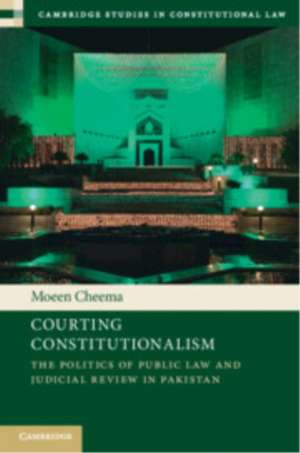
Courting Constitutionalism
Autor Moeen Cheemaen Limba Engleză Paperback – 20 feb 2025
Preț: 294.72 lei
Puncte Express: 442
Carte tipărită la comandă
Livrare economică 23 noiembrie-07 decembrie
Livrare prin curier în România Termenul estimat este afișat lângă disponibilitate.
Transport gratuit de la 400.00 lei Plată online sau ramburs, în funcție de opțiunile comenzii.
Retur gratuit în 14 zile Comandă securizată și suport în română.
Specificații
ISBN-13: 9781108927451
ISBN-10: 1108927459
Pagini: 288
Dimensiuni: 152 x 229 x 16 mm
Greutate: 0.42 kg
Editura: Cambridge University Press
ISBN-10: 1108927459
Pagini: 288
Dimensiuni: 152 x 229 x 16 mm
Greutate: 0.42 kg
Editura: Cambridge University Press
Cuprins
1. Introduction; 2. Postcolonial legality: fragments of the rule of law and constitutionalism; 3. Martial rule: military‒bureaucratic authoritarianism and 'basic' constitutionalism; 4. Elective dictatorship: socialist populism and the myth of a consensus constitution; 5. Praetorian governmentality: Islamisation of laws and the genesis of substantive constitutionalism; 6. Indirect praetorianism: 'public interest litigation' and the first wave of judicial activism; 7. Military‒civil composite: 'military incorporated' and the 'lawyers' movement'; 8. Corporatist governance: the 'Chaudhry court' and 'judicial proactivism'; 9. Conclusion: judicialisation of politics in Pakistan.
Recenzii
'In this beautifully written and meticulously researched book, Moeen Cheema complicates and enriches common narratives of judicialisation of politics since World War II by showing how, since independence, the Supreme Court of Pakistan has creatively built on foundations laid in the colonial period using materials and resources provided by concepts and tools of administrative legality, not constitutional rights. By keeping a relatively low political profile, the Court navigated the choppy waters of a divided society during alternating periods of civilian, military and military-backed civilian rule to become a major constitutional player. This is a gripping and important story.' Peter Cane, University of Cambridge
'Global scholars do not pay enough attention to the recent history of the Pakistani Supreme Court – they should. The Pakistani Court has engaged in constitutional review in challenging circumstances, and delivered a wide range of decisions on the separation of powers, constitutional amendment and the protection of rights. In this important new book, Moeen Cheema takes us through these decisions and explains their broader social and political context, giving us insight into how constitutional law has shaped politics, and politics constitutional law, in modern Pakistan. It is a must-read for anyone interested in constitutionalism in South Asia.' Rosalind Dixon, University of New South Wales
'A landmark contribution to the study of public law, Courting Constitutionalism is at once a rich contextual inquiry into the construction of judicial power in Pakistan, a superb exemplar of the best traditions of historical institutionalism, and an outstanding model for the next generation of constitutional studies. Truly magnificent!' Richard Albert, Professor of World Constitutions and Director of Constitutional Studies, The University of Texas at Austin
'Moeen Cheema's account of the Pakistani judiciary's evolution into a key actor in what Ran Hirschl calls constitutional “mega-politics” is thoughtful, rigorous and informative. Its contribution to scholarship is not restricted to Pakistani or subcontinental constitutionalism alone. This study of the dramatic growth of judicial power in a context that has oscillated between military, quasi-military and hybrid-civil regimes is a serious provocation to a field that continues to debate the legitimacy of judicial review largely within the narrow confines of the “counter-majoritarian difficulty” in democratic regimes. The book's historical institutionalist method offers rich insights for appreciating how courts, as strategic constitutional institutions, manage not only to survive and but also to thrive in seemingly inhospitable ground.' Tarunabh Khaitan, Head of Research, Bonavero Institute of Human Rights, Oxford
'Global scholars do not pay enough attention to the recent history of the Pakistani Supreme Court – they should. The Pakistani Court has engaged in constitutional review in challenging circumstances, and delivered a wide range of decisions on the separation of powers, constitutional amendment and the protection of rights. In this important new book, Moeen Cheema takes us through these decisions and explains their broader social and political context, giving us insight into how constitutional law has shaped politics, and politics constitutional law, in modern Pakistan. It is a must-read for anyone interested in constitutionalism in South Asia.' Rosalind Dixon, University of New South Wales
'A landmark contribution to the study of public law, Courting Constitutionalism is at once a rich contextual inquiry into the construction of judicial power in Pakistan, a superb exemplar of the best traditions of historical institutionalism, and an outstanding model for the next generation of constitutional studies. Truly magnificent!' Richard Albert, Professor of World Constitutions and Director of Constitutional Studies, The University of Texas at Austin
'Moeen Cheema's account of the Pakistani judiciary's evolution into a key actor in what Ran Hirschl calls constitutional “mega-politics” is thoughtful, rigorous and informative. Its contribution to scholarship is not restricted to Pakistani or subcontinental constitutionalism alone. This study of the dramatic growth of judicial power in a context that has oscillated between military, quasi-military and hybrid-civil regimes is a serious provocation to a field that continues to debate the legitimacy of judicial review largely within the narrow confines of the “counter-majoritarian difficulty” in democratic regimes. The book's historical institutionalist method offers rich insights for appreciating how courts, as strategic constitutional institutions, manage not only to survive and but also to thrive in seemingly inhospitable ground.' Tarunabh Khaitan, Head of Research, Bonavero Institute of Human Rights, Oxford