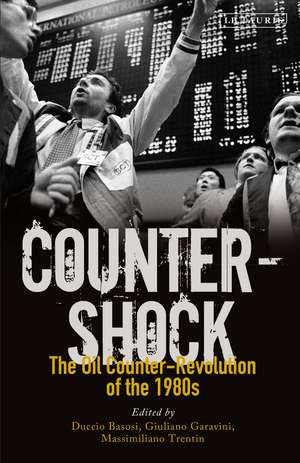
Counter-shock: The Oil Counter-Revolution of the 1980s
Editat de Duccio Basosi, Giuliano Garavini, Massimiliano Trentinen Limba Engleză Paperback – 31 oct 2019
picture and local study cases. In particular, it highlights the crucial interaction between the oil counter-shock and the political `counterrevolution' against state intervention in economic management, put forward by Ronald Reagan and Margaret Thatcher in the same period.
Preț: 251.91 lei
Preț vechi: 332.92 lei
-24%
Puncte Express: 378
Carte tipărită la comandă
Livrare economică 18 noiembrie-02 decembrie
Livrare prin curier în România Termenul estimat este afișat lângă disponibilitate.
Transport gratuit de la 400.00 lei Plată online sau ramburs, în funcție de opțiunile comenzii.
Retur gratuit în 14 zile Comandă securizată și suport în română.
Specificații
ISBN-13: 9781838605827
ISBN-10: 1838605827
Pagini: 400
Ilustrații: 21 bw integrated
Dimensiuni: 86 x 218 x 24 mm
Greutate: 0.46 kg
Editura: Bloomsbury Publishing
Colecția I.B.Tauris
Locul publicării:London, United Kingdom
ISBN-10: 1838605827
Pagini: 400
Ilustrații: 21 bw integrated
Dimensiuni: 86 x 218 x 24 mm
Greutate: 0.46 kg
Editura: Bloomsbury Publishing
Colecția I.B.Tauris
Locul publicării:London, United Kingdom
V-ar putea interesa
-
 The Rise and Fall of OPEC in the Twentieth CenturyGiuliano Garavini-14%Preț: 218.31 lei254.47 lei
 -
 -31%Preț: 1043.06 lei1517.65 lei
 -
 -24%Preț: 252.31 lei333.13 lei
 -
 -33%Preț: 774.61 lei1150.25 lei
 -
 -42%Preț: 52.88 lei91.76 lei
 -
 -26%Preț: 476.52 lei647.56 lei
 -
 -37%Preț: 852.34 lei1360.95 lei
 -
 Oil Shock: The 1973 Crisis and its Economic LegacyDr Elisabetta Bini-38%Preț: 848.61 lei1358.68 lei
 -
 Orientalism in Early Modern France: Eurasian Trade, Exoticism, and the Ancien RégimeIna Baghdiantz-MacCabe-29%Preț: 839.81 lei1176.84 lei
 -
 The Political Economy of Syria Under AsadVolker Perthes-21%Preț: 190.44 lei241.05 lei
 -
 The Development of London as a Financial CentreR. C. Michie-34%Preț: 4574.00 lei6921.52 lei
 -
 Managing the Oil Wealth: OPEC's Windfalls and PitfallsJahangir Amuzegar-20%Preț: 304.41 lei381.42 lei
 -
 Preț: 362.84 lei
 -
 -8%Preț: 538.29 lei585.10 lei
Cuprins
List of Illustrations
List of Contributors
Introduction: Counter-shock and counter-revolution by Duccio Basosi, Giuliano Garavini and Massimiliano Trentin
PART I: OIL PRICES IN CONTEXT
1. Price regimes, price series and price trends: oil shocks and counter-shocks in historical perspective by Giovanni Favero and Angela Faloppa
2. The role of the dollar and the justificatory discourse of neoliberalism by David E. Spiro
3. The oil market and global finance in the 1980s by Catherine R. Schenk
4. Counter-shocked? The oil majors and the price slump of the 1980s by Francesco Petrini
PART II: THE PRODUCERS: OPEC
5. Saudi Arabia and the counter-shock of 1986 by Majid Al-Moneef
6. Iran and the counter-shock: oil as a weapon (for survival) by Claudia Castiglioni
7. Iraq, Saudi Arabia, and the counter-shock by Ibrahim Al-Marashi
PART III: THE PRODUCERS: NON-OPEC
8. Abandoning enforced autarky for re-insertion in the world petroleum market: Mexican oil policy, 1976-86 by Juan Carlos Boué
9. The double shock: the Soviet energy crisis and the oil price collapse of 1986 by Olga Skorokhodova
10. The counter-shock in Norwegian oil history by Einar Lie and Dag Harald Claes
11. Counter-shock or after-shock? North Sea oil and economics as politics in the UK, 1973-86 by Martin Chick
PART IV: THE CONSUMERS
12. Reducing dependence on OPEC-oil. The IEA's energy strategy between 1976 and the mid-1980s by Henning Türk
13. The United States and the oil price collapse of the 1980s by Victor McFarland
14. Back to the future: changes in energy cultures and patterns of consumption in the United States, 1973-86 by Elisabetta Bini
PART V: ENERGY AND ENVIRONMENTAL CHALLENGES
15. The rise of environmentalist movements and the debate on alternative sources of energy during the oil crisis in the United States by Angela Santese
16. The role of nuclear reactor technology on the development of the nuclear industry and decision making in the context of the price fluctuations of the 1970s and 1980s by Duncan Connors and Eshref Trushin
17. A small window. The opportunities for renewable energies from shock to counter-shock by Duccio Basosi
Notes
Bibliography
Index
List of Contributors
Introduction: Counter-shock and counter-revolution by Duccio Basosi, Giuliano Garavini and Massimiliano Trentin
PART I: OIL PRICES IN CONTEXT
1. Price regimes, price series and price trends: oil shocks and counter-shocks in historical perspective by Giovanni Favero and Angela Faloppa
2. The role of the dollar and the justificatory discourse of neoliberalism by David E. Spiro
3. The oil market and global finance in the 1980s by Catherine R. Schenk
4. Counter-shocked? The oil majors and the price slump of the 1980s by Francesco Petrini
PART II: THE PRODUCERS: OPEC
5. Saudi Arabia and the counter-shock of 1986 by Majid Al-Moneef
6. Iran and the counter-shock: oil as a weapon (for survival) by Claudia Castiglioni
7. Iraq, Saudi Arabia, and the counter-shock by Ibrahim Al-Marashi
PART III: THE PRODUCERS: NON-OPEC
8. Abandoning enforced autarky for re-insertion in the world petroleum market: Mexican oil policy, 1976-86 by Juan Carlos Boué
9. The double shock: the Soviet energy crisis and the oil price collapse of 1986 by Olga Skorokhodova
10. The counter-shock in Norwegian oil history by Einar Lie and Dag Harald Claes
11. Counter-shock or after-shock? North Sea oil and economics as politics in the UK, 1973-86 by Martin Chick
PART IV: THE CONSUMERS
12. Reducing dependence on OPEC-oil. The IEA's energy strategy between 1976 and the mid-1980s by Henning Türk
13. The United States and the oil price collapse of the 1980s by Victor McFarland
14. Back to the future: changes in energy cultures and patterns of consumption in the United States, 1973-86 by Elisabetta Bini
PART V: ENERGY AND ENVIRONMENTAL CHALLENGES
15. The rise of environmentalist movements and the debate on alternative sources of energy during the oil crisis in the United States by Angela Santese
16. The role of nuclear reactor technology on the development of the nuclear industry and decision making in the context of the price fluctuations of the 1970s and 1980s by Duncan Connors and Eshref Trushin
17. A small window. The opportunities for renewable energies from shock to counter-shock by Duccio Basosi
Notes
Bibliography
Index
Recenzii
The wide variety of perspectives adopted makes this volume complex and opens up important areas of future research ... A work that straddles economic history, political history and more specifically international relations, which illuminates in particular a significant historical junction to which contemporary history has not paid sufficient attention.
An important book, thoroughly crafted/planned by its editors [and] co-written by 20 contributors, mostly foreign and Italian academics.
An important book, thoroughly crafted/planned by its editors [and] co-written by 20 contributors, mostly foreign and Italian academics.