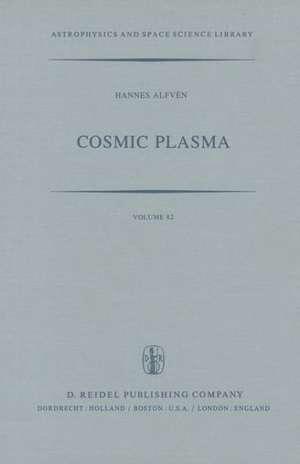
Cosmic Plasma: Astrophysics and Space Science Library, cartea 82
Autor H. Alfvènen Limba Engleză Hardback – 28 feb 1981
Din seria Astrophysics and Space Science Library
- 18%
 Preț: 816.41 lei
 -
 Preț: 387.27 lei
 - 15%
 Preț: 644.83 lei
 -
 Preț: 386.74 lei
 - 18%
 Preț: 983.60 lei
 -
 Preț: 400.17 lei
 - 18%
 Preț: 1263.54 lei
 - 18%
 Preț: 1783.90 lei
 -
 Preț: 388.91 lei
 - 18%
 Preț: 982.14 lei
 - 18%
 Preț: 990.14 lei
 -
 Preț: 387.03 lei
 -
 Preț: 393.95 lei
 -
 Preț: 403.07 lei
 -
 Preț: 405.77 lei
 - 18%
 Preț: 915.91 lei
 -
 Preț: 393.50 lei
 - 18%
 Preț: 986.17 lei
 -
 Preț: 392.60 lei
 - 18%
 Preț: 1267.83 lei
 - 18%
 Preț: 1268.49 lei
 -
 Preț: 393.21 lei
 - 15%
 Preț: 659.36 lei
 - 18%
 Preț: 1210.29 lei
 - 18%
 Preț: 987.46 lei
 - 18%
 Preț: 1905.63 lei
 - 18%
 Preț: 1271.93 lei
 - 18%
 Preț: 1281.81 lei
 -
 Preț: 400.91 lei
 - 18%
 Preț: 1271.93 lei
 - 15%
 Preț: 671.74 lei
 - 18%
 Preț: 1270.88 lei
 -
 Preț: 390.39 lei
 - 15%
 Preț: 644.87 lei
 -
 Preț: 381.30 lei
 - 18%
 Preț: 1265.61 lei
 - 18%
 Preț: 909.41 lei
 - 18%
 Preț: 1268.77 lei
 - 18%
 Preț: 1262.38 lei
 -
 Preț: 381.63 lei
 -
 Preț: 396.85 lei
Preț: 667.01 lei
Preț vechi: 784.71 lei
-15%
Puncte Express: 1001
Carte tipărită la comandă
Livrare economică 07-21 decembrie
Livrare prin curier în România Termenul estimat este afișat lângă disponibilitate.
Transport gratuit pentru acest produs Plată online sau ramburs, în funcție de opțiunile comenzii.
Retur gratuit în 14 zile Comandă securizată și suport în română.
Specificații
ISBN-13: 9789027711519
ISBN-10: 9027711518
Pagini: 184
Ilustrații: XI, 168 p.
Dimensiuni: 183 x 260 x 16 mm
Greutate: 0.49 kg
Ediția:1981
Editura: Springer
Colecția Astrophysics and Space Science Library
Seria Astrophysics and Space Science Library
Locul publicării:Dordrecht, Netherlands
ISBN-10: 9027711518
Pagini: 184
Ilustrații: XI, 168 p.
Dimensiuni: 183 x 260 x 16 mm
Greutate: 0.49 kg
Ediția:1981
Editura: Springer
Colecția Astrophysics and Space Science Library
Seria Astrophysics and Space Science Library
Locul publicării:Dordrecht, Netherlands
V-ar putea interesa
-
 The Universe WithinNeil ShubinPreț: 92.60 lei
 -
 Introduction to 3+1 Numerical RelativityMiguel Alcubierre-31%Preț: 568.00 lei819.55 lei
 -
 Theory of Black Hole Accretion DiscsMarek A. AbramowiczPreț: 440.60 lei
 -
 Compact Stellar X-Ray SourcesWalter Lewin-11%Preț: 565.35 lei635.22 lei
 -
 Elements of String CosmologyMaurizio Gasperini-11%Preț: 512.50 lei575.83 lei
 -
 Gamma-Ray BurstsChryssa Kouveliotou-9%Preț: 835.45 lei918.08 lei
 -
 High Energy AstrophysicsMalcolm S. Longair-8%Preț: 631.48 lei686.39 lei
 -
 Relativistic Astrophysics of the Transient UniverseMaurice H P M van Putten-9%Preț: 741.85 lei815.22 lei
 -
 Astrophysics Through ComputationBrian Koberlein-11%Preț: 565.21 lei635.06 lei
 -
 The Physics and Evolution of Active Galactic NucleiHagai Netzer-11%Preț: 509.89 lei572.90 lei
 -
 An Introduction to Celestial MechanicsRichard Fitzpatrick-8%Preț: 501.79 lei545.42 lei
 -
 The Cosmic CenturyMalcolm S. LongairPreț: 408.85 lei
 -
 Asteroids and Dwarf Planets and How to Observe ThemRoger DymockPreț: 416.23 lei
 -
 Astrophysics of the Diffuse UniverseMichael A. Dopita-15%Preț: 616.89 lei725.76 lei
Public țintă
ResearchCuprins
I / Survey.- I.1. Experimental and Theoretical Approach to Plasma Physics.- I.2. Plasma Phenomena in Laboratory and Space.- I.3. Field and Particle Aspects of Plasmas.- I.4. Present State of the Classical Theory.- I.5. Boundary Conditions. Circuit Dependence.- I.6. Cosmology and the Origin of the Solar System.- I.7. Aims of the Monograph.- II / Electric Currents in Space Plasmas.- II.1. Dualism in Physics.- II.2. Particle-Related Phenomena in Plasma Physics.- II.3. Magnetic Field lines.- II.4. Filaments.- II.5. Local Plasma Properties and the Circuit.- II.6. Electric Double Layers.- II.7. Field-Aligned Currents as ‘Cables’.- II.8. An Expanding Circuit.- II.9. Different Types of Plasma Regions.- II.10. Cellular Structure of Space.- II.11. Fine Structure of Active Plasma Regions.- III / Circuits.- III.1. Importance of Electric Current Models.- III.2. The Auroral Circuits.- III.3. Rotating Magnetized Body Surrounded by a Plasma.- III.4. The Heliospheric Current System.- III.5. Circuits of Magnetospheric Tail, Comets, and Venus.- III.6. Magnetospheric Circuit.- III.7. Other Magnetospheres.- III.8. Solar Prominence Circuit and Solar Flares.- III.9. Solar Wind Acceleration.- III.10. Transfer of Energy from the Solar Core to the Aurora.- IV / Theory of Cosmic Plasmas.- IV.1. Classical Theory and Its Difficulties.- IV.2. Ionization.- IV.3. Cosmic Abundances and Differentiation.- IV.4. Turbulence.- IV.5. Flux Amplification.- IV.6. Critical Velocity.- IV.7. Dusty Plasma.- IV.8. Formation and Evolution of Interstellar Clouds.- IV.9. Ambiplasma.- IV.10. High Energy Phenomena.- V / Origin of the Solar System.- V.1. How We Can Reconstruct Earlier Epochs.- V.2. Sources of Information.- V.3. Impact of Magnetospheric Results.- V.4. Electromagnetic Effects Aiding the Formation andContraction of Clouds.- V.5. Chemical Differentation in the Primeval Cloud.- V.6. Intrinsically Produced Currents.- V.7. Band Structure and the Critical Velocity.- V.8. Solar System in Formation.- V.9. Hetegony and the ‘Hetegonic Principle’.- VI / Cosmology.- VI.1. The State of Cosmology.- VI.2. Coexistence of Matter and Antimatter.- VI. 3. Annihilation as a Source of Energy.- VI.4. Hubble Expansion in a Euclidean Space.- VI.5. A Model for the Evolution of the Metagalaxy.- VI.6. Other Metagalaxies.- VI.7. Discussion.- VI.8. Conclusions.- References.