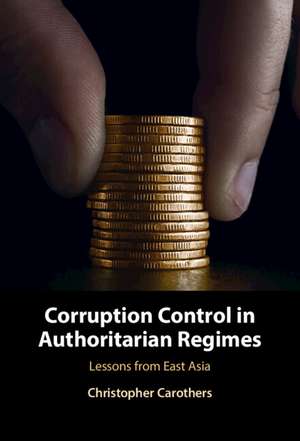
Corruption Control in Authoritarian Regimes: Lessons from East Asia
Autor Christopher Carothersen Limba Engleză Hardback – 6 apr 2022
| Toate formatele și edițiile | Preț | Express |
|---|---|---|
| Paperback (1) | 259.03 lei 43-57 zile | |
| Cambridge University Press – 19 sep 2024 | 259.03 lei 43-57 zile | |
| Hardback (1) | 653.30 lei 43-57 zile | |
| Cambridge University Press – 6 apr 2022 | 653.30 lei 43-57 zile |
Preț: 653.30 lei
Preț vechi: 734.04 lei
-11%
Puncte Express: 980
Preț estimativ în valută:
115.53€ • 136.99$ • 100.59£
115.53€ • 136.99$ • 100.59£
Carte tipărită la comandă
Livrare economică 30 martie-13 aprilie
Specificații
ISBN-13: 9781316513286
ISBN-10: 1316513289
Pagini: 293
Dimensiuni: 156 x 235 x 22 mm
Greutate: 0.58 kg
Ediția:Nouă
Editura: Cambridge University Press
Colecția Cambridge University Press
Locul publicării:New York, United States
ISBN-10: 1316513289
Pagini: 293
Dimensiuni: 156 x 235 x 22 mm
Greutate: 0.58 kg
Ediția:Nouă
Editura: Cambridge University Press
Colecția Cambridge University Press
Locul publicării:New York, United States
Cuprins
1. Introduction; 2. Theory and Methodology; 3. How the Kuomintang Cleaned House in Taiwan; 4. Corruption Control in Authoritarian South Korea; 5. The Chinese Communist Party's War Against Corruption, 1921–90; 6. Xi Jinping's Campaign and the End of Political Liberalization; 7. Anti-Corruption Efforts Around the Authoritarian World; 8. Conclusion.
Recenzii
'In this provocative, well-researched and wide-ranging book, Carothers shows that autocratic efforts to control corruption are more common, occur for different reasons, and are more often successful than we think. His analysis of anti-corruption drives by different leaders in Taiwan, South Korea, and China sheds new light on the history and contemporary politics of all three places, and his identification of a distinctly authoritarian anti-corruption model is theoretically path-breaking as well as policy-relevant. This challenge to the conventional wisdom deserves to be read carefully, by scholars and policymakers alike.' Sheena Chestnut Greitens, University of Texas at Austin
'Carothers has written an important book challenging the conventional wisdom that there is a necessary connection between authoritarian government and political corruption. Through both a quantitative analysis and historical case studies, he shows that a number of authoritarian regimes, including Xi Jinping's China, have succeeded in reducing levels of corruption. Highly recommended for both China specialists and governance studies.' Francis Fukuyama, Stanford University
'Corruption Control in Authoritarian Regimes addresses the classical question of whether dictatorships can curb the predatory behavior of their agents. Carothers' invaluable comparative study of how three dictatorships in East Asia tackled corruption provides an original and persuasive answer. This book is a major contribution to the literature on corruption in general, and on the political economy of authoritarianism in particular.' Minxin Pei, Claremont McKenna College
'Carothers breaks open the black box of authoritarianism to provide much needed insight into the politics of corruption. Whether one wants to learn more about political development and durability in East Asia, or when, how, and why autocrats curb corruption more generally, this book delivers.' Karrie J. Koesel, University of Notre Dame
'Carothers has written an important book challenging the conventional wisdom that there is a necessary connection between authoritarian government and political corruption. Through both a quantitative analysis and historical case studies, he shows that a number of authoritarian regimes, including Xi Jinping's China, have succeeded in reducing levels of corruption. Highly recommended for both China specialists and governance studies.' Francis Fukuyama, Stanford University
'Corruption Control in Authoritarian Regimes addresses the classical question of whether dictatorships can curb the predatory behavior of their agents. Carothers' invaluable comparative study of how three dictatorships in East Asia tackled corruption provides an original and persuasive answer. This book is a major contribution to the literature on corruption in general, and on the political economy of authoritarianism in particular.' Minxin Pei, Claremont McKenna College
'Carothers breaks open the black box of authoritarianism to provide much needed insight into the politics of corruption. Whether one wants to learn more about political development and durability in East Asia, or when, how, and why autocrats curb corruption more generally, this book delivers.' Karrie J. Koesel, University of Notre Dame
Notă biografică
Descriere
Reveals how meaningful corruption control by authoritarian regimes is surprisingly common and follows a different playbook than democratic anti-corruption reform.